Knowledge Base

KNOWLEDGE HUB

Knowledge Hub

Access BIOFIN's library of resources, including flagship publications, country reports, finance solution case studies, webinars, explainer videos, podcasts, and more.

Key Publications

Publications

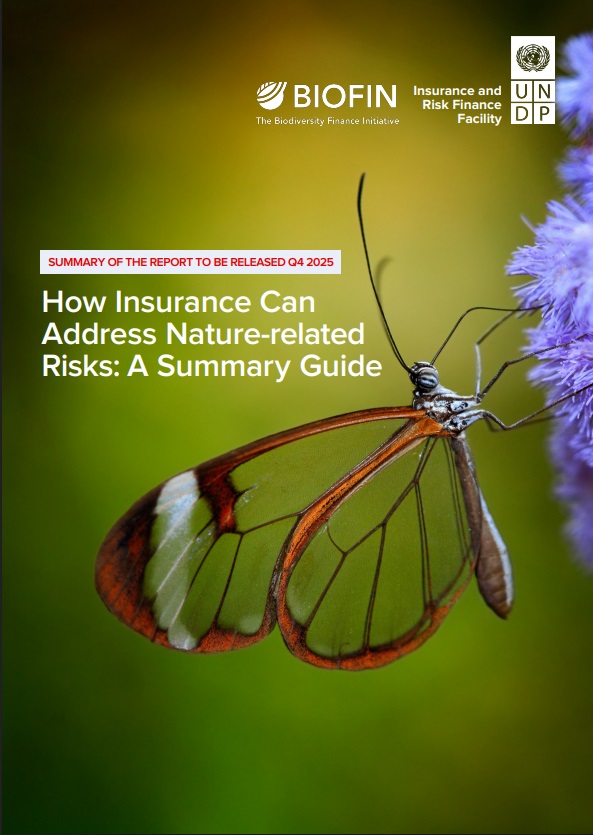
Insurance can play a crucial role in biodiversity conservation by providing financial protection against risks to natural assets, incentivizing sustainable practices, and securing key investments.
Publications

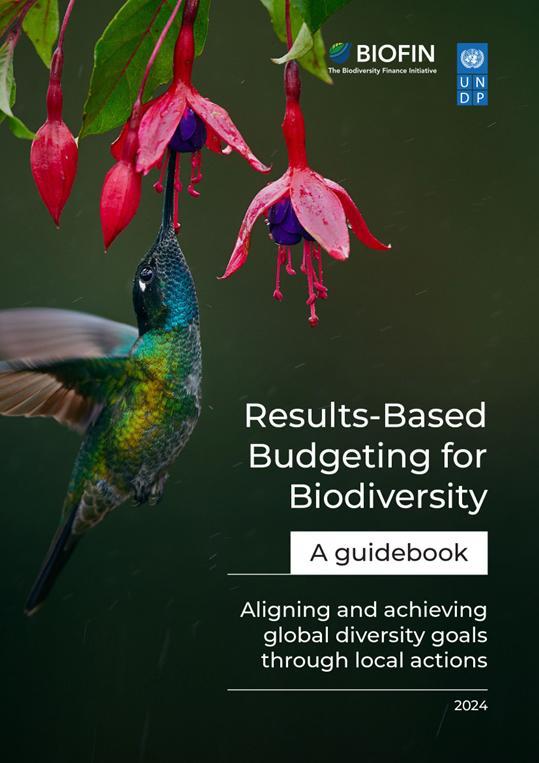
In 2022, countries adopted new global biodiversity targets under the Kunming-Montreal Global Biodiversity Framework (GBF), revisiting many goals that had gone unachieved or underachieved over the past decade.
Publications

Global Biodiversity Expenditure (GLOBE) is a taxonomy that categorizes all potential public expenditures for biodiversity.

The taxonomy consists of two components:
Publications

The BIOFIN Workbook 2024 provides detailed guidance to design and implement national biodiversity finance plans.  These are not mere plans. They set out a process to engage a coalition of actors around the issue of biodiversity finance for an extended time.
Publications

At the Conference of the Parties to the Convention on Biological Diversity 15 (CBD COP 15) in 2022, countries agreed to review and update their National Biodiversity Strategy and Action Plans
Publications

Well-intentioned subsidies aimed at socio-economic goals can have unintended negative impacts on the environment, including biodiversity. The BIOFIN team has developed a step-by-step guide to repurpose such subsidies and improve their positive impacts on people and nature.
Publications

The Kunming-Montreal Global Biodiversity Framework (GBF) calls for a whole-of-society approach to halting and reversing nature loss.

Publications


The Little Book of Investing in Nature provides an essential overview of the area of biodiversity finance at a time when governments and international negotiators are urgently seeking pragmatic solutions for the twin crises of climate change and the loss of nature.

E-LEARNING

Learning for nature: our free biodiversity finance certified e-learning course

Take our free biodiversity finance certified e-learning course. Master the methodology, connect with experts, and gain certification.

Start E-Learning
Browse the Knowledge Platform

636 Results
Webinars

El Programa de las Naciones Unidas para el Desarrollo - PNUD y la Iniciativa Finanzas para la Biodiversidad - BIOFIN, realizaron el foro virtual "Sistemas de Crédito para la Aceleración de Compensaciones Ambientales", en donde se presentó este mecanismo como instrumento para facilitar la compensación de impactos ambientales de proyectos, obras y/o actividades económicas, su desarrollo actual y su potencial en Colombia.

Consulte la grabación completa de este foro virtual a continuación:

Webinars

El Programa de las Naciones Unidas para el Desarrollo - PNUD y la Iniciativa Finanzas para la Biodiversidad - BIOFIN, tienen el gusto de invitarlos a consultar las presentaciones expuestas en el foro virtual "Sistemas de Crédito para la Aceleración de Compensaciones Ambientales", en donde se presentó este mecanismo como instrumento para facilitar la compensación de impactos ambientales de proyectos, obras y/o actividades económicas, su desarrollo actual y su potencial en Colombia.

Publications

El ABC de los Servicios y Actividades No Esenciales, es un instrumento que reúne los elementos fundamentales para el adecuado otorgamiento de estos servicios en las Áreas Silvestres Protegidas, permitiéndole a las personas funcionarias y a potenciales organizaciones oferentes tener mayor claridad durante su implementación y operación.

Publications

Link to download: https://www.th.undp.org/content/thailand/en/home/library/environment_energy/the-biodiversity-finance-plan.html 

The Biodiversity Finance Plan (The Plan) outlines a set of actions which would help to significantly improve the management and financing of biodiversity conservation in Thailand. The Plan calls for an integrated national approach which builds on the economic and business imperative for scaling up action on biodiversity protection in order to meet national biodiversity goals. Without a concerted effort involving both the public and private sector as well as civil society in the implementation of prioritized biodiversity finance solutions, Thailand will not be able to continue to enjoy the benefits of the ecosystem services generated by its national biodiversity. The Plan is prepared in line with the Biodiversity Policy and Institutional Review (PIR), the Biodiversity Expenditure Review (BER), and the Financial Needs Assessment (FNA) in response to the National Biodiversity Strategy and Action Plan (NBSAP).

Implementing the Plan

The Plan aims to deliver a prioritized set of biodiversity finance solutions which explore new finance mechanisms and ways of creating and supporting new partnerships. These finance solutions aim to capture the breadth of options available, for meeting the four results of biodiversity finance as outlined by The Biodiversity Finance Initiative – BIOFIN: 1) Avoid future expenditures, 2) Deliver better, 3) Generate revenues, and 4) Realign expenditures. The prioritized biodiversity finance solutions in the Plan are complementary and promote a combination of systemic and local sustainable financing, policy changes, and other incentive mechanisms within four thematic areas of intervention. The finance solutions can be summarized as follows:

1. Sustainable Tourism Finance Solution: Increasing industry revenue sources for safeguarding biodiversity and environmental management.

2. Wildlife and Protected Areas Finance Solution: Introduction of conservation vehicle license plates to support wildlife conservation in Thailand  

3. Government Budget Finance Solution: Enhancing effectiveness and biodiversity impact of local budgets in Thailand

4. Private Sector Finance Solution: Mobilizing the private sector and impact investment in support of biodiversity


Publications

El documento expone el mapa de actores de la actividad turística en la Reserva de Biósfera del Chocó Andino de Pichicha en Ecuador. La Reserva fue seleccionada como piloto para la estructuración de un portafolio de inversiones, debido a la representatividad de subsistemas de áreas naturales protegidas que contiene. El mapeo se estructuró a partir del análisis de redes y cadena de valor.

Publications

Este documento plasma los resultados del análisis de situación de la Estrategia de Financiamiento que acompaña la Estrategia Nacional de Biodiversidad y su Plan de Acción. Propone además, un conjunto de recomendaciones para orientar la participación de los actores en su implementación. 

Publications

El documento identifica y describe desde su rol funcional a los actores relacionados con la implementación de la Estrategia de Financiamiento de la Estrategia Nacional de Biodiversidad y su Plan de Acción al año 2020.

Publications

El documento expone las fuentes potenciales de financiamiento de la Empresa Pública de Areas Protegidas y Agua, iniciativa que surgió como posibilidad al momento de fusionarse el Ministerio del Ambiente y la Secretaría Nacional del Agua.

Si bien la creación de la Empresa no se concretó, la propuesta de movilización de recursos financieros puede ser referente para otros modelos de gestión que se adopte para el Patrimonio de Areas Naturales del Estado Ecuatoriano.

Publications

The following document presents the current status of the work undertaken by the BIOFIN project in Colombia. In it you will find our financial strategy, the main products and results for each BIOFIN component: the Policy and Institutional Review, the Biodiversity Expenditure Review, the Financial Needs Assessment, and the Biodiversity Finance Plan. Finally, it presents some recommendations for future activities.

Publications

The following document presents the current status of the work undertaken by the BIOFIN project in Colombia. In it you will find our financial strategy, the main products and results for each BIOFIN component: the Policy and Institutional Review, the Biodiversity Expenditure Review, the Financial Needs Assessment, and the Biodiversity Finance Plan. Finally, it presents some recommendations for future activities.