Knowledge base

Browse the Knowledge Platform

4 Results
Publications

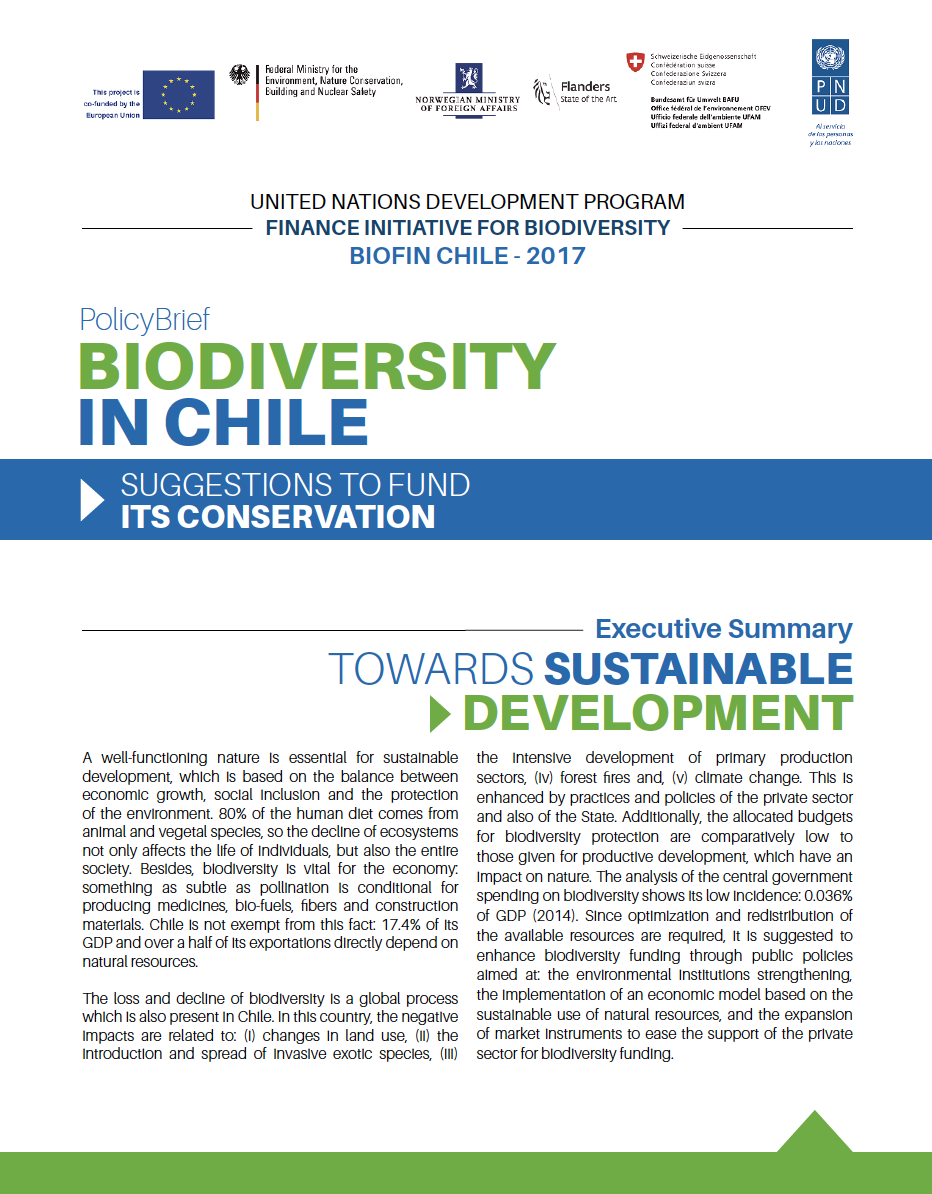
A well-functioning nature is essential for sustainable development, which is based on the balance between economic growth, social inclusion and the protection of the environment. 80% of the human diet comes from animal and vegetal species, so the decline of ecosystems not only affects the life of individuals, but also the entire society. Besides, biodiversity is vital for the economy: something as subtle as pollination is conditional for producing medicines, bio-fuels, fibers and construction materials. Chile is not exempt from this fact: 17.4% of its GDP and over a half of its exportations directly depend on natural resources. 

The loss and decline of biodiversity is a global process which is also present in Chile. In this country, the negative impacts are related to: (i) changes in land use, (ii) the introduction and spread of invasive exotic species, (iii) the intensive development of primary production sectors, (iv) forest fires and, (v) climate change. This is enhanced by practices and policies of the private sector and also of the State. Additionally, the allocated budgets for biodiversity protection are comparatively low to those given for productive development, which have an impact on nature. The analysis of the central government spending on biodiversity shows its low incidence: 0.036% of GDP (2014). Since optimization and redistribution of the available resources are required, it is suggested to enhance biodiversity funding through public policies aimed at: the environmental institutions strengthening, the implementation of an economic model based on the sustainable use of natural resources, and the expansion of market instruments to ease the support of the private sector for biodiversity funding.

Publications

A well-functioning nature is essential for sustainable development, which is based on the balance between economic growth, social inclusion and the protection of the environment. 80% of the human diet comes from animal and vegetal species, so the decline of ecosystems not only affects the life of individuals, but also the entire society. Besides, biodiversity is vital for the economy: something as subtle as pollination is conditional for producing medicines, bio-fuels, fibers and construction materials. Chile is not exempt from this fact: 17.4% of its GDP and over a half of its exportations directly depend on natural resources. 

The loss and decline of biodiversity is a global process which is also present in Chile. In this country, the negative impacts are related to: (i) changes in land use, (ii) the introduction and spread of invasive exotic species, (iii) the intensive development of primary production sectors, (iv) forest fires and, (v) climate change. This is enhanced by practices and policies of the private sector and also of the State. Additionally, the allocated budgets for biodiversity protection are comparatively low to those given for productive development, which have an impact on nature. The analysis of the central government spending on biodiversity shows its low incidence: 0.036% of GDP (2014). Since optimization and redistribution of the available resources are required, it is suggested to enhance biodiversity funding through public policies aimed at: the environmental institutions strengthening, the implementation of an economic model based on the sustainable use of natural resources, and the expansion of market instruments to ease the support of the private sector for biodiversity funding.

Publications

A well-functioning nature is essential for sustainable development, which is based on the balance between economic growth, social inclusion and the protection of the environment. 80% of the human diet comes from animal and vegetal species, so the decline of ecosystems not only affects the life of individuals, but also the entire society. Besides, biodiversity is vital for the economy: something as subtle as pollination is conditional for producing medicines, bio-fuels, fibers and construction materials. Chile is not exempt from this fact: 17.4% of its GDP and over a half of its exportations directly depend on natural resources. 

The loss and decline of biodiversity is a global process which is also present in Chile. In this country, the negative impacts are related to: (i) changes in land use, (ii) the introduction and spread of invasive exotic species, (iii) the intensive development of primary production sectors, (iv) forest fires and, (v) climate change. This is enhanced by practices and policies of the private sector and also of the State. Additionally, the allocated budgets for biodiversity protection are comparatively low to those given for productive development, which have an impact on nature. The analysis of the central government spending on biodiversity shows its low incidence: 0.036% of GDP (2014). Since optimization and redistribution of the available resources are required, it is suggested to enhance biodiversity funding through public policies aimed at: the environmental institutions strengthening, the implementation of an economic model based on the sustainable use of natural resources, and the expansion of market instruments to ease the support of the private sector for biodiversity funding.

Publications

INTERNATIONAL SEMINAR: 

Highlighting The Need Of Investment On Environment To Ensure The Sustainable Development Of Chile 

The importance of aligning economic growth and environmental care to move towards the sustainable development of the country was the main subject of the conference, which brought together citizens, professors and politicians, all of those participated in the keynote speeches and panels prepared to address –from different points of views – the need to advance into a sustainable development. 

The seminar, carried out last March 30th in Santiago, was organized by the United Nations Development Programme UNDP Chile, in pursuance of its mission to promote the discussion of formulae with respect to the countries’ challenges under a sustainable scheme. In the case of Chile, the consolidation of a sustainable management of ecosystems is crucial to strengthen a long-term human development and the achievement of the Sustainable Development Goals; which was highlighted by the Resident Representative of the UNDP Chile, Silvia Rucks, who opened the seminar.

Knowledge Partners

Biodiversity and Ecosystem Services Network logo
Biodiversity finance resources library and forum.
Sustainable Development Finance Platform logo
Guidance and detailed descriptions of finance solutions for sustainable development.

NBSAP logo
Support for action on National Biodiversity Strategy and Action Plans