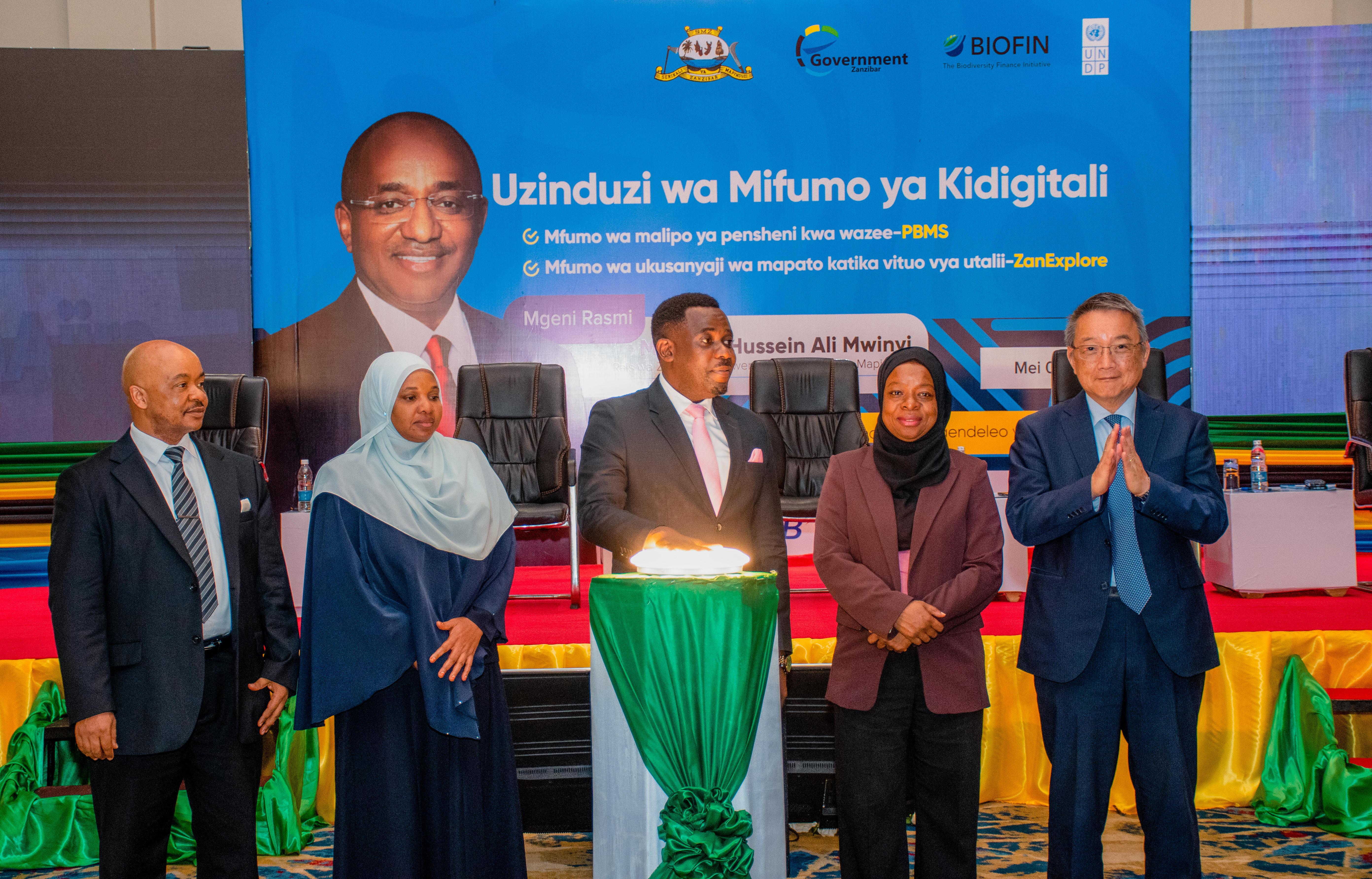
Zanzibar, 7 May 2026: The Revolutionary Government of Zanzibar, in partnership with the United Nations Development Programme (UNDP) through the Biodiversity Finance Initiative (BIOFIN), yesterday launched a new Digital Cashless and Tourism System for marine and terrestrial protected areas, marking a major step toward modern, transparent, and sustainable conservation financing.
The system, officially launched by Mudrick Ramadhan Soraga, Minister for Communication, Information Technology and Innovation on behalf of H.E. Dr. Hussein Ali Mwinyi, President of Zanzibar and Chairman of the Revolutionary Council, will streamline revenue collection from protected area entry fees, allowing visitors to pay through multiple channels, including mobile money, bank transfers, and credit cards, while enhancing real-time monitoring and reducing revenue leakages.
“Digital transformation is not optional—it is essential. It is the foundation for strengthening revenue collection, improving public services, and building a modern economy that serves our people efficiently. We appreciate the continued support of the United Nations Development Programme (UNDP) in advancing digital transformation and strengthening service delivery in Zanzibar”.- H.E. Dr. Hussein Ali Mwinyi, President of Zanzibar and Chairman of the Revolutionary Council.
Speaking at the same event, Mr. Shigeki Komatsubara, UNDP Resident Representative in Tanzania, hailed the b milestone as a “transformative journey from the traditional world of cash transactions to a modern, secure, and transparent digital system.”

“This innovation will strengthen financial accountability, boost efficiency, and help ensure that more tourism revenues are reinvested into protecting Zanzibar’s natural heritage and supporting local communities,” said Mr. Komatsubara. “It is a powerful example of how technology and biodiversity finance can work hand in hand to serve both people and the planet.”
The digital platform complements Zanzibar’s updated fee structure for marine and terrestrial conservation areas, which had previously been among the lowest in the region.
“Compared to other popular ocean-based destinations in the region, Zanzibar’s entry fee (US$3) was by far the cheapest,” said Dr. Makame Omar Makame, Director of the Department of Conservation Areas, Zanzibar. “Updating the fees allows us to better protect these ecosystems while maintaining Zanzibar’s competitiveness as a world-class destination.”
The updated fees are projected to triple annual revenues from US$1.3 million to over US$4.3 million. Introduced in August 2025, the system is already delivering the expected results. Since its launch, revenues have reached nearly US$1.9 million, exceeding the total collected in all of 2024. In the fourth quarter of 2025 alone, revenues rose from US$364,827 in Q4 2024 to US$921,530, representing an increase of approximately 153 percent. With nearly US$2 million generated in two quarters, projections reaching US$4.3 million annually are well within reach.
80 percent of these collections will be reinvested into conservation, community livelihoods, and fisheries management, creating a sustainable financing loop that benefits both people and nature. With Marine Conservation Areas spanning over 2,000 square kilometers, additional revenue will help address critical challenges, including insufficient funding, lack of boats and equipment, and a shortage of trained personnel.
Zanzibar’s protected areas, including Mnemba Atoll, Jozani-Chwaka Bay, and Pemba Channel Conservation Areas, attract hundreds of thousands of visitors annually. The new cashless system will improve visitor convenience, ensure fair and transparent fee collection, and strengthen the island’s capacity to manage tourism growth sustainably.
Mr. Komatsubara further commended the close collaboration among key government institutions, including the First Vice President’s Office, the Ministry of Blue Economy and Fisheries, the Ministry of Agriculture, Irrigation, Natural Resources and Livestock, the Ministry of Tourism and Heritage, and the E-Government Authority, whose leadership made this achievement possible.
“This system is not just about technology. It is about building a sustainable future — one where tourism revenues protect the ecosystems that make Zanzibar unique, while improving livelihoods for those who depend on them,” he added.

The cashless payment system is just one of several areas of work supported by UNDP BIOFIN in Zanzibar. With BIOFIN’s support, biodiversity is increasingly being integrated into national development and investment frameworks in Tanzania and is now a core component of Public-Private Partnerships (PPPs) in protected areas, helping align private investment with conservation outcomes. At the same time, ongoing assessments are focused on reforming and repurposing harmful subsidies in sectors such as fisheries, agriculture, and tourism, redirecting financial flows toward more sustainable practices. Additional efforts aim to mobilize funding for blue carbon credit initiatives and strengthen biodiversity conservation through the establishment and enhancement of botanical gardens.
With BIOFIN’s support, Zanzibar joins over 40 countries globally implementing biodiversity finance solutions that mobilize resources for nature through fiscal reform, digital innovation, and public–private collaboration.
Categories
Countries
Archives
- Junio 2018 (2)
- Mayo 2018 (4)
- Abril 2018 (3)
- Marzo 2018 (4)
- Febrero 2018 (3)
- Enero 2018 (4)
- Diciembre 2017 (3)
- Noviembre 2017 (6)
- Octubre 2017 (3)
- Septiembre 2017 (7)