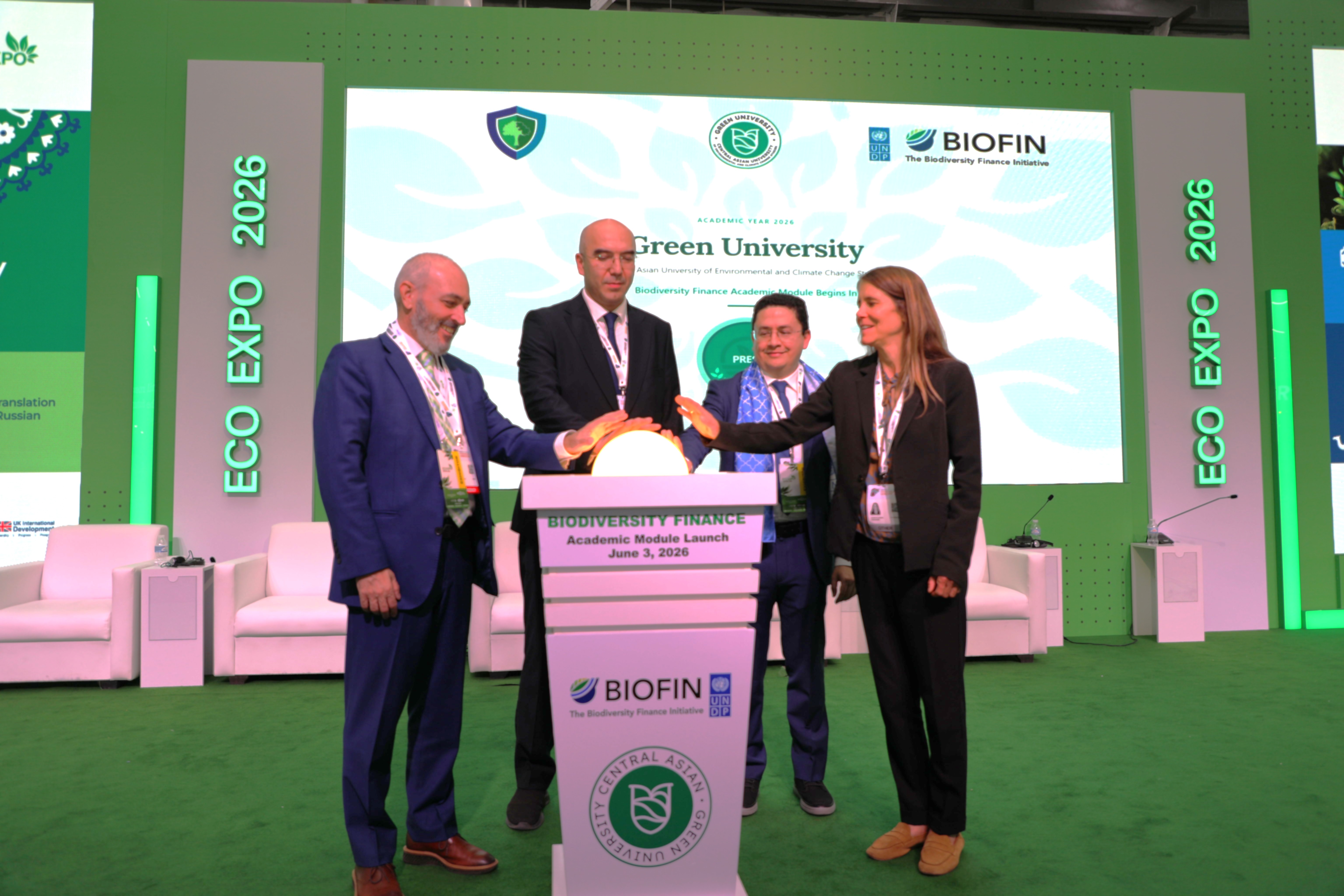
Samarkand, 3 June 2026 — The United Nations Development Programme (UNDP) and the Central Asian Green University officially launched a new academic module on Biodiversity Finance today at Eco Expo Central Asia 2026, marking an important step in strengthening the knowledge and skills needed to finance nature conservation and ecosystem restoration in Uzbekistan and beyond.
The module, developed jointly by UNDP's Biodiversity Finance Initiative (BIOFIN) and the Central Asian Green University with support from the Government of Switzerland, will be offered as an elective course within the University's Master's Programme in Sustainable Finance. This is the first time that the academic module based on UNDP BIOFIN's globally recognized methodology has been embedded in the academic curriculum.
The methodology itself has been supporting more than 130 countries in identifying financing solutions for biodiversity conservation and sustainable ecosystem management. It combines international experience with national priorities and practical case studies relevant to Uzbekistan and Central Asia.
“By combining the academic expertise of Green University with the global experience of UNDP, we are creating educational opportunities that directly address real-world challenges and prepare students to become agents of positive change," said Prof. Bakhtiyor Pulatov, Rector of the Central Asian Green University.
The launch took place during a side event co-hosted by UNDP and the Central Asian Green University, bringing together representatives of government institutions, academia, development partners, and environmental finance experts.
“Education is the most powerful tool you can use to positively change the world. In the context of biodiversity crisis and opportunity of nature-positive development, that tool must now be wielded by a new generation of finance-for-nature professionals. Uzbekistan is leading the way,” – said Martin Cadena, UNDP BIOFIN Global Manager.
 As countries around the world face the interconnected challenges of climate change, biodiversity loss, and pollution, there is growing recognition that protecting nature requires not only sound environmental policies, but also innovative financial solutions and qualified professionals capable of designing and implementing them.
“We are convinced that education as such and in particular higher education institutions are crucial in shaping and training future decision-makers, as well as in generating the knowledge that forms the basis for evidence- and science-based decision-making. In our view, policy - in particular environmental and climate policy, but also (public) investment - must be grounded in knowledge and science," – noted Andre Wehrly, Senior Policy Advisor, Alternate GEF Council Member of Switzerland (donor country that funded the development of BIOFIN academic module).

The new academic module responds to this need by equipping students with practical tools to assess biodiversity financing needs, identify funding gaps, develop nature-positive finance solutions, and integrate biodiversity considerations into public and private financial decision-making.
The launch builds on the findings of Uzbekistan's Biodiversity Finance Plan, developed through the BIOFIN programme, which identified opportunities to strengthen biodiversity financing and highlighted the importance of developing national expertise in nature finance.
Alongside the academic module, UNDP BIOFIN is also supporting access to additional learning opportunities, including the global online course Biodiversity Finance: Designing and Implementing Finance Plans for Nature, which is now available in Uzbek through UNDP's Learning for Nature platform.

The launch reflects a shared commitment by UNDP, the Central Asian Green University, the National Committee on Ecology and Climate Change, and international partners to strengthen human capital for the green transition and advance implementation of Uzbekistan's biodiversity, climate, and sustainable development goals.
Categories
Archives
- Agosto 2026 (1)
- Julio 2026 (11)
- Junio 2026 (10)
- Mayo 2026 (4)
- Abril 2026 (13)
- Marzo 2026 (6)
- Febrero 2026 (3)
- Enero 2026 (3)
- Diciembre 2025 (2)
- Noviembre 2025 (5)