What if forests, wetlands and wildlife were viewed the same way as roads, power grids or water systems?
Across Africa, governments are increasingly doing just that. Rather than viewing biodiversity solely as an environmental issue, they are beginning to recognize healthy ecosystems as essential infrastructure that supports economic growth, livelihoods and long-term resilience.
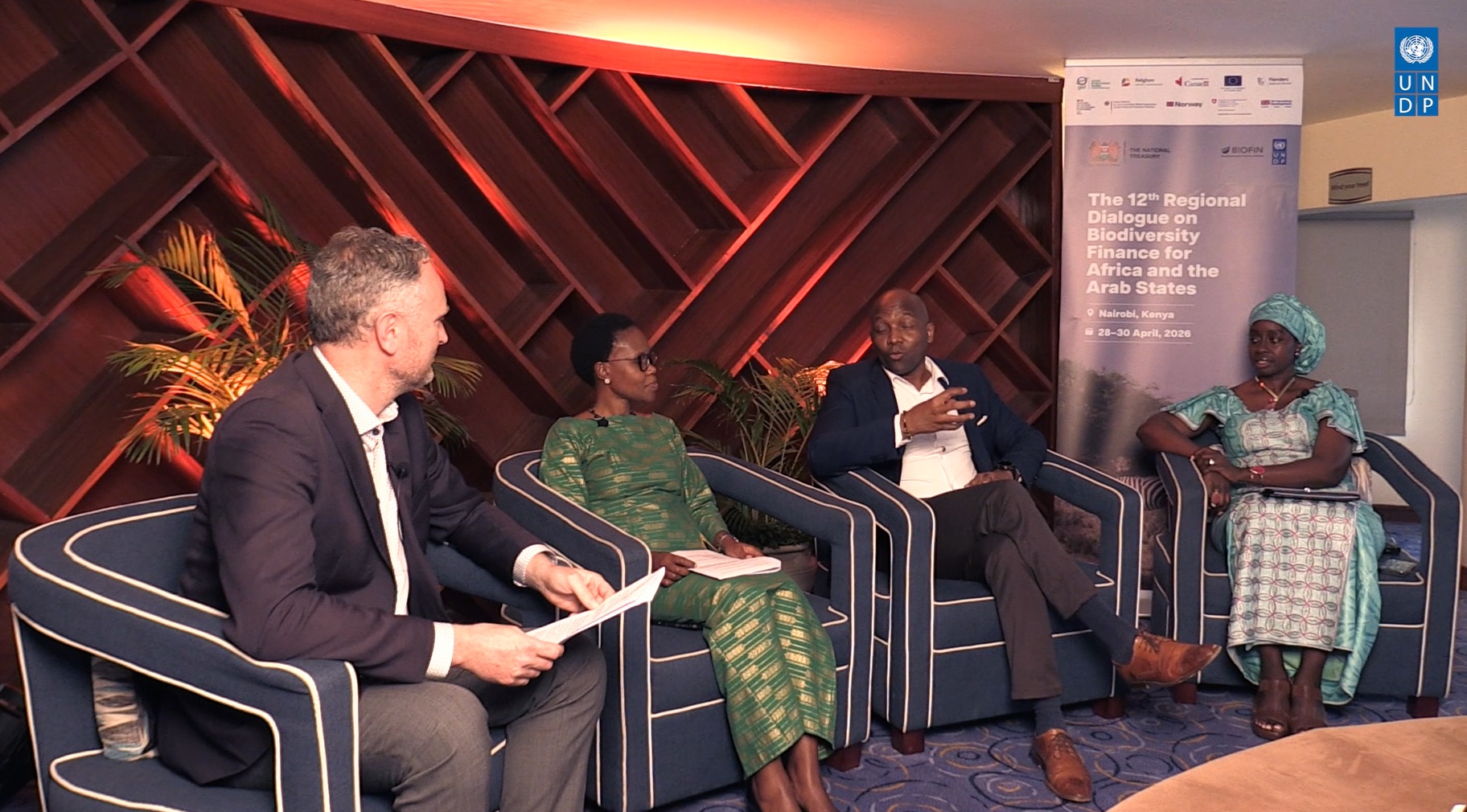
This shift was at the heart of a conversation held alongside the Regional Dialogue on Biodiversity Finance for Africa and the Arab States in Nairobi, where Maxwell Gomera, UNDP Resident Representative in South Africa; Fatmata Lovetta Sesay, UNDP Resident Representative in Rwanda; and Christine Mwangi, Programme Manager for UNDP BIOFIN Kenya, joined Onno van den Heuvel, Global Lead for Nature Finance at UNDP BIOFIN, to discuss how countries are transforming financial systems to better value nature.
Watch the full conversation
From conservation to economic planning
For decades, biodiversity was largely treated as the responsibility of environment ministries. Today, that is changing.
Countries are increasingly integrating biodiversity into national budgets, investment planning and financial decision-making. Finance ministries, central banks, development banks and the private sector are becoming key partners in designing solutions that mobilize new investment for nature while supporting broader development priorities.
As Onno van den Heuvel noted, the goal is not simply to finance conservation, but to help governments redesign financial systems so biodiversity becomes part of everyday economic decision-making.
Changing incentives, not just raising funds
One of the discussion's central themes was that biodiversity finance is about changing incentives.
As Maxwell Gomera explained, "The individual logic works, but the collective logic is catastrophic."
A farmer cutting down a tree for firewood is making a rational decision to meet immediate household needs. But when millions of people face the same pressures, the result is widespread deforestation, degraded watersheds and declining biodiversity.
The challenge, therefore, is not simply asking people to make different choices. It is creating financial and policy systems that make sustainable choices possible and economically attractive.
This is where biodiversity finance moves beyond traditional conservation funding. Rather than relying solely on public budgets, countries are reforming policies, creating new financial mechanisms and aligning incentives so that protecting nature also supports livelihoods and economic development.
Innovation is already happening across Africa
Across the continent, countries are demonstrating that biodiversity finance is not a theoretical concept but a practical tool for economic transformation.
Botswana revised protected area fees, generating more than US$30 million in additional revenue for conservation. Malawi and Madagascar are integrating biodiversity into national budgeting processes. South Africa is working with its Development Bank to establish dedicated investment windows for biodiversity while advancing nature-related financial risk assessments that help financial institutions better understand their exposure to nature loss.
In Rwanda, Fatmata Lovetta Sesay highlighted the introduction of Irembo Pay, an innovative digital system that enables environmental fines to be collected instantly through mobile payments. The revenues are channelled into the Rwanda Green Fund and reinvested in ecosystem restoration, environmental education and wetland rehabilitation.

Photo: Irembo Pay, an innovative digital system that enables environmental fines to be collected instantly through mobile payments
"It is not only about collecting the resources," she explained. "Nature has to be regenerated by ourselves who are using it and depending on it."
The system also strengthens public accountability by showing citizens exactly how environmental penalties contribute to restoring the ecosystems on which communities depend.
Meanwhile, Kenya is developing its Biodiversity Finance Plan by analysing biodiversity expenditures, assessing financing needs and identifying solutions that can be embedded into national planning and budgeting processes.
Rather than replicating approaches from elsewhere, Christine Mwangi emphasized that countries are adapting successful ideas to their own circumstances.
"It's not about replication," she said. "It's about looking at what has worked in other countries, analysing those solutions and adapting them to our national and local context."
That exchange of experience has become one of BIOFIN's greatest strengths. Countries learn from one another while developing finance solutions that reflect their own environmental, economic and institutional realities.
A growing role for finance leaders
Another important shift highlighted during the discussion is who is now leading the conversation.
According to Christine Mwangi, ministers of finance are increasingly becoming active participants in biodiversity policy. Their involvement helps translate commitments into public investment, budget reforms and long-term implementation.
Fatmata Lovetta Sesay also pointed to the growing engagement of central banks, finance ministries and the private sector, alongside communities themselves. Bringing these actors together helps ensure that biodiversity is no longer treated as a standalone environmental issue but as a foundation for economic development.
As biodiversity becomes integrated into financial planning, countries are moving beyond asking whether nature deserves investment. Instead, they are asking how financial systems can better recognise ecosystems as productive national assets.
Investing in nature means investing in people
The discussion ultimately pointed to a broader shift in development thinking.
Healthy ecosystems provide water, fertile soil, energy resources and natural capital that support agriculture, tourism, industry and rural livelihoods. Investing in biodiversity is therefore not separate from investing in economic growth or poverty reduction is part of the same agenda.
As Onno van den Heuvel concluded, countries do not need separate investment strategies for nature and development. By putting the right financial incentives and policies in place, governments can strengthen biodiversity while supporting more resilient economies and improving people's lives.
Across Africa, this transformation is already underway. And as countries continue implementing their Biodiversity Finance Plans, they are demonstrating that investing in nature is not simply an environmental responsibility; it is a smart economic strategy for a more sustainable future.
Categories
Archives
- Octubre 2025 (5)
- Septiembre 2025 (2)
- Agosto 2025 (10)
- Julio 2025 (9)
- Junio 2025 (5)
- Mayo 2025 (8)
- Abril 2025 (9)
- Marzo 2025 (8)
- Febrero 2025 (2)
- Enero 2025 (5)