


A new Wildlife Risk Insurance Policy covers losses ranging from damaged crops and homes to human injury and loss of life. Developed through collaboration among government institutions, insurers and conservation partners, it represents an important step towards protecting both communities and biodiversity in Nepal.
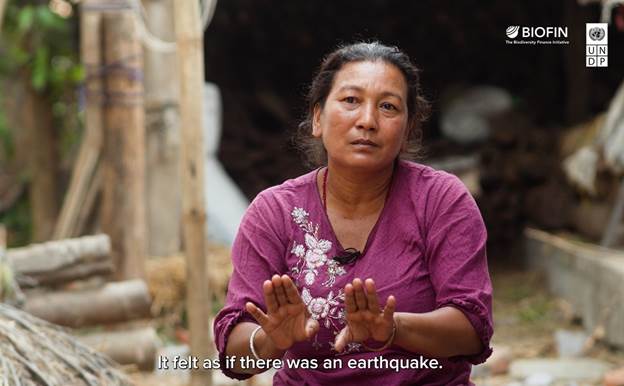
“When the elephant came that evening, I was so frightened. It felt like there was an earthquake.”
For Nita Shrestha from Bahundangi, Jhapa, the encounter has left a lasting mark. As the elephant shook her house, the entire building trembled. Nearly a month later, the fear remained.
Other families have experienced even greater losses. One man lost sight in one eye after being attacked by a tiger. Another lost his wife when an elephant attacked her as she harvested paddy.
These experiences illustrate the human cost of living alongside wildlife in Nepal. In 2024, 14,821 human–wildlife incidents were recorded across Nepal, resulting in damaged crops and property, lost livestock, injuries and deaths.
Watch: Living with human–wildlife conflict in Nepal
Now, a new insurance policy aims to give affected communities greater financial protection.
Nepal has introduced its Wildlife Risk Insurance Policy for communities living alongside wildlife. Offered by non-life insurance companies licensed by the Nepal Insurance Authority, it covers crop damage, livestock losses, property damage, and human injury or death caused by multiple wildlife species.
The policy marks an important milestone in Nepal’s efforts to move from human–wildlife conflict towards coexistence.
When conservation success creates new challenges
Nepal has achieved internationally recognized progress in restoring forests and protecting wildlife, including the recovery of species such as tigers and rhinoceroses.
But as wildlife populations recover and habitats increasingly overlap with farmland and settlements, communities living near forests, protected areas and biological corridors face growing risks.
For families whose livelihoods depend on a harvest, a small herd of livestock or a modest home, a single wildlife encounter can cause a serious financial shock. A destroyed crop can eliminate a season’s income. Losing an animal can take away an important household asset. Damage to a house may leave a family without the resources needed to repair it.
In the most serious cases, families must also cope with the consequences of injury or the death of a household member.
These losses can weaken local support for conservation and sometimes contribute to retaliatory action against wildlife. Protecting communities is therefore not separate from wildlife conservation—it is essential to its long-term success.
Closing gaps in existing support
Nepal already has compensation, relief and agricultural insurance mechanisms that can help people affected by wildlife. However, many households in biodiversity hotspots have struggled to access them.
Verification and compensation processes can take time, available public budgets are limited, and not every form of loss has been covered. Awareness of insurance remains low in some communities, while documentation requirements, affordability and a lack of trust can also discourage participation.
For families able to access insurance, however, it can make a meaningful difference. One farmer had spent two years raising a buffalo that was about to calve. The family hoped to earn additional income by selling its milk, but a tiger killed the animal.
“My buffalo was just about to turn three years old and was about to calve,” the farmer said. “Our financial condition is weak, and we hoped to earn a little by selling a few litres of milk. But the tiger killed it.”
Because the buffalo was insured, the family received compensation. “If I had not insured my cattle, I would not have received even a single rupee,” the farmer explained. “The two years I spent raising it would also have been lost. Insurance gave me some relief. It gave me hope.”
The experience demonstrates both the value of insurance and the importance of making it easier to access. Many community members still do not know what insurance covers, how to enrol or what to do when damage occurs. Local governments, cooperatives, insurance providers and community organizations can help close this gap by explaining the process, supporting registration and helping families report and document their losses.
Watch: How insurance helped a family recover after a tiger killed their buffalo
In 2025, Nepal’s Ministry of Forests and Environment, with support from UNDP BIOFIN, began expanding agricultural insurance in biodiversity hotspots to reach communities that had previously struggled to access coverage. The initiative focused on connecting farmers and community groups with insurance services, improving insurance literacy, supporting claims processes and exploring ways to finance premiums.
The Wildlife Risk Insurance Policy takes this work further. By including property damage as well as human injury and death, it offers a more comprehensive response to the range of risks communities face. It is intended to complement Nepal’s existing government relief system, rather than replace it.
Turning collaboration into a financial solution
The new policy builds on collaboration involving UNDP BIOFIN, government institutions, the Nepal Insurance Authority, the insurance sector and conservation organizations.
Each has a distinct role to play. Government and conservation authorities bring knowledge of affected landscapes and communities. The Nepal Insurance Authority provides the regulatory framework. Insurance companies translate identified risks into workable coverage and claims procedures. Local institutions and community organizations can help families understand the policy, enrol and submit claims.
UNDP BIOFIN has supported this process as part of its work to help countries identify and implement finance solutions that contribute to their biodiversity goals.
Insurance is an emerging area of biodiversity finance. Rather than relying solely on public compensation after damage occurs, insurance pools and distributes risk. If designed well and made accessible, it can help families recover more quickly while reducing pressure on limited government relief budgets.
For communities, this can mean greater financial security. For conservation, it can strengthen trust and reduce the risk that losses lead to hostility or retaliation against wildlife.
Insurance is one part of the solution
Insurance alone cannot prevent human–wildlife conflict.
Measures are still needed to restore and manage habitats, maintain wildlife corridors, improve early-warning systems and use practical deterrents to keep animals away from farms and settlements. Clear responsibilities are also required among federal and provincial governments, forest divisions, conservation authorities and local institutions.
Insurance should therefore form part of a broader risk-management approach: first reducing the likelihood and severity of conflict, and then providing financial protection when losses cannot be avoided.
Community participation will also be critical. The policy will only succeed if people understand what it covers, can afford or receive support for premiums, and can navigate claims procedures without unnecessary delays.
Its impact will depend on how effectively it is implemented and how widely communities adopt it. Local access, clear enrolment procedures, awareness of available coverage and support with claims will all help determine whether the policy reaches the people most exposed to wildlife-related risks.
A potential model for other countries
Human–wildlife conflict is not unique to Nepal. Communities living near important ecosystems in many countries face similar risks, particularly as habitat loss, land-use change and climate change alter interactions between people and wildlife.
Nepal’s experience shows how governments, regulators, insurers and conservation partners can work together to develop a financial solution shaped around these realities.
The new policy also demonstrates what biodiversity finance can mean in practice. It is not only about raising additional money for conservation. It is also about using financial policies and instruments to distribute risks more fairly, protect livelihoods and make conservation more sustainable.
For families living alongside Nepal’s wildlife, the stakes are immediate and deeply personal. Successful conservation must ensure that recovering wildlife populations do not leave vulnerable communities to absorb the costs alone.
By helping families cover those costs, insurance can contribute to a future in which people and wildlife can thrive together.