BIODIVERSITY FINANCE
NEXTOPIA Gaming App: Turning Everyday Play into Conservation Finance
What if a few minutes on your phone, between shopping, commuting, or waiting for coffee, could help restore a mangrove…








Thailand is one of Southeast Asia's most biodiverse countries, home to rich forests, wetlands, coral reefs and marine ecosystems that support livelihoods, food security, tourism and the country's Bio-Circular-Green (BCG) Economy. Approximately 9% of the world's known species occur in Thailand, making biodiversity one of the country's most valuable natural assets.
Despite significant progress in conservation, Thailand faces an estimated biodiversity financing gap of approximately US$1.1 billion, with current investments insufficient to fully achieve the country's National Biodiversity Strategies and Action Plans (NBSAPs) and the targets of the Kunming–Montreal Global Biodiversity Framework. Addressing this gap requires stronger public investment, greater private sector participation and innovative financing mechanisms that complement traditional conservation funding.
UNDP BIOFIN was launched in Thailand in 2014 to strengthen the country's biodiversity finance framework and mobilize new resources for nature. Working closely with the Office of Natural Resources and Environmental Policy and Planning (ONEP), government agencies, financial institutions, businesses and local communities, UNDP BIOFIN has developed and is implementing innovative finance solutions including sustainable tourism finance, biodiversity-positive public–private partnerships, digital finance, biodiversity budgeting and the repurposing of environmentally harmful subsidies. These initiatives are helping transform the way biodiversity is financed while supporting Thailand's transition to a more resilient and nature-positive economy.
UNDP BIOFIN Thailand is implementing a portfolio of innovative finance solutions designed to mobilize new public and private investment for biodiversity conservation. Building on the Biodiversity Finance Plan (2023–2027), these solutions combine policy reform, sustainable tourism, blended finance, local government budgeting, private sector partnerships and digital innovation to create long-term financing for nature.
Finance Solution 1: Sustainable Tourism Finance Solution - Increasing sources of revenue for safeguarding biodiversity and environmental management in Koh Tao
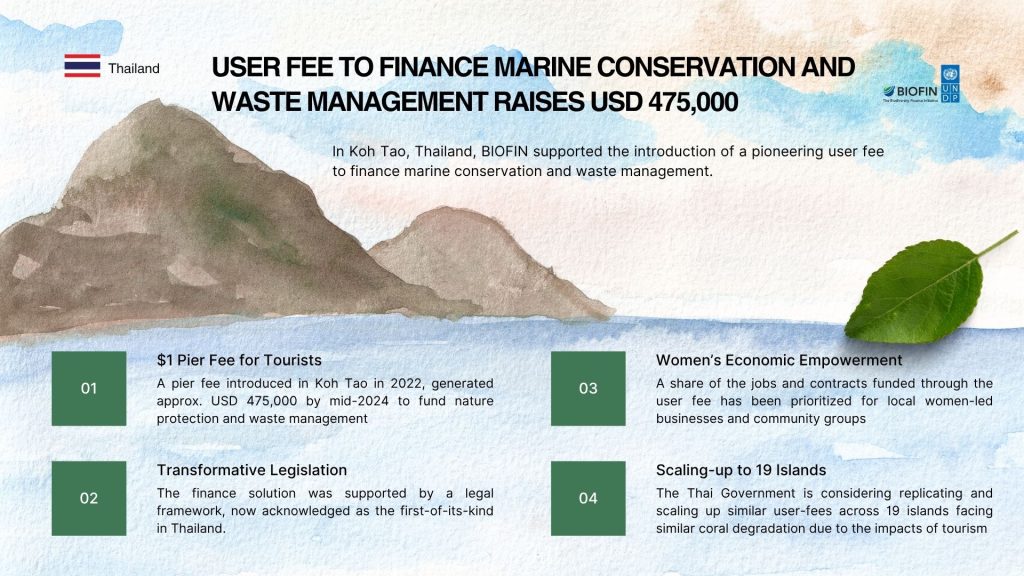
UNDP BIOFIN is scaling innovative tourism finance to generate sustainable revenues for biodiversity conservation. Building on the successful Koh Tao model, the programme supports visitor user charges, community conservation funds and local partnerships that reinvest tourism revenues into coral reef restoration, marine conservation, waste management and sustainable livelihoods. The approach demonstrates how tourism can become a long-term source of finance for nature.
Finance Solution 2: Government Budget Finance Solution – Enhancing effectiveness and biodiversity impact of local budgets in Thailand
UNDP BIOFIN is helping Local Administrative Organizations integrate biodiversity into planning and budgeting, improving the effectiveness of public expenditure and supporting implementation of Thailand's Bio-Circular-Green (BCG) Economy model. The finance solution promotes results-based budgeting and stronger biodiversity investment at the local level.
Finance Solution 3: Private Sector Finance Solution – Public–Private Partnerships for Sustainable Mangrove Management in Phetchaburi province
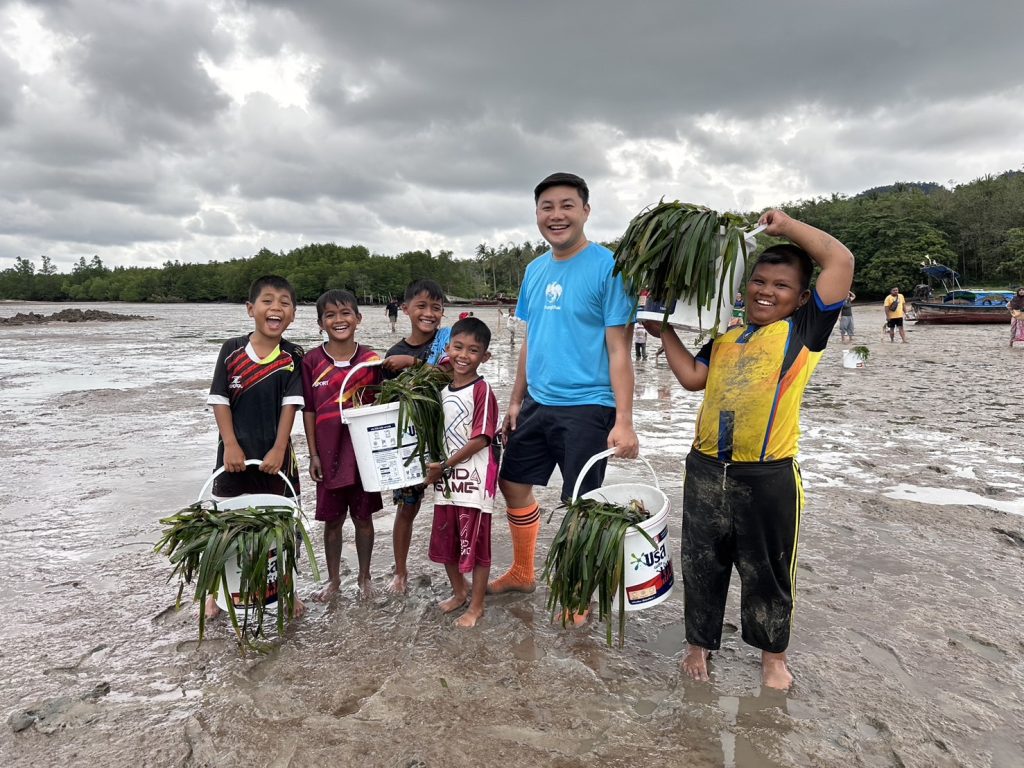
UNDP BIOFIN is implementing Thailand's first subnational biodiversity finance plan for sustainable mangrove management in Phetchaburi Province. Developed in partnership with Krungthai Bank, government agencies and local communities, the initiative combines biodiversity funds, social enterprises, public budgeting and private investment to restore mangrove ecosystems while creating sustainable livelihoods and strengthening the local bioeconomy.
Finance Solution 4: Private Sector Finance Solution – A Platform to scale impact investment opportunities in biodiversity
UNDP BIOFIN is strengthening Thailand's biodiversity investment ecosystem by connecting biodiversity-positive enterprises with investors and financial institutions. The programme supports investment-ready projects in sustainable fisheries, circular economy, ecosystem restoration and nature-based businesses, helping mobilize blended finance and private capital for biodiversity.
Finance Solution 5: Deployment of conservation vehicle license plates to support wildlife conservation in Thailand
UNDP BIOFIN developed an innovative Conservation Vehicle License Plate mechanism to generate voluntary contributions for wildlife conservation. The proposed scheme would create a dedicated domestic revenue stream for biodiversity while encouraging public participation in financing nature conservation.
Finance Solution 6: Crowdfunding Finance Solution – Digital Finance for Nature
UNDP BIOFIN is pioneering digital biodiversity finance through innovative platforms that encourage citizens and businesses to support conservation through everyday activities. Building on the "Koh Tao, Better Together" campaign, the programme has expanded into initiatives such as NEXTOPIA, demonstrating how digital engagement can unlock new private finance while increasing public participation in biodiversity conservation.
Finance solution 7: Repurposing of harmful subsidies: The study of the impacts of subsidies on biodiversity and ecosystems in Thailand
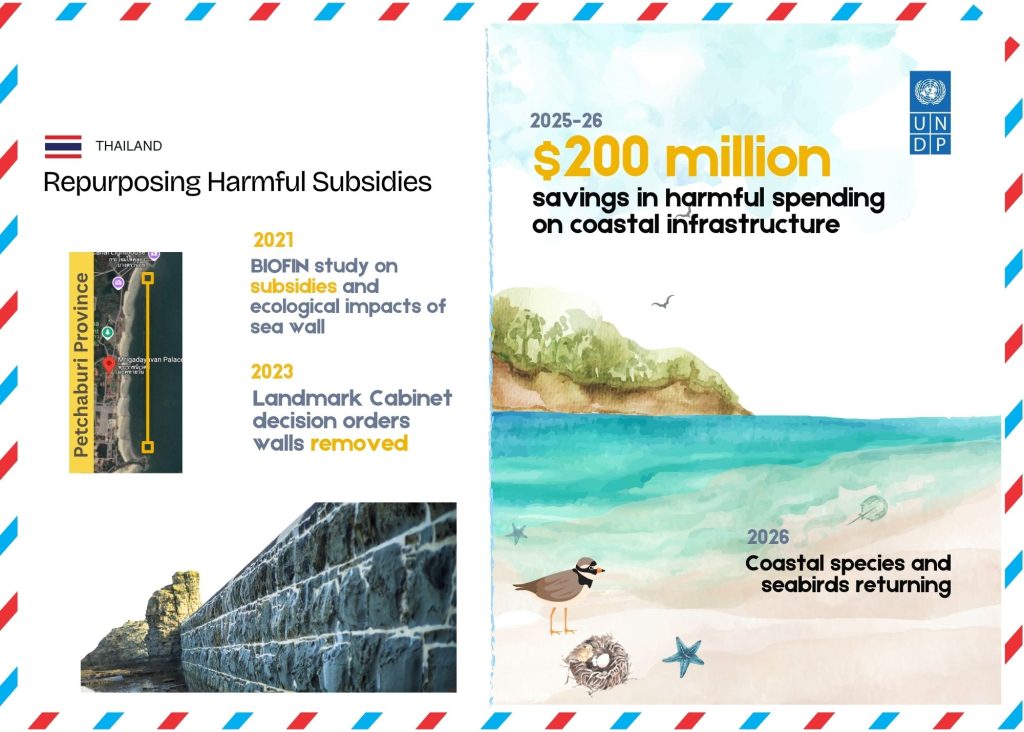
UNDP BIOFIN is supporting Thailand to identify, reform and repurpose public subsidies and fiscal incentives that can negatively affect biodiversity. The work has contributed to policy shifts away from harmful coastal infrastructure investment and is advancing a biodiversity-positive land tax incentive to encourage landowners to conserve ecologically important areas. The solution demonstrates how fiscal policy can redirect public finance from activities that degrade nature towards incentives that protect ecosystems and support Thailand’s biodiversity commitments.
Finance solution 8: Nature-related bond: The pre-feasibility assessment for financing the National Tiger Action Plan (NTAP) through a Tiger Ecosystem Bond
UNDP BIOFIN is exploring innovative nature-related finance to support long-term investment in Thailand’s tiger landscapes. A pre-feasibility assessment examined the potential of a Tiger Ecosystem Bond to finance implementation of the National Tiger Action Plan and mobilize additional public and private capital for conservation. Building on this work, Thailand is strengthening cross-ministerial collaboration and exploring mechanisms to reduce investment risks, creating a pathway towards larger-scale finance for tiger habitat conservation and sustainable development.
Establishing Thailand's Biodiversity Finance Framework
UNDP BIOFIN completed Thailand's Policy and Institutional Review (PIR), Biodiversity Expenditure Review (BER), Financial Needs Assessment (FNA) and Biodiversity Finance Plan (BFP), providing the country's first comprehensive biodiversity finance framework. In 2024, Thailand endorsed its updated Biodiversity Finance Plan (2023–2027) and established a dedicated Biodiversity Finance Unit to coordinate implementation and strengthen biodiversity finance across government.
Transforming Tourism into Biodiversity Finance
UNDP BIOFIN pioneered Thailand's innovative Koh Tao biodiversity user charge, demonstrating how tourism revenues can directly finance marine conservation and environmental management. The initiative introduced a THB 20 (approximately US$0.60) conservation fee that supports biodiversity protection while providing a practical model for sustainable tourism finance that is now inspiring similar initiatives elsewhere in the country.
Repurposing Harmful Subsidies for Nature
Following technical support from a BIOFIN expert and other scientists, the Thai Cabinet, in a landmark decision, directed the Marine Department to allocate US$285,714 to remove the harmful structures and to cease further harmful subsidies of US$8.4 million at the Mrigadayavan Palace. In 2025, a major financial milestone shows that Thailand ended US$285.2 million in harmful subsidies for the construction of seawalls across the country over the past 20 years. Starting in Fiscal Year 2025, the Department of Public Works and Town & Country Planning (Ministry of Interior) and the Marine Department (Ministry of Transportation) ceased budget requests for seawall construction projects. This decisive action prevents future expenditures, effectively avoiding an annual cost of US$17 million. The repurposing of these subsidies not only prevents environmental harm but also redirects financial resources toward more sustainable and biodiversity-positive investments in the future.
Scaling Public–Private Partnerships for Nature
Building on its biodiversity finance work, UNDP BIOFIN launched Thailand's first subnational public–private partnership for biodiversity finance in Phetchaburi Province. Implemented with Krungthai Bank, the Office of Natural Resources and Environmental Policy and Planning, local authorities and communities, the initiative combines biodiversity funds, social enterprises, public budgeting and private investment to finance sustainable mangrove management, community-based ecotourism and local bioeconomy development.
Pioneering Digital Finance for Nature
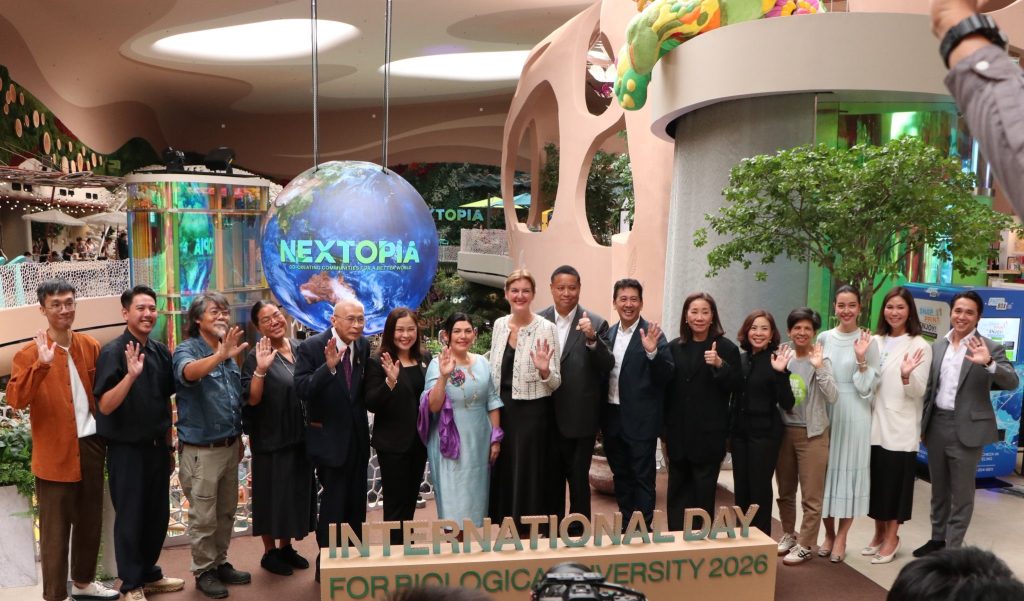
UNDP BIOFIN launched NEXTOPIA, an innovative digital platform that enables consumers to contribute to biodiversity conservation through everyday digital engagement. Developed with private-sector partners, the initiative demonstrates how technology, gamification and consumer participation can unlock new private finance for nature while increasing public awareness and support for biodiversity conservation.