
NEWS
Ghana launches BIOFIN to mobilize resource for biodiversity conservation
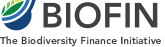
15 April 2025 – Accra, Ghana – Ghana has officially joined the global Biodiversity Finance Initiative (BIOFIN), launching a new…


Ghana’s rich biodiversity underpins key sectors of the economy, including agriculture, forestry, fisheries, tourism and water resources, while providing essential ecosystem services that support livelihoods, food security and climate resilience. Achieving the country’s biodiversity priorities under the National Biodiversity Strategy and Action Plan 2025–2030 requires sustained and well-coordinated financing.
Biodiversity finance comes from a combination of government budgets, revenues generated by natural resource institutions, environmental fees and levies, international cooperation and private investment. However, financial flows are spread across multiple institutions and sectors, making it difficult to comprehensively track biodiversity expenditure, assess financing needs and align resources with national biodiversity priorities.
UNDP BIOFIN is supporting the Government of Ghana, through the Ministry of Environment, Science and Technology and in partnership with the Ministry of Finance, to strengthen the country’s approach to biodiversity finance. The BIOFIN Ghana team is embedded within the Ministry of Finance, supporting closer integration of biodiversity into public finance and national development planning. A National Project Steering Committee has also been established to provide strategic oversight and strengthen cross-sectoral coordination.
The Policy and Institutional Review is at an advanced stage, while data collection is underway for the Biodiversity Expenditure Review. These assessments will inform the Finance Needs Assessment and Ghana’s Biodiversity Finance Plan, which will identify and prioritize practical finance solutions to improve the use of existing resources and mobilize additional finance for implementation of national biodiversity priorities and the Kunming–Montreal Global Biodiversity Framework.
The Policy and Institutional Review has identified several potential finance solutions for further assessment through Ghana’s BIOFIN process. These options will be evaluated and prioritized as the country advances its Finance Needs Assessment and Biodiversity Finance Plan.
1. Biodiversity Budget Tagging
Develop a biodiversity budget tagging framework to systematically identify, track and report biodiversity-related public expenditure across sectors. This can strengthen expenditure transparency and support evidence-based budgeting and resource allocation for biodiversity.
Stage: Under Consideration
2. Reforming Biodiversity-Harmful Subsidies
Assess selected subsidies and incentives in sectors such as agriculture, fisheries and extractives to identify opportunities for reform or repurposing. The objective is to reduce incentives that contribute to biodiversity loss while supporting more nature-positive practices.
Stage: Under Consideration
3. Biodiversity Credits
Assess the feasibility of biodiversity credit mechanisms that could mobilize private investment for ecosystem conservation, restoration and measurable biodiversity outcomes, subject to appropriate standards and safeguards.
Stage: Concept Development
4. Payments for Ecosystem Services
Explore payment mechanisms that provide incentives for communities, landholders and other ecosystem stewards to conserve forests, watersheds and other important ecosystems and maintain the services they provide.
Stage: Under Consideration
5. Nature-Based Carbon Finance
Assess opportunities to mobilize finance through REDD+, Article 6 mechanisms and other nature-based carbon initiatives that can generate climate benefits while supporting biodiversity conservation and ecosystem restoration.
Stage: Under Consideration
6. Mainstreaming Biodiversity into Public Financial Management
Strengthen the integration of biodiversity into national planning, budgeting and public financial management to improve the allocation, coordination and effectiveness of public resources for biodiversity.
Stage: Under Consideration
BIOFIN Ghana is establishing the analytical and institutional foundations required to strengthen biodiversity finance and support implementation of the National Biodiversity Strategy and Action Plan (2025–2030).
Institutional Strengthening
The project has established a multi-sectoral Project Steering Committee and strengthened collaboration between the Ministry of Finance, the Ministry of Environment, Science and Technology, UNDP and other key biodiversity institutions. The BIOFIN team is embedded within the Ministry of Finance, helping to position biodiversity finance within national public financial management and development planning processes.
Evidence for Policy and Finance Reform
The ongoing Policy and Institutional Review (PIR) and Biodiversity Expenditure Review (BER) are expected to identify policy, legal and institutional reforms that will strengthen biodiversity finance governance, improve coordination across sectors and provide a clearer understanding of biodiversity-related public expenditure.
Emerging Finance Reforms
The BIOFIN process is expected to support the development of biodiversity budget tagging, strengthen biodiversity expenditure tracking, identify opportunities for reforming biodiversity-harmful subsidies, and assess innovative finance mechanisms that can mobilise additional public and private investment for biodiversity conservation.
The findings of the PIR and BER will inform Ghana's Financial Needs Assessment (FNA) and Biodiversity Finance Plan (BFP), which will prioritise finance solutions and provide a strategic roadmap for mobilising and optimising resources to achieve national biodiversity targets and the Kunming–Montreal Global Biodiversity Framework.