
NEWS
Burundi advances national Biodiversity Finance Plan as new governance bodies begin work
The country is progressing with key assessments and exploring finance solutions to support the implementation of its national biodiversity priorities.


Burundi is home to diverse ecosystems, including mountain forests, savannahs, wetlands, freshwater ecosystems and extensive agricultural landscapes. Lake Tanganyika and the country’s protected areas are particularly important for biodiversity, while healthy ecosystems support water security, agriculture, livelihoods and resilience to climate change.
Despite this natural wealth, financing for biodiversity remains limited. Domestic allocations for biodiversity represent less than 1% of the national budget, while an estimated 60–75% of biodiversity-related expenditure is financed from external sources. Available domestic resources are largely directed towards operational costs, leaving limited funding for conservation activities, monitoring and enforcement. At the same time, existing environmental revenues and financing mechanisms are not yet systematically directed towards biodiversity priorities.
UNDP BIOFIN is supporting the Government of Burundi, led by the Ministry of Environment, Agriculture and Livestock in partnership with the Ministry of Finance, Budget and Digital Economy, to strengthen the way biodiversity is planned, financed and integrated into public financial management. The initiative is assessing existing policies and institutions, biodiversity expenditure and future financing needs while identifying opportunities to make better use of domestic, international and other sources of finance.
The Policy and Institutional Review is progressing through review, while the Biodiversity Expenditure Review and Financial Needs Assessment are underway. Together, these assessments will provide the evidence for Burundi’s Biodiversity Finance Plan, which will identify and prioritize practical finance solutions to support implementation of the NBSAP and the Kunming–Montreal Global Biodiversity Framework.
The draft Policy and Institutional Review identified several potential finance solutions to strengthen domestic resource mobilization, improve the use of existing environmental revenues and reduce Burundi's dependence on project-based external financing. These options remain at the analytical stage and will be further assessed and prioritized through the BIOFIN process.
1. Operationalizing the National Forestry Fund
The National Forestry Fund is already provided for under Burundi's Forestry Code but is not yet operational. BIOFIN is exploring how the Fund could be activated, with appropriate governance and financing arrangements, to channel forest-related revenues towards reforestation, forest protection and community-based conservation.
2. Establishing a National Biodiversity Trust Fund
Explore the establishment of a national financing mechanism that could pool resources from government, international partners and the private sector to provide more predictable, long-term financing for priority biodiversity actions. Such a mechanism could help reduce reliance on short-term, project-based external funding.
3. Payments for Ecosystem Services
Build on existing work to develop Payments for Ecosystem Services (PES), including potential pilot approaches around priority landscapes such as Kibira National Park. These could create financial incentives for communities to protect watersheds and other ecosystem services while connecting beneficiaries of these services with conservation financing.
4. Green Fiscal Reform and Environmental Revenues
Review existing environmental taxes, fees and other fiscal instruments to increase their contribution to biodiversity. Potential reforms include strengthening pollution-related charges and improving how revenues from tourism, forestry and mining are allocated and reinvested in ecosystem restoration and conservation.
5. Biodiversity Offsets and Environmental Compensation
Explore a national framework requiring development projects with significant residual impacts on biodiversity, after appropriate avoidance and minimization measures, to finance suitable compensation or restoration measures. This could strengthen application of the polluter-pays principle while improving financing for biodiversity conservation.
6. Strengthening Protected-Area and Tourism Revenues
Review entry fees and other charges associated with national parks, reserves and nature-based tourism to improve their contribution to conservation. Potential measures include updated fee structures, improved revenue collection and transparency, and mechanisms to reinvest a greater share of revenues in protected-area management, community conservation and related infrastructure. Burundi Office for Environmental Protection (OBPE), Ministry of Environment, Agriculture and Livestock, Ministry of Finance, Budget and Digital Economy, Ministry of Trade and Tourism, National Tourism Office, UNDP BIOFIN.
Building Burundi’s Biodiversity Finance Evidence Base
Burundi has launched the three core BIOFIN assessments. The draft Policy and Institutional Review (PIR) has been completed and is under review, while the Biodiversity Expenditure Review (BER) and Financial Needs Assessment (FNA) are progressing. Together, these assessments will provide the evidence base for Burundi’s Biodiversity Finance Plan.
Identifying Key Biodiversity Finance Challenges
The draft PIR has highlighted important structural challenges to biodiversity financing. Domestic allocations for biodiversity represent less than 1% of the national budget, while an estimated 60–75% of biodiversity-related expenditure comes from external sources. The analysis also identified fragmented financing and limited resources for conservation activities, monitoring and enforcement.
Identifying Opportunities to Strengthen Domestic Biodiversity Finance
The BIOFIN analysis has identified opportunities to make better use of existing domestic financing mechanisms. These include operationalizing existing environmental funds, strengthening protected-area and tourism revenues, improving environmental fiscal instruments and exploring Payments for Ecosystem Services and other mechanisms. Six preliminary finance solutions are being considered for further assessment and prioritization.
Strengthening Biodiversity Expenditure Tracking
The ongoing Biodiversity Expenditure Review has highlighted the absence of systematic biodiversity budget tagging across government institutions. Addressing this gap could help Burundi better identify and track biodiversity expenditure and provide stronger evidence for future public budgeting and resource mobilization.
Connecting Biodiversity Planning and Finance
Collaboration between the BIOFIN and NBSAP processes has strengthened the link between national biodiversity priorities and biodiversity finance planning. Joint consultations and analytical work are helping ensure that the future Biodiversity Finance Plan responds directly to the financing needs of Burundi’s national biodiversity priorities.
Engaging Stakeholders in Biodiversity Finance
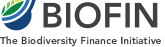
Nearly 350 stakeholders, including representatives of government, civil society, the private sector, financial institutions and development partners, have participated in national consultations and workshops. Women accounted for approximately 49% of participants, supporting broad and inclusive engagement in the biodiversity finance process.