1.1 Biodiversity in the global economy
Nature sustains life and is the foundation of functioning economies and a healthy society. Over half of global GDP, approximately US$44 trillion, is moderately or highly dependent on nature. At the same time, the world must increasingly confront the reality that around one million plant and animal species are at risk of extinction in the coming decades.
Around 2010, the policy focus began shifting from merely valuing nature to understanding investment levels, assessing financial needs, and developing practical policy solutions. Despite progress, a substantial biodiversity ‘finance gap’ persists, estimated at around US$700 billion per year, roughly seven times greater than current investment estimates. Nature remains largely invisible in economic decision-making, often treated as a free and unlimited resource. This invisibility leads to misallocation of resources, underinvestment in conservation, and continued support for activities that harm biodiversity.
The cost of inaction — and the return on action
Ecosystem service loss could reduce global GDP by US$2.7 trillion by 2030. Meanwhile, investments that degrade nature continue to rise, totalling US$7 trillion (7.1% of GDP) in 2022. Nonetheless, nature-positive investments yield high economic returns, with every US$1 spent on restoration generating at least US$9 in benefits.
Capturing this opportunity while reversing current trends requires a dual strategy: mobilizing additional resources and reducing harmful financial flows that drive biodiversity loss. This strategy shapes the enabling environment to promote biodiversity-positive behaviour while discouraging harmful practices.
Policy and financing instruments that support the transition
Market-based instruments
Certification schemes, voluntary offsets.
Fiscal mechanisms
Tax incentives, penalties.
Improved public budgets
Results-based budgeting, ecological fiscal transfers.
Reform of perverse incentives
Harmful subsidies.
Closing the biodiversity finance gap requires targeted, evidence-based approaches that expand public and private financing and reduce expenditures and investments that drive biodiversity loss.
1.2 Biodiversity finance in the Kunming-Montreal Global Biodiversity Framework (GBF)
The GBF, adopted in December 2022, sets four goals and 23 targets aimed at halting and reversing biodiversity loss by 2030. Five of these targets are explicitly focused on biodiversity finance:
| Target | What it calls for |
|---|---|
| Target 14 | Integrate biodiversity into policies, planning, and national accounting, progressively aligning all public and private financial flows with GBF goals. |
| Target 15 | Implement measures (legal, administrative, or policy) to enable financial institutions and businesses to monitor, assess, and disclose their risks, dependencies, and impacts on biodiversity. |
| Target 16 | Empower consumers to make better sustainable decisions. |
| Target 18 | Scale up positive incentives and eliminate, phase out, or reform harmful incentives (including subsidies) by at least $500 billion per year by 2030. |
| Target 19 | Mobilize at least $200 billion per year from all sources (domestic and international, public and private). Target 19 specifically states that resource mobilization should be facilitated by national biodiversity finance plans (BFPs), which are recognized as an important planning tool by the CBD. |
Effectively meeting these targets requires evidence-based diagnostics, planning, and sustained implementation, supported by high-level government engagement, often requiring joint leadership between the Ministry of Finance and the Ministry of Environment.
1.3 BIOFIN and Biodiversity Finance Plans (BFPs)
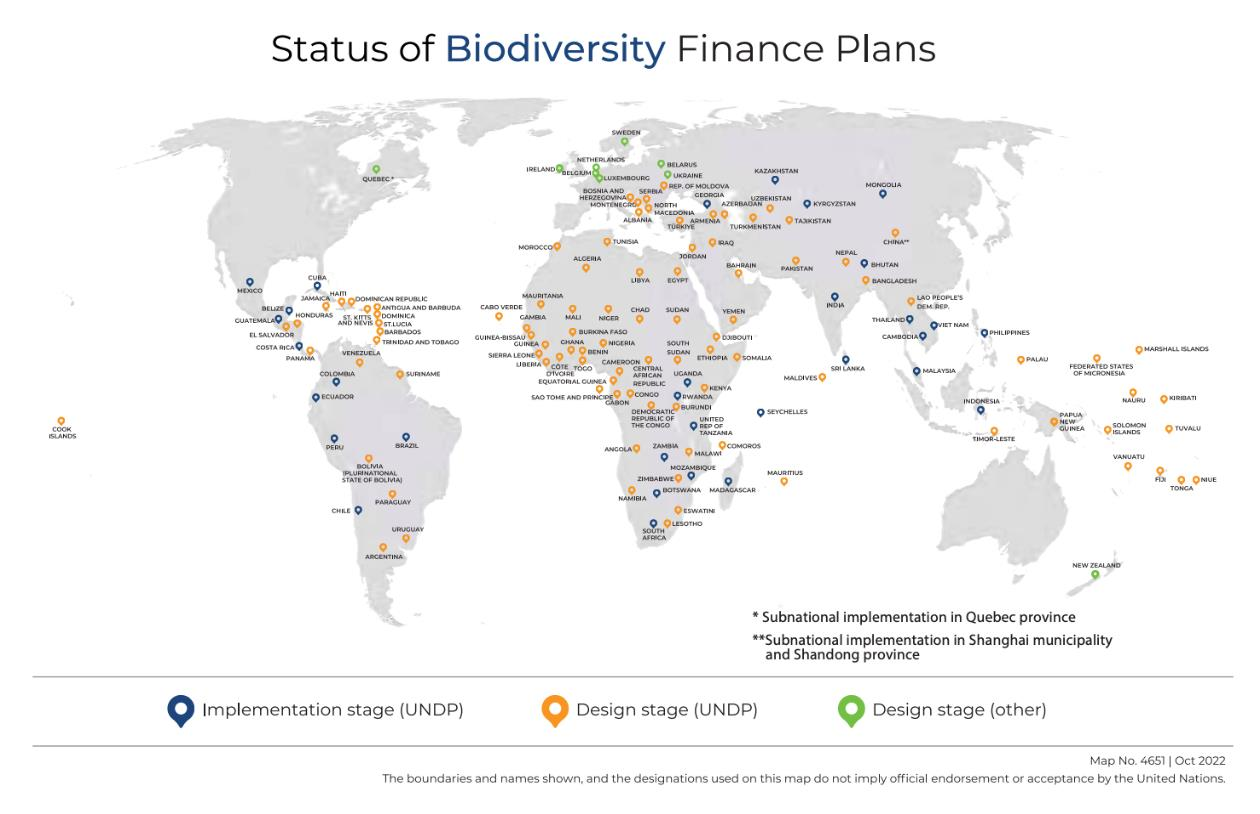
The UNDP’s Biodiversity Finance Initiative (BIOFIN) has assisted countries since 2012 to address nature-blind financial systems. More than 130 countries are implementing and/or developing their Biodiversity Finance Plans. BIOFIN established the first methodology for developing a BFP over ten years ago, and this Workbook is the fourth iteration. BFPs are customized financial plans that help countries close their biodiversity financing gaps.
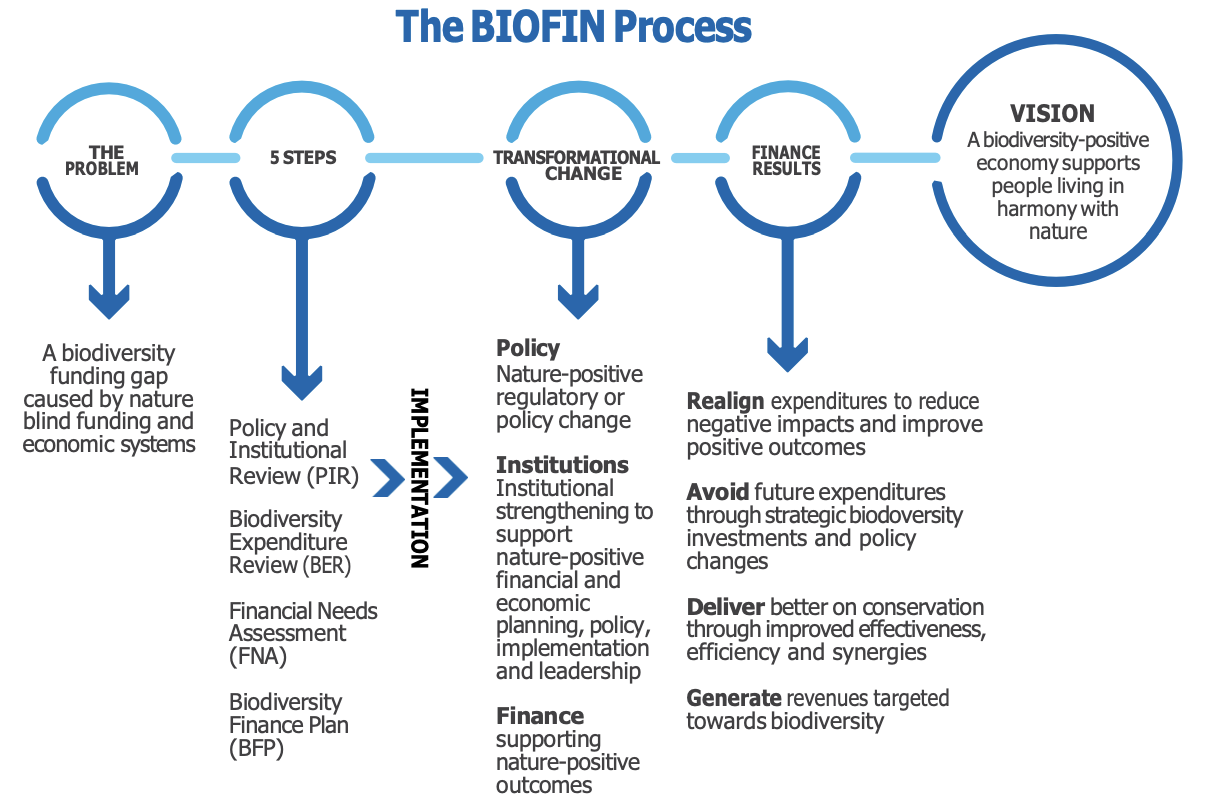
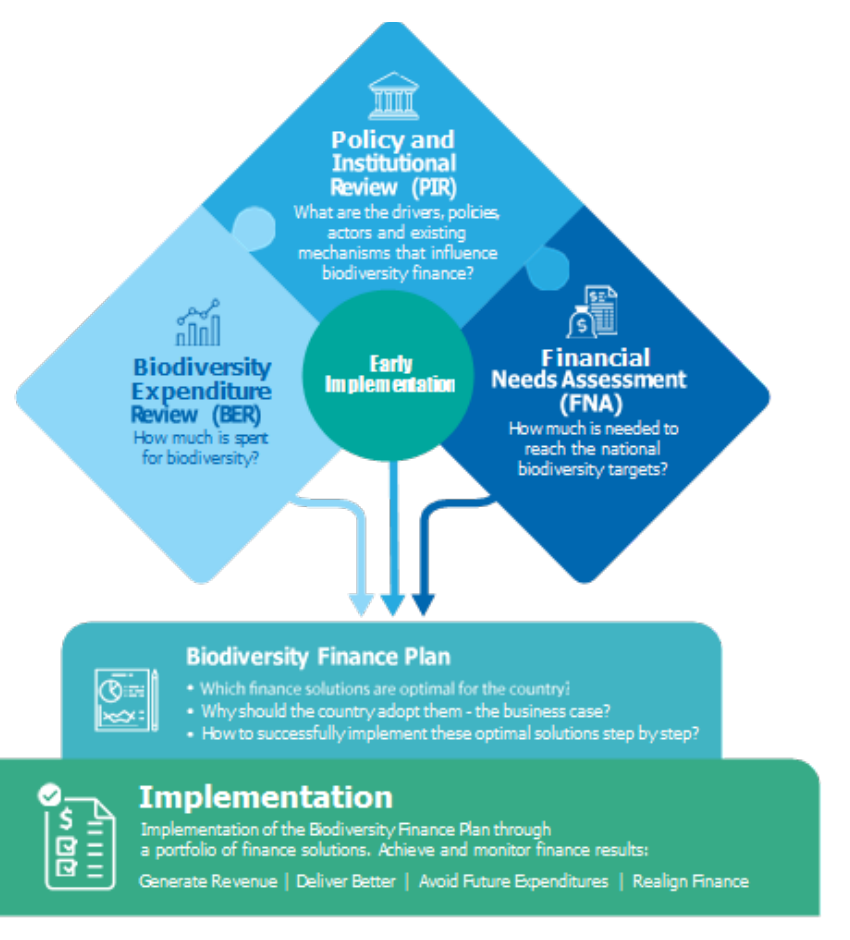
The BIOFIN methodology is structured sequentially to guide countries through a rigorous, evidence-driven process that typically spans diagnostics (1–2 years), development (1 year), and implementation (5–15 years).
The five BIOFIN steps
- Policy and Institutional Review (PIR) Identifies drivers of loss/gain, policies, actors, and existing financing mechanisms, along with an initial inventory of harmful subsidies.
- Biodiversity Expenditure Review (BER) Examines major expenditures to establish which ones are nature-positive and aligned with national goals.
- Financial Needs Assessment (FNA) Calculates the finance required to achieve all national biodiversity goals.
- Design the Biodiversity Finance Plan (BFP) Develops a vision and selects priority financing solutions based on the results of the PIR, BER, and FNA.
- Implementation Operationalizes the selected finance solutions.
The four finance results
BFPs aim to achieve transformative change by generating four finance results:
Generate revenues
For example, protected area fees.
Deliver better
Improving efficiency of available resources — for example, results-based budgeting.
Avoid future expenditures
Investing in preventative actions.
Realign expenditures
Mainstreaming biodiversity into policies — for example, greening subsidies.
This transformative change is sought across three areas: Policy, Institutions, and Finance.