
2.1 Introduction and transformational process
The BIOFIN methodology is designed to be flexible to meet national needs and must be evidence-driven. The BIOFIN process aims for transformational change across three areas: Policy, Institutions, and Finance.
The eight pillars of a transformational BIOFIN approach
- High-level government engagement Building on strong political backing from the outset.
- Adapting to the country context Tailoring the methodology to the unique national situation.
- New partnerships among ministries Especially those focused on finance, planning and environment.
- A timely sustainability strategy Developed early, with opportunities for institutionalization.
- Private sector engagement Increasing the involvement of business in biodiversity.
- Advocacy and communications Pairing technical work with adequate communication activity.
- Capacity development Making capacity building central to all activities.
- Direct engagement with decision-makers Connecting with key decision-makers and ongoing policy processes.
Leaving no one behind
The process stresses inclusiveness in prioritization and decision-making, aiming to ensure that the needs of the poorest and most vulnerable members of society are considered. It also promotes a gender-sensitive approach, mitigating potential negative impacts and promoting gender-positive processes.
2.1.2 Engagement with national stakeholders
Partnerships are central to the BIOFIN process, because the entire model depends on bringing many different actors together to mobilize and realign finance for biodiversity. At the national level, effective engagement with a wide variety of stakeholders helps create this shared understanding and vision. It also allows for a greater understanding of capacity gaps and helps identify how to respond to them together, in a coordinated manner.
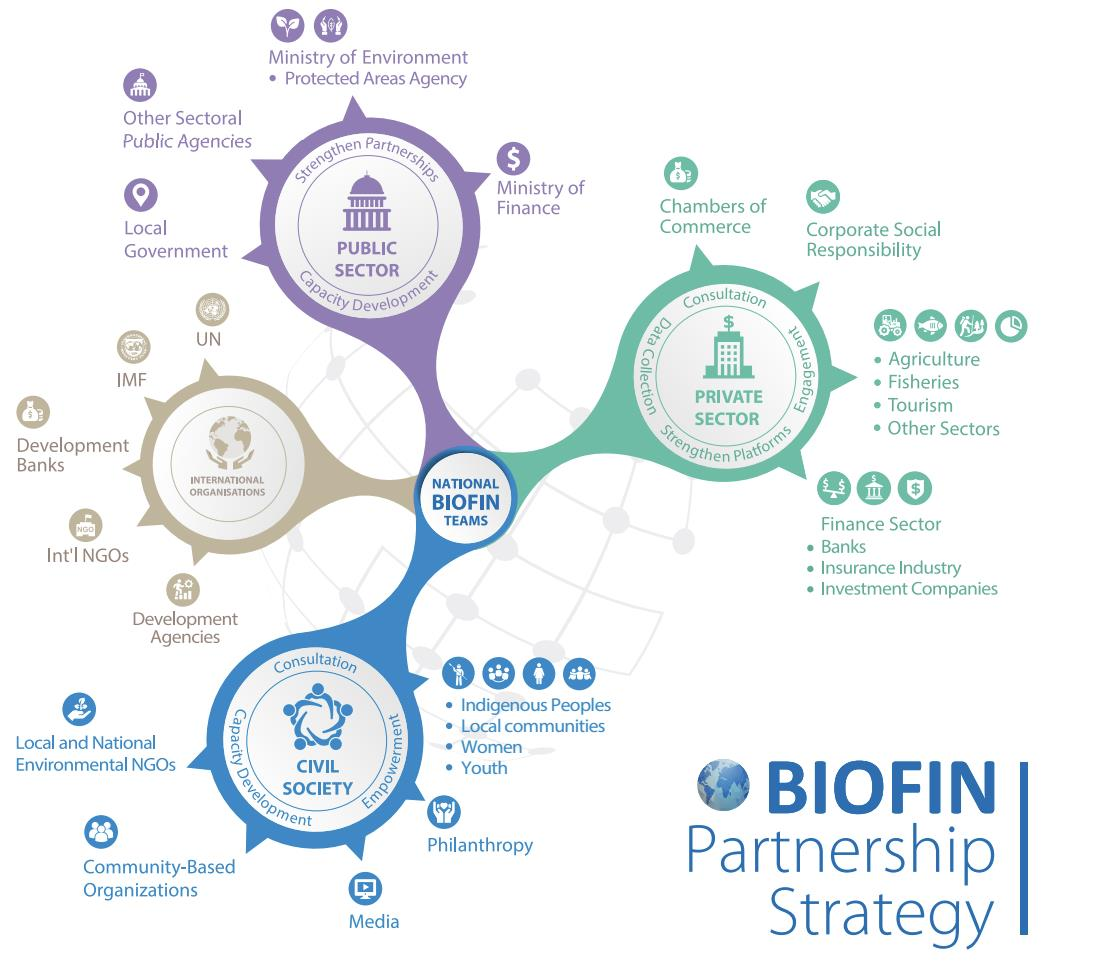
Four primary engagement axes
Public sector
Connecting environmental ministries with finance ministries and other relevant public entities to improve cooperation. Establishing joint leadership of BIOFIN between ministries of finance and the environment is critical.
Businesses and financial institutions
Identifying opportunities for nature-positive investments and reducing harmful practices. Growing recognition of nature-related risks and GBF Target 15 — disclosure of risks, dependencies, and impacts on biodiversity — underscore this axis.
Civil society
Representing local communities, Indigenous Peoples and local communities, women, and youth. Civil society organizations, including conservation NGOs, often play vital roles as financial conduits or direct implementers of biodiversity actions.
Development partners
International organizations, development banks, and philanthropic organizations, who can provide significant financing and coordination infrastructure.
Champions of change
Engaging key “champions of change” — senior government officials, visionary entrepreneurs, or civil society leaders — is emphasized, as they play a catalytic role in policy processes.
2.2 The inception stage
The inception stage is crucial for empowering national stakeholders, leading to overarching coordination structures, and fully anchoring the process in existing institutional and policy arrangements. Key initial actions include:
- Conducting a rapid screening of the policy context The National Biodiversity Strategy and Action Plan (NBSAP) is the foremost document to review, serving as the main basis for calculating financial needs and formulating the Biodiversity Finance Plan. The screening assesses the NBSAP’s status, endorsement level, stakeholder involvement, and whether it includes a clear action plan.
- Establishing the coordination and management framework The principal governing body is the National Steering Committee, which provides strategic guidance, endorses work plans, and validates reports. It should ideally be co-led by representatives from the Ministry of Finance and the Ministry of Environment and meet at least twice a year. Countries may also form a Technical Working Group to offer expert review and guidance.
- Forming a national BIOFIN team Teams are often based in the UNDP country office or hosted by the Ministry of Finance, Environment, or Planning, depending on the need for inter-ministerial dialogue and integration into national planning. An ideal team includes a Project Coordinator, a Senior Finance Expert, and a Policy Expert.
- Staging the first national consultation This inception workshop creates awareness of BIOFIN, engages a wide variety of stakeholders, and gauges perspectives on the challenges and potential of biodiversity finance.
- Scoping for gender and biodiversity finance Exploring the relationship between gender and biodiversity finance, aligning with GBF Target 23 for a gender-responsive approach. Recommendations include ensuring women’s participation in all consultations and bodies, using gender-sensitive indicators, and fostering partnerships with specialized organizations.
- Documenting baseline findings in an inception report This report formalizes major decisions, including the scope of work, committee and team composition, and initial baseline findings on the national biodiversity and finance context.
2.3 Communicating biodiversity finance
Communication is vital throughout the entire process, particularly for advocacy and implementation. Key messages should be tailored to different audiences — for example policy makers, the private sector, and the general public. Advocacy entails communicating complex messages, and campaigns should be based on robust data and evidence. The formulation of an advocacy and communication plan should occur systematically.