
The goal of the BFP is to produce an ambitious, context-based finance plan that supports national biodiversity targets and the objectives of the Convention on Biological Diversity (CBD). The resulting Plan is a national document designed to be owned and supported by the government, civil society, and the private sector.
The BFP development follows six key steps.
Step 1 — Prepare
Preparation involves establishing the core team and partnerships. Preparation of the BFP typically takes 9–12 months.
Ownership and status
It is crucial to agree on the BFP’s ownership and legal status, ideally formalizing it as a government strategy that is periodically updated. The BFP or its elements may be integrated into other national policies, such as the NBSAP, the Integrated National Financing Framework (INFF) for the SDGs, or Nationally Determined Contributions (NDCs) for climate change.
Coordination
The Steering Committee oversees and guides the process. Countries like Cuba have institutionalized the BFP by integrating its solutions into permanent planning documents, such as the National Economic and Social Development Plan.
Capacity and buy-in
Specialized expertise is needed, and ongoing advocacy is critical to ensure shared ownership and successful implementation. The team must stock take and fully integrate inputs from the PIR, the BER, and the FNA.
| Prior assessment | Key inputs for BFP development |
|---|---|
| PIR (Chapter 3) | Identification of key stakeholders, institutional/policy gaps, existing finance mechanisms for potential scale-up, and main drivers of biodiversity loss. |
| BER (Chapter 4) | Baseline expenditures, scope of biodiversity spending, and discrepancies between allocated budget and actual expenditure (identifying implementation challenges). |
| FNA (Chapter 5) | Major funding needs, which inform the BFP vision and focus areas. Comparative costing exercises (e.g. assessing the cost-effectiveness of different approaches). |
Step 2 — Define the vision and focus areas
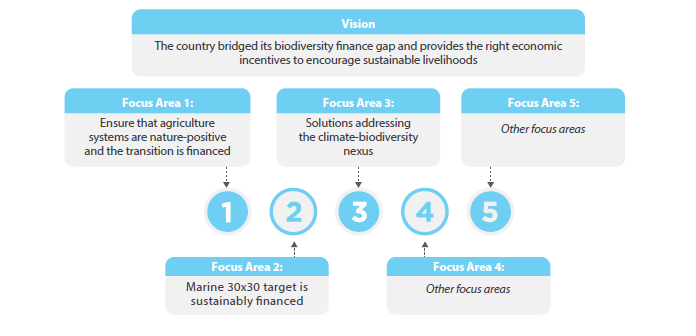
A shared vision and articulated focus areas are defined to create a BFP that addresses specific national needs and challenges.
- Vision: This represents the broadest aspiration for addressing biodiversity finance, striving to be transformative, ambitious, inclusive, and sufficient to address the country’s biodiversity finance gap.
- Focus areas: These reflect the major targets of the NBSAP, significant funding needs (from the FNA), and the primary drivers of loss or gain (from the PIR). Examples include focusing on Protected Areas, Ecosystem Restoration, Sustainable Utilization (South Africa), or addressing drivers of loss stemming from food systems.
Step 3 — Compile the long list of finance solutions
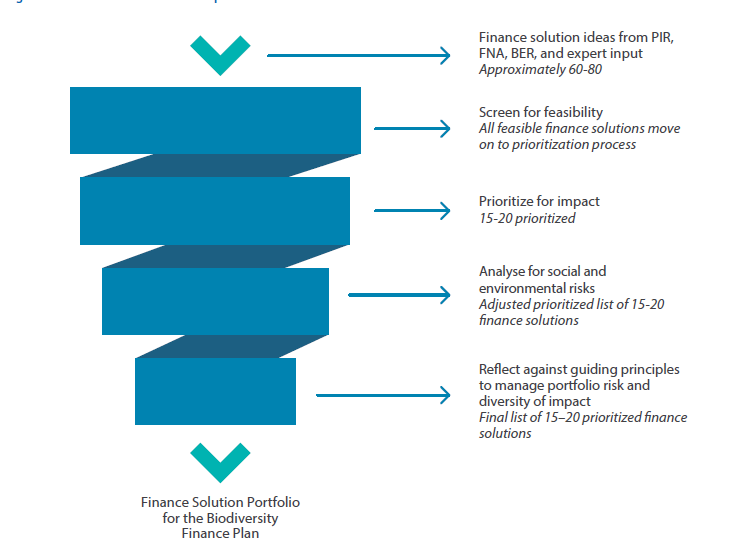
An initial comprehensive list of finance solutions is compiled, drawing from recommendations in the PIR, BER, and FNA, complemented by new ideas, potentially sourced from the BIOFIN Catalogue of Finance Solutions. This list typically includes around 60 to 80 potential solutions.
Six guiding principles for a diverse and transformative list
- Finance, policy, and institutional outcomes Positive for biodiversity, covering all four BIOFIN finance results (deliver better, realign expenditures, avoid future expenditures, generate revenues).
- A good mix of sectors and actors Private, financial, and public sector solutions across different sectors and tiers of government to increase resilience to external shocks.
- A mix of time horizons Short-, medium-, and long-term actions.
- Address the main drivers of loss Identified in the PIR, including repurposing harmful incentives.
- Address the main NBSAP targets Especially those with the highest financial needs (from the FNA).
- Align with sustainable development goals and ideals Including co-benefits for vulnerable groups, gender equality, Indigenous Peoples, and climate change.
Step 4 — Screen and prioritize finance solutions
The long list is narrowed down through a structured process involving screening for feasibility and prioritization based on expected impact.
1. Screening for feasibility
Solutions are scored based on their likelihood of success (political support, capacity for implementation, and suitability for the country’s economic context). Solutions scoring too low are excluded or redesigned.
2. Prioritization for impact
The screened solutions are scored based on five impact criteria (each scored 0–8 points):
Biodiversity impact
Magnitude and long-term sustainability of the positive impact.
Finance result
Potential to save, generate, leverage, or realign a substantial amount of financial resources.
Transformed institutions
Potential to create sustained institutional change, for example creating a dedicated biodiversity finance unit.
Transformed policy
Potential to create positive formal policy or legislative change.
Social and environmental co-benefits
Positive impact on vulnerable groups, gender equality, Indigenous Peoples and Local Communities, or climate change.
3. Risk analysis and review
The resulting list of 15–20 prioritized solutions undergoes a risk screening, assessing social and environmental risks and mitigation measures (drawing on procedures like UNDP’s Social and Environmental Screening Procedure). The final portfolio is reviewed against the guiding principles to ensure diversification and managed risk.
Step 5 — Develop technical proposals for prioritized finance solutions
Initial technical designs for the prioritized solutions are developed.
- Content: Each proposal must define core elements, justification, expected financial results, sequencing, risks, and mitigation measures.
- Key sections: Proposals include a solution summary, a detailed description (outcomes, stakeholders, financial instruments involved), advocacy messages, analysis of enabling conditions, market demand (for market-based solutions), capacity requirements, schedule, cost projections, and a monitoring and evaluation (M&E) plan.
- Investment case: A rationale for investment is set out, adapted for different audiences (government, private sector, development partners), including both economic and social arguments, and potentially using Benefit-Cost Analysis (BCA).
Step 6 — Draft and validate the Biodiversity Finance Plan
The final BFP is drafted, validated, and formally endorsed, preferably through a government order.
- Structure: The final document includes the Executive Summary, the Vision and Focus Areas, the Portfolio of Finance Solutions, and a detailed Action Plan.
- Annexes: Detailed technical proposals for each finance solution, the Overall Action Plan and Budget, a Resource Mobilization Strategy (if significant gaps exist), and a summary of the BFP Design Process are included as annexes. The Action Plan should detail the responsible organization, necessary institutional changes, time frame, and required budget for each action.