
3.1 Objectives and definition of a PIR
The PIR is a widely used systems analysis tool employed to assess the strengths, weaknesses, adequacy, and functionality of existing policies and institutional frameworks within a sector. For BIOFIN, the PIR specifically analyses the relationship between the state of nature and a country’s fiscal, economic, legal, policy, and institutional framework.
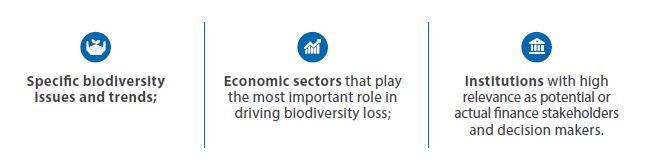
The objectives of the PIR are to identify
- An improved understanding of how biodiversity and ecosystem services support national sustainable development goals and visions.
- A comprehension of key policy and institutional drivers of biodiversity change.
- A first-time catalogue of existing biodiversity finance mechanisms, incentives, subsidies, and other instruments, including sources of biodiversity revenues.
- A preliminary selection of finance solutions for early implementation.
The PIR is essential for understanding the complexity of drivers of biodiversity loss and their connection to finance flows, as nature interacts with numerous economic sectors. The goal is to gather diverse background information to establish the baseline for the remainder of the BIOFIN Process.
3.2 Summary of PIR steps (Steps 1–7)
- Prepare Establish the team, define the scope, develop a consultation plan, and identify information sources.
- Review national biodiversity strategies, sustainable development strategies, and linkages between them Analysing the NBSAP, understanding biodiversity’s role in broader planning, and collecting existing evidence of nature’s economic value.
- Identify important trends and drivers for biodiversity change Determine the main positive and negative trends in biodiversity, and identify their underlying drivers and levers of change, often through root cause analysis.
- Review the current state of biodiversity finance Map existing finance instruments and related legislation, review the national budgeting process, map biodiversity-related revenues, and analyse existing positive or harmful incentives.
- Analyse main institutions Identify and analyse the main institutions and organizations involved in biodiversity finance, scoring them based on their interest and influence to develop a stakeholder engagement plan.
- Carry out an initial selection of finance solutions Select new and existing finance solutions for early implementation.
- Draft a summary and recommendations Present main findings and detailed, actionable policy and institutional recommendations.
3.3 Key steps in detail
Step 2 — Review national strategies and linkages
The NBSAP is the foremost document reviewed, as it serves as the basis for costing in the Financial Needs Assessment and formulating the Biodiversity Finance Plan. The PIR assesses the NBSAP’s formal status, institutional arrangements, and alignment with the Convention on Biological Diversity (CBD) framework. It is also critical to review how biodiversity and ecosystem services are integrated into national development planning and sectoral plans (for example tourism, water). Additionally, the PIR takes stock of existing economic valuation studies to explain why investing in biodiversity is vital for sustainable economic growth and decision-making.
Step 3 — Identify drivers of change
The PIR identifies both positive and negative trends in biodiversity to guide the selection of finance solutions. Root cause analysis — such as the “Five Whys Method” or the Driver-Pressure-State-Impact-Response (DPSIR) Framework — is used to identify the underlying economic and financial drivers of these trends, ensuring resources are spent addressing root causes rather than just symptoms.
Step 4 — Review current state of biodiversity finance
This step creates a comprehensive background context of the finance landscape.
Finance instruments
Existing financial instruments, policies, and laws are mapped and inventoried, covering regulatory, market, fiscal, grant, debt/equity, and risk-related tools.
National budgeting
The PIR maps and analyses the national and subnational budgeting process (preparation, approval, execution, auditing) to understand when and by whom budget decisions are made.
Biodiversity-related revenue
Public revenues (tax and non-tax, such as fees, licenses, and charges) generated from the use of nature assets — their sources, volume, and whether they are officially earmarked for conservation.
Harmful incentives and subsidies
Mapping and screening subsidies that may have unintended negative and costly effects on biodiversity, to identify and prioritize politically viable subsidies for redesign or elimination.
Step 5 — Analyse main institutions
Institutions identified in previous steps are analysed to summarize their role and function in biodiversity finance. A power and interest matrix is used to score organizations based on their ability to influence outcomes and their interest in biodiversity, helping to prioritize engagement with “Close Engagement” institutions.
Step 6 — Select finance solutions for early implementation
The PIR conducts an initial selection of finance instruments with the most promising and realistic short-term results (financial, policy, or institutional) or those addressing an urgent need. Solutions are pre-selected based on three criteria:
- High feasibility or short-term opportunity/need;
- Available budget for implementation; and
- The ability to achieve a finance or policy result in 1–2 years.
These are then ranked by their expected impact on biodiversity. Solutions can either be newly identified or existing solutions that may be improved upon.
Step 7 — Summary and recommendations
The final step is preparing a summary report that presents main findings and detailed, actionable policy and institutional recommendations, citing legislation, policies, and responsible organizations. The analysis and report should be validated and approved through consultations with stakeholders and published for widespread access. A policy brief is recommended to better communicate main conclusions and recommendations. The PIR is used as a background assessment for the other BIOFIN assessments and the Biodiversity Finance Plan.