
5.1 Objectives of the FNA
The core objective of the FNA is to obtain a comprehensive and detailed estimate of the financial resources needed to achieve national or subnational biodiversity targets, particularly in the context of the Kunming-Montreal Global Biodiversity Framework.
This approach is considered bottom-up, starting from zero and building a costing estimate for all necessary human resources, capital investments, and financial needs. The intent is not merely to budget based on available funds, but to identify the realistic resources required for effective delivery of conservation goals (“aspirational”).
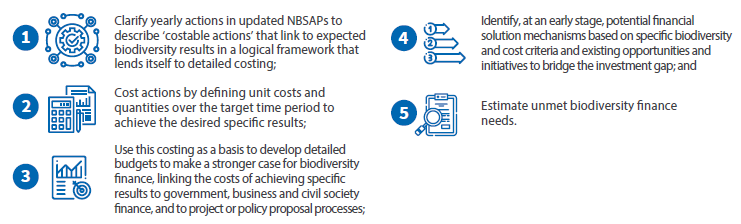
In many countries, environmental budgets are vague and lack strong justification, lessening their ability to garner support from ministries of finance and other budgetary decision makers. This has especially been the case traditionally with NBSAPs — most of which never included detailed budgets, and as a result, finance for NBSAPs was rarely adequate. The CBD has encouraged countries to apply an FNA type approach to develop a detailed and realistic budget for their NBSAPs for precisely this reason.
5.2 The FNA process and links to other chapters
The FNA process is designed to be participatory, involving key partners such as the ministries of environment and finance, and central planning agencies.
Policy alignment
The FNA must be compatible with national planning and budgeting practices identified in the Policy and Institutional Review (PIR).
Baseline comparison
The results of the FNA are compared against future expenditure projections derived from the Biodiversity Expenditure Review (BER) to estimate the financing gap.
Informing solutions
This assessment guides the prioritization and development of the Biodiversity Finance Plan (BFP), helping to select sound finance solutions.
5.3 Principles and methods for costing
The FNA focuses on direct financial costs rather than the broader economic definition of costs, although BIOFIN encourages using cost-benefit analysis to build the investment case. Key principles for the FNA include being comprehensive, accurate, detailed, prioritized, and aligned with national budgeting practices.
Various costing approaches can be used, often in combination, though incremental budgeting (based on the previous year’s budget) is discouraged.
- Historical projections Uses known detailed historical costs (for example, replanting a hectare of mangroves) to estimate future costs, adjusted for inflation and scale.
- Cost modelling Uses quantitative models to estimate future costs, potentially transferring cost coefficients from similar situations elsewhere. This approach can be complex but is useful when independent costing is lacking.
- Activity-based costing Estimates budgets based on specific programs and activities, tying administrative overheads directly to those activities.
- Results-based costing (RBC) BIOFIN recommends using RBC (or elements thereof), where costs are associated with specific medium- to long-term results (outcomes) rather than just activities (outputs). This aligns with performance-based budgeting increasingly adopted globally.
To ensure accuracy, the costing should utilize a catalogue of unit costs (for example, human resources, infrastructure, equipment) that is based on government or business norms.
5.4 Summary of the six steps of an FNA
- Prepare Establish the team, define roles, and establish a consultation plan.
- Scope and clarify biodiversity targets, results, strategies, and actions Translate strategies (like the NBSAP) into a logical framework of clear, quantifiable “costable actions.” This requires defining specific results (for example, “decrease poaching incidents of elephants by 30 percent”).
- Conduct a desktop study and prepare initial costing tables Identify budget units and standard costs (for example, government salary scales) to build detailed cost tables, separating recurring and capital expenditures.
- Refine costs with expert input Use expert consultations and workshops to test and validate cost assumptions and conduct a tagging exercise to link actions to categories (for example, sectors, GBF targets, SDGs).
- Analyze costing results Summarize and analyse multi-annual cost statements by targets, sectors, and actors. This includes comparing costs relative to biodiversity priorities to identify the most cost-effective actions.
- Estimate unmet biodiversity finance needs Compare the detailed costing statements (needs) with projected future expenditures (availability) from the BER to assess unmet finance needs.
Caution — the BER and the FNA are not directly comparable
The BER captures overall spending (including secondary expenditures and routine management) while the FNA typically costs incremental actions and desired outcomes. These discrepancies require careful reconciliation.
| Strategy 1 — FNA reflects unmet needs | Strategy 2 — FNA-based | Strategy 3 — BER-based |
|---|---|---|
| Avoid comparison altogether (not recommended). | Make one-on-one comparisons for specific activities in the FNA (recommended). | Reduce the BER results to only those well-captured in the FNA (recommended only if BER data are of high quality). |
Outputs and recommendations
The main end-product of the FNA is a well-documented and argued, prioritized, fully costed budget for achieving the country’s biodiversity targets. The main outputs of the FNA are a written report and a spreadsheet with all the detailed budget information (cost sheets or statements) and analyses. Clear and well-supported recommendations are essential to moving the analysis from an analytical report to a useful document. Potential recommendations include:
- Better inclusion of biodiversity targets and results in national policies and planning (both sectoral and national);
- Institutionalizing the tools and analyses of this approach in environment sector budgeting including future NBSAP elaboration;
- Adopting approaches tying existing and proposed finance solutions to specific targets, organizations, and results;
- Integrating the results from the FNA into the regular national budget planning cycle.
The FNA findings are crucial for identifying potential finance solutions for early implementation (before the BFP is finalized) and for providing recommendations on how to integrate costing elements into official financial planning and budgeting frameworks.