


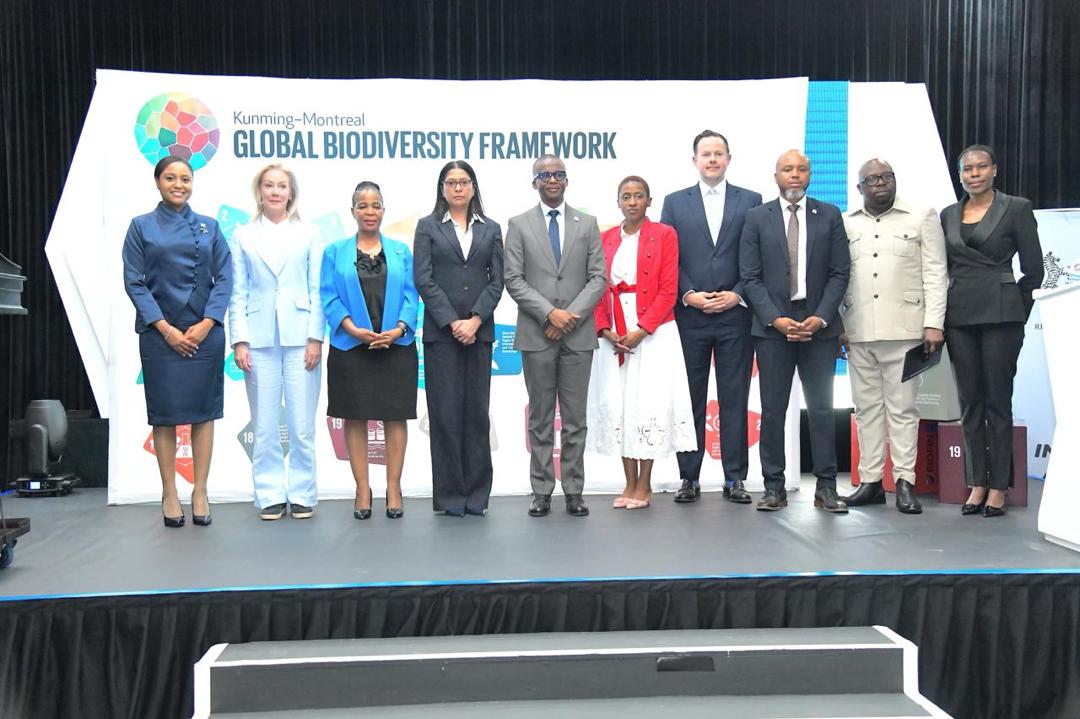
Botswana has established a Green Finance Mainstreaming Working Group to help integrate nature and climate considerations into the country’s financial policies, regulations and everyday market practices.
The Working Group will bring together government institutions, financial regulators and other key stakeholders. Its first task will be to support the Mainstreaming Biodiversity Finance in Botswana’s Financial Sector initiative, led by the Bank of Botswana, the Ministry of Finance and the Ministry of Environment and Tourism. The initiative is backed by the Global Environment Facility and implemented with UNDP through the Biodiversity Finance Initiative (UNDP BIOFIN).
The announcement was made by Botswana’s Vice President and Minister of Finance, Ndaba Nkosinathi Gaolathe, during a sustainable finance dialogue with regulators, chief financial officers, banks, investors, insurers, businesses and development partners in Gaborone on 27 August 2026.
The Working Group will examine where regulations need to be strengthened, where financial institutions require clearer guidance, and where gaps in data and institutional capacity need to be addressed. It will also explore opportunities to develop new financial products and markets.
“Nature and climate can no longer sit at the edge of that conversation. They belong at the centre of it,” the Vice President said.
Why nature is a financial issue
Botswana’s economy depends substantially on natural resources and the ecosystem services they provide.
Tourism relies on healthy wildlife and landscapes. Agriculture depends on water, living soils and productive land. Mining, infrastructure and industry require reliable access to water, energy, land and other natural resources.
When these natural systems come under pressure, the consequences extend beyond the environment. For businesses, nature loss, water scarcity and climate change can result in higher costs, disrupted production, damaged supply chains and weaker revenues. For banks, these pressures can increase credit risk and reduce the value of collateral, while insurers may face growing claims.
“These used to sound like environmental issues. They are financial issues now,” the Vice President said.
This connection makes financial leaders central to Botswana’s response. Decisions made by chief financial officers, banks, investors and regulators determine which projects receive funding, how risks are reflected in financial models and where capital is deployed.
In her remarks, UNDP Botswana Resident Representative Lovita Ramguttee emphasized that nature and climate considerations must increasingly move from sustainability teams into risk registers, investment appraisal, financial planning and board-level decision-making.
The work forms part of Botswana’s wider economic transformation agenda, including Vision 2036, National Development Plan 12, the Botswana Economic Transformation Programme and the Botswana Sustainable Financing Strategy.
Developing a Botswana Green Taxonomy
One of the principal outputs expected from this work is a Botswana Green Taxonomy—a shared classification system defining which economic activities can credibly be considered environmentally sustainable.
A taxonomy can give businesses clearer guidance when designing projects and seeking green finance. It can help banks develop lending products, support investors in allocating capital and provide regulators with a consistent basis for assessing sustainable economic activities.
For the Government, it can also help determine whether financial flows are contributing to Botswana’s national environmental and development objectives.
The taxonomy will be designed around Botswana’s economy and priorities while taking regional and international approaches into account. Its purpose will extend beyond classification: it is expected to help build a pipeline of credible and investable projects capable of attracting domestic and international capital.
Building markets that benefit Botswana
Botswana is also developing the policy and institutional foundations needed to participate in high-integrity carbon markets and explore other market-based approaches.
These markets could create additional channels for private investment in conservation, ecosystem restoration, sustainable land management and climate-positive activities. However, the Government has emphasized that participation must be environmentally credible, aligned with national interests and accompanied by transparent benefit-sharing.
Communities living alongside and managing Botswana’s landscapes must share in the value generated from the country’s natural capital. Achieving this will require clear rules, strong institutions, credible monitoring and effective safeguards.
Public resources alone will not be sufficient to finance Botswana’s green economic transformation. Banks, pension funds, insurers, businesses, development finance institutions and international investors will all have a role in turning sustainable opportunities into investments that are environmentally credible, commercially viable and capable of reaching scale.
Through UNDP BIOFIN, UNDP will continue supporting national institutions to understand how nature-related dependencies and risks affect businesses and financial institutions and to develop appropriate policy, regulatory and financial responses.
“Our objective is not to add another layer of reporting or compliance,” Ramguttee said. “It is to help build a financial system that is better able to anticipate risk, identify opportunity and finance Botswana’s long-term economic transformation.”
Watch the video
Why are Botswana’s rivers, wildlife, soils and water resources becoming financial issues? This video by SnapFlash examines the links between the country’s natural capital, financial risks and economic transformation.