Knowledge base

Browse the Knowledge Platform

636 Results
Publications
Publications

In this executive summary, BIOFIN Mexico compiles the results of Phase I of the project, as well as the finance solutions for biodiversity that the initiative will be implementing during Phase II. 

Publications

Sri Lankan FNA estimated the additional financial requirement (assuming that the government will maintain its current level of investments for the next six years) to implement four national level action plans (including NBSAP) which contained biodiversity related outputs. Altogether Sri Lanka needs approximately 31 Billion LKR (190 million USD) within next seven years.

Publications

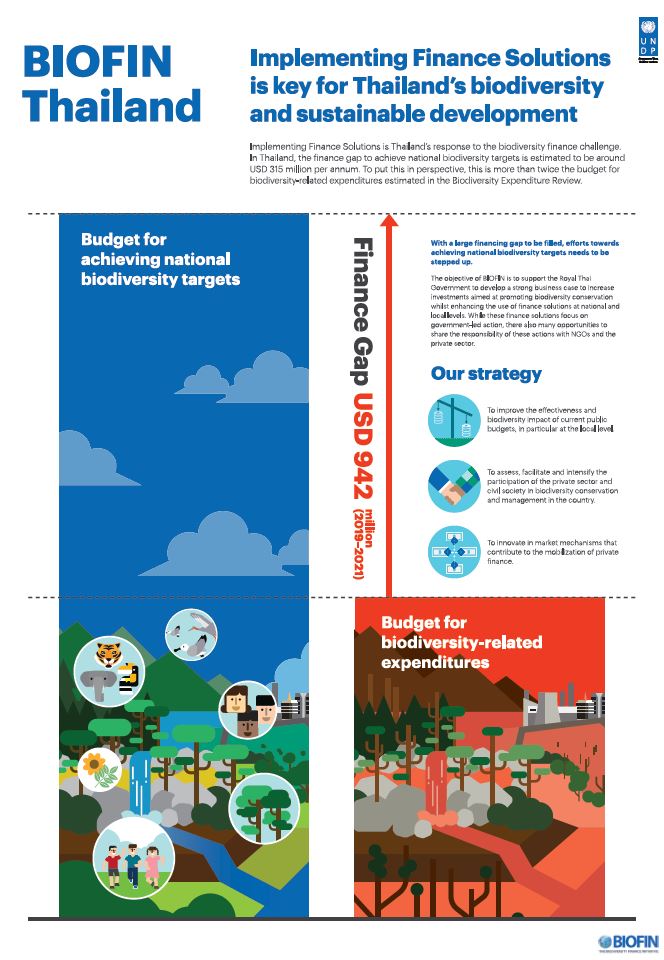
Following the BIOFIN methodology, the Biodiversity Financial Needs Assessment (FNA) aims to make a comprehensive estimate of the financial resources required to achieve national biodiversity targets. This FNA builds on the findings of Thailand’s BER, which showed that the main domestic source of biodiversity funding in Thailand is from the government’s budget allocation, which mostly pays for the operations of the core environmental agencies. The total expenditure for the core agencies accounted for around 80 percent of the overall biodiversity related budget in 2015. The finance gap as the difference between the BAU budget allocation scenario and the required budget to execute the actions in the target areas amounts to $942 million (THB 31,978 million) for the remaining three-year period of the current NBSAP (2019-2021).

Publications

This report presents the results of the integration of public and private expenditure on climate change over the period 2014-2017, both constitute the total climate financing for Guatemala. The objective of this report is to create relevant information for decision making and the allocation of resources by public and private actors in order to align expenses to an efficient prioritization according to the environment status and the defined sectorial goals. The National Action Plan on Climate Change was used to guide and organize the information. The results showed that the main executing institutions of the expenditure are: five public institutions (MARN, MAGA, CONAP, INAB, CONRED) and two private sector components (international cooperation and private sector). The most important source of financing for climate change comes from loans from the national financial sector to the private sector (Q 4,220.91 million). The second source corresponds to external loans to the private sector (Q 4,206.36 million), followed by the private sector’s resources (Q 3,687.58 million). The fourth source comes from the public sectors and from the current income, particularly from taxes collection (Q 1,830.79 million); The fifth source of financing is made up of external donations from the international cooperation (Q 969.71 million). The national expenditure on climate change for the period 2014-2017 is equivalent to Q 15,661.67 million, 84% of this amount was allocated to mitigation actions and the remaining 16% was allocated to adaptation actions. By relating this information with the GDP, the total national expenditure on climate change remains on 0.77% of GDP. Finally, the report also identifies that measurement of private expenditure on climate change presents greater methodological and institutional challenges than the measurement of public expenditure. 

Publications

Le Programme des Nations unies pour le développement (PNUD), l’Union internationale pour

la conservation de la nature (UICN), la Commission mondiale des aires protégées (UICN/CMAP)

et WildArk sont heureux de déclarer ouvert le dépôt de candidatures et les nominations pour la

première édition du prix Pathfinder. Ce prix sera remis chaque année, et il se concentre sur des

thèmes liés aux aires protégées et conservées.

Knowledge Partners

Biodiversity and Ecosystem Services Network logo
Biodiversity finance resources library and forum.
Sustainable Development Finance Platform logo
Guidance and detailed descriptions of finance solutions for sustainable development.

NBSAP logo
Support for action on National Biodiversity Strategy and Action Plans