Knowledge base

Browse the Knowledge Platform

649 Results
Publications


This report aims at identifying the required financing needs for the implementation of the Medium-term Action Plan /hereafter referred to as medium-term plan/ of the National Biodiversity Program (NBP) Mongolia. The financing needs have been defined by the identified activities, yearly needs and by NBP strategic areas. The financing gap for the implementation of the medium-term plan is estimated at 136.6 million MNT or 51.8 million USD.

It was estimated that 74.7-84.3% of the total required funding of the strategic areas #1 and #2 are deficient, which amounts to 95.7% of the total NBP financing gap. In contrast, the financing gap for strategic areas #3 and #4 is relatively small. Nevertheless, funding the financing gaps of the strategic areas 3 and 4 should be prioritized by establishing the legal frameworks for economic incentives and ecosystem payments. It would further rationalize the use and conservation by increasing private sector participation and find solutions for future financing needs and/or reducing the future costs from environmental damages and degradation. The relevant data from six ministries and one government agency, which was used for this report, were collected through the Ministry of Environment and Tourism (MET), whereas the data from international organizations were collected through the respective project coordinators. An official letter, signed by the State Secretary of MET, requesting the implementation status of the medium-term plan during 2016-2018, and the planned activities for 2019-2021 was sent to the six ministries, GASI, NSO, and MOF on 9 March 2019.

As of 1 May 2019, a response was received from the MCUD, MOE, and MMHI, however, these ministries notified that they did not receive any official information regarding measures/activities of the medium-term plan that they should be in charge of. Therefore, no expenditures occurred, or no funding was budgeted for the NBP activities. A response from the ministries other than MET was not received, and the 2020 Fiscal Framework has not been formally approved; thus, related information was not included in this report. The assessment of data and information on 9 donor projects and 36 projects funded by international organizations was carried out. The report included information on 25 projects that are relevant to the respective goals of the program.

Publications

Mongolia’s Biodiversity Finance Plan (BFP) outlines a comprehensive strategy to secure sustainable financing for the conservation and sustainable use of biodiversity, recognizing ecosystem services as essential and irreplaceable for human well-being.

Developed under the United Nations Development Programme’s BIOFIN Initiative, the plan builds on Mongolia’s long-standing commitment to the Convention on Biological Diversity, including the National Program on Biodiversity and its alignment with global targets such as the Aichi Biodiversity Targets.

The BFP assesses current biodiversity status, financing gaps, and future needs, and proposes practical solutions to mobilize resources. It emphasizes strengthening institutional frameworks, improving cost-efficiency, reforming harmful subsidies, and leveraging both domestic and international funding sources.

Structured across four sections, the plan provides a roadmap for addressing biodiversity pressures, scaling up financing, and ensuring effective implementation of Mongolia’s national biodiversity priorities in the face of fiscal constraints.

Publications

The result of applying the BIOFIN approach in Belize is The Biodiversity Finance Plan (BFP) presented here as the fourth output of BIOFIN Phase 1. The Plan proposes a suite of biodiversity finance solutions, which are capable of raising the financial and other resources required to achieve the country’s biodiversity targets in accordance with the activities of the National Biodiversity Strategy
and Action Plan (NBSAP), the long-term development strategy Horizon 2030, and the Sustainable Development Goals (SDGs). Belize acknowledges the urgency of effecting the finance plan given the reality that its economic stability strongly links to the conservation of its biological resources.
 

Publications

The Policy and Institutional Review has provided an important snapshot into the current policy, institutional, and finance landscape for biodiversity finance in Belize. The introduction and implementation of the BIOFIN in Belize, in and of itself, has raised the profile of biodiversity finance in Belize.
 

Publications

The Financial Needs Assessment (FNA) is the third output of BIOFIN, that assists in estimating the funds required to achieve the biodiversity targets of the country in accordance with the activities of the National Biodiversity Strategy and Action Plan (NBSAP). It aims to assist policy makers in understanding the total cost implications for implementing each NBSAP activity and aggregates the total cost for all strategies and actions within Belize's NBSAP
 

Publications

The Biodiversity Expenditure Review contains detailed data on public, private, and civil society biodiversity expenditures data. The BER engaged in assessing the expenditure status of investments pertinent to biodiversity conservation and environmental management throughout the period of 2012 – 2017.The overarching primary sectors and most pertinent agencies were identified and selected from
the Policy and Institutional Review’s prioritization “power and interest” matrix to undergo BIOFIN expenditure assessment. The BER focused its assessment on the key sectors and agencies which contribute both directly and/or indirectly to biodiversity conservation in Belize. 
 

Publications

This report compiles the findings from three assessments conducted as part of the national Biodiversity Finance Initiative (BIOFIN) process. The three assessments discussed include the policy and institutional review (PIR), the budget and expenditure review (BER), and the financial needs assessment (FNA). The PIR analyzes the policy and institutional context, identifies the biodiversity targets to be achieved, and lays out the context for the intended change in financing. The BER analyzes public and private expenditures for biodiversity and establishes past and projected expenditures on biodiversity. The FNA provides an estimation of the financing required to achieve identified biodiversity targets.

The FNA also assesses the financing gap between the status quo of projected expenses and the estimated budget to meet biodiversity goals. Findings from these three assessments feed into the formulation of the country’s Biodiversity Finance Plan (BFP) and are used to develop prioritized finance solutions that are then taken into the implementation phase of the BIOFIN process.

BIOFIN Thailand assesses the policy and institutional context by classifying biodiversity resources into four ecological functions. The latter are terrestrial, marine and coastal, wetlands, and urban ecosystems. The PIR finds that the key document that sets national goals for biodiversity is the National Biodiversity Strategy and Action Plan (NBSAP). In addition to this, key policy documents include the Ministry of Natural Resources and Environment (MONRE)’s 20-Year Strategic Plan (2017 – 2036), and the strategic and action plans of important line agencies.

These policy documents are set within the context of national development policies, which are the 20-Year National Strategy (2018 – 2037) and the five-year National Economic and Social Development Plan (NESDP). For biodiversity, key implementing agencies are all within MONRE. Three agencies are especially important. They are the Royal Forest Department (RFD), the Department of National Parks, Wildlife, and Plant Conservation (DNP), and the Department of Marine and Coastal Resources (DMCR). Of these three, RFD and DNP are responsible for the terrestrial ecosystem while the DMCR’s mandate is with regards to marine and coastal ecosystems. There are no designated agencies that are directly responsible for wetlands and urban ecosystems. Biodiversity in these two ecosystems are overseen by a wide range of agencies. Nonetheless, given the number of projects and activities related to wetlands in the NBSAP, it can be said that the wetlands ecosystem is given much importance. While the majority of institutions working on biodiversity in Thailand are government agencies, non-profit organizations and some from the private sector have also contributed to biodiversity efforts. 

Publications

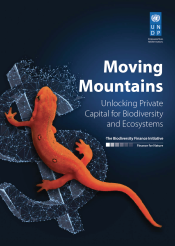
This supplementary guidance document to the Biodiversity Finance Initiative (BIOFIN) 2018 Workbook aims to enhance public and private collaboration to unlock private capital for biodiversity and ecosystems. It is targeted towards biodiversity finance practitioners, financial institutions, conservation agencies, and private sector investors. It is BIOFIN’s ambition that it will assist them to find creative and appropriate private sector finance solutions for conserving biodiversity and ecosystems and, in doing, contribute to a growing global movement that is pushing the boundaries of private investment in conservation and monitoring closely the benefits, risks and accountabilities of this.

Knowledge Partners

Biodiversity and Ecosystem Services Network logo
Biodiversity finance resources library and forum.
Sustainable Development Finance Platform logo
Guidance and detailed descriptions of finance solutions for sustainable development.
NBSAP logo
Support for action on National Biodiversity Strategy and Action Plans