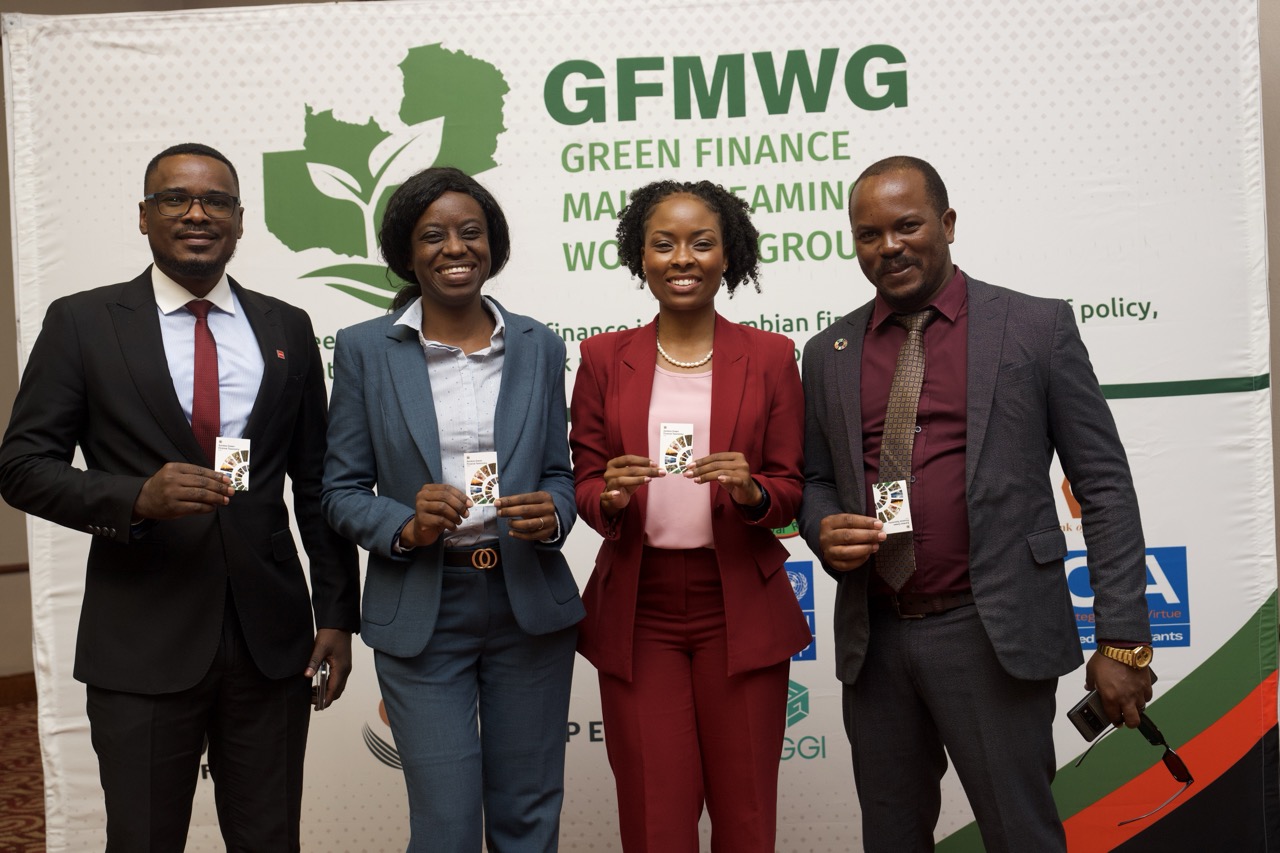
Lusaka, Zambia — 2nd December 2025 - Zambia has reached a major milestone in its transition toward a green and climate-resilient economy with the official launch of the Zambia Green Finance Taxonomy (ZGFT), a landmark national framework that provides clear, science-based criteria for identifying environmentally sustainable economic activities. With this achievement, Zambia becomes one of the few countries in Africa and globally, to establish a national green finance taxonomy, placing the country at the forefront of sustainable finance leadership.

Developed under the Green Finance Mainstreaming Working Group, with active participation from the country’s financial regulators and key ministries, the taxonomy was technically led by UNDP’s Biodiversity Finance Initiative (BIOFIN) Zambia. Work began in February 2024 and has since undergone extensive consultation and refinement to ensure strong national ownership.
Why BIOFIN Zambia Prioritised the Taxonomy as a Workstream
BIOFIN and other stakeholders thorough Zambia’s Biodiversity Finance Plan identified the taxonomy as a critical workstream because Zambia previously lacked a nationally accepted definition or classification system for what qualifies as “green.” This gap made it difficult for the financial sector to assess the environmental sustainability of investments, contributed to inconsistent practices, and limited the credibility of emerging green finance instruments.
As BIOFIN Zambia advanced work on green bonds and other innovative financing solutions, it became clear that a taxonomy was a foundational tool to ensure environmental integrity, comparability, and transparency. A strong classification system provides:
- A clear benchmark for evaluating green projects
- A standard reference for regulators, issuers, and investors
- Reduced risk of greenwashing
- Better alignment with global norms
- A platform for scaling nature and climate finance across sectors
By supporting the taxonomy’s development, BIOFIN helped Zambia is laying the enabling foundation required to further unlock green bonds, green loans, and other biodiversity-positive and innovative market instruments.
Government and UNDP Highlight Taxonomy as a Catalyst for Credible, Aligned, and Scalable Green Investments
During the launch, Permanent Secretary Dr. Douty Chimbamba, speaking on behalf of the Minister of Green Economy and Environment, emphasized the increasing demand for transparency and authenticity in sustainable finance. He stated:
“Investors around the world and within our borders are increasingly demanding clarity, consistency, and credibility in sustainability-linked investments. The Zambia Green Finance Taxonomy provides this clarity. It equips our financial system with a standardized framework for identifying and classifying environmentally sustainable economic activities—helping investors, regulators, and financial institutions make informed, transparent, and responsible decisions.”
The taxonomy’s introduction comes at a critical moment for Zambia, as the country seeks to mobilize significant resources to implement its major national strategies. Delivering remarks on behalf of the UNDP Zambia Resident Representative, the UNDP Deputy Resident Representative highlighted that Zambia will require more than USD 42 billion by 2030 to effectively deliver the 8th National Development Plan, the Zambia Green Growth Strategy, the National Biodiversity Strategy and Action Plan, the Nationally Determined Contributions (NDCs), the National Adaptation Plan, and other nature- and climate-related frameworks. He emphasized that the taxonomy will be instrumental in directing green capital to priority national programs and accelerating implementation of these strategic blueprints.
Eight Priority Sectors Form the Backbone of the Taxonomy
The ZGFT’s design directly supports this ambition by establishing standardized criteria across eight priority sectors central to Zambia’s environmental and economic transformation, including 1. Agriculture, 2. Energy and Energy Efficiency, 3. Forestry, 4. Mining, 5. Tourism, 6. Transportation, 7. Waste, and 8. Water.
These sectors were selected for their strategic importance in driving green growth, reducing emissions, protecting biodiversity, and strengthening climate resilience, and were aligned to national policies and strategies.
How Biodiversity is Mainstreamed in the Taxonomy
Unlike in other taxonomies, biodiversity is not treated as a peripheral component, it is embedded throughout the taxonomy’s structure.
Across the taxonomy, Do-No-Significant-Harm (DNSH) criteria explicitly safeguard biodiversity, ecosystems, and natural habitats. For example, the DNSH conditions for climate mitigation and adaptation activities require:
- Avoidance of activities that degrade habitats or ecosystems
- Prevention of harm to ecosystem integrity, protected areas, and key biodiversity hotspots
- Demonstrated alignment with environmental impact assessment requirements and national biodiversity legislation
In addition, the taxonomy contains a dedicated environmental objective on Biodiversity, Ecosystem Protection, and Restoration, outlining expected performance and behavioural requirements for nature-positive activity design. While the substantial contribution criteria for this objective will be further developed in subsequent phases, the biodiversity safeguards already ensure that all taxonomy-aligned investments must respect and protect ecosystems.
This is particularly important for Zambia, where biodiversity underpins rural livelihoods, climate resilience, water systems, and economic sectors such as tourism and agriculture.
Unlocking Green Finance and Catalyzing Market Innovation
A core strength of the taxonomy is its seamless complementarity with other financing solutions developed under BIOFIN Zambia’s portfolio, particularly green bonds, and green loans, etc. Together, these tools form a cohesive architecture for unlocking and scaling green finance in the country. The taxonomy now serves as the foundation for this ecosystem, such that:
- Issuers of green bonds and green loans can use the ZGFT to structure credible, taxonomy-aligned projects.
- Financial institutions can assess eligibility and reduce exposure to greenwashing.
- Regulators gain a standardized reference point for evaluating sustainable finance products.
- Project developers can craft well-aligned proposals that meet investor expectations.
- Government ministries may use the taxonomy to harmonize policy, investment criteria, and implementation priorities across sectors.
By improving transparency and comparability in Zambia’s sustainable finance market, the taxonomy is expected to catalyze significant investment into renewable energy, sustainable agriculture, forestry and landscape restoration, responsible mining, climate-smart tourism, low-carbon transport, circular economy innovations, and improved waste and water systems.
More broadly, the launch of the Zambia Green Finance Taxonomy represents a strategic turning point, strengthening the country’s ability to attract climate and nature finance, reducing greenwashing risks, and positioning Zambia as an emerging regional leader in sustainable finance.
The Zambia Green Finance Taxonomy can be accessed here: https://www.mgee.gov.zm/?page_id=7004
Categories
Archives
- janvier 2024 (3)
- décembre 2023 (1)
- novembre 2023 (7)
- octobre 2023 (5)
- septembre 2023 (2)
- août 2023 (2)
- juillet 2023 (1)
- juin 2023 (1)
- mai 2023 (45)
- avril 2023 (1)