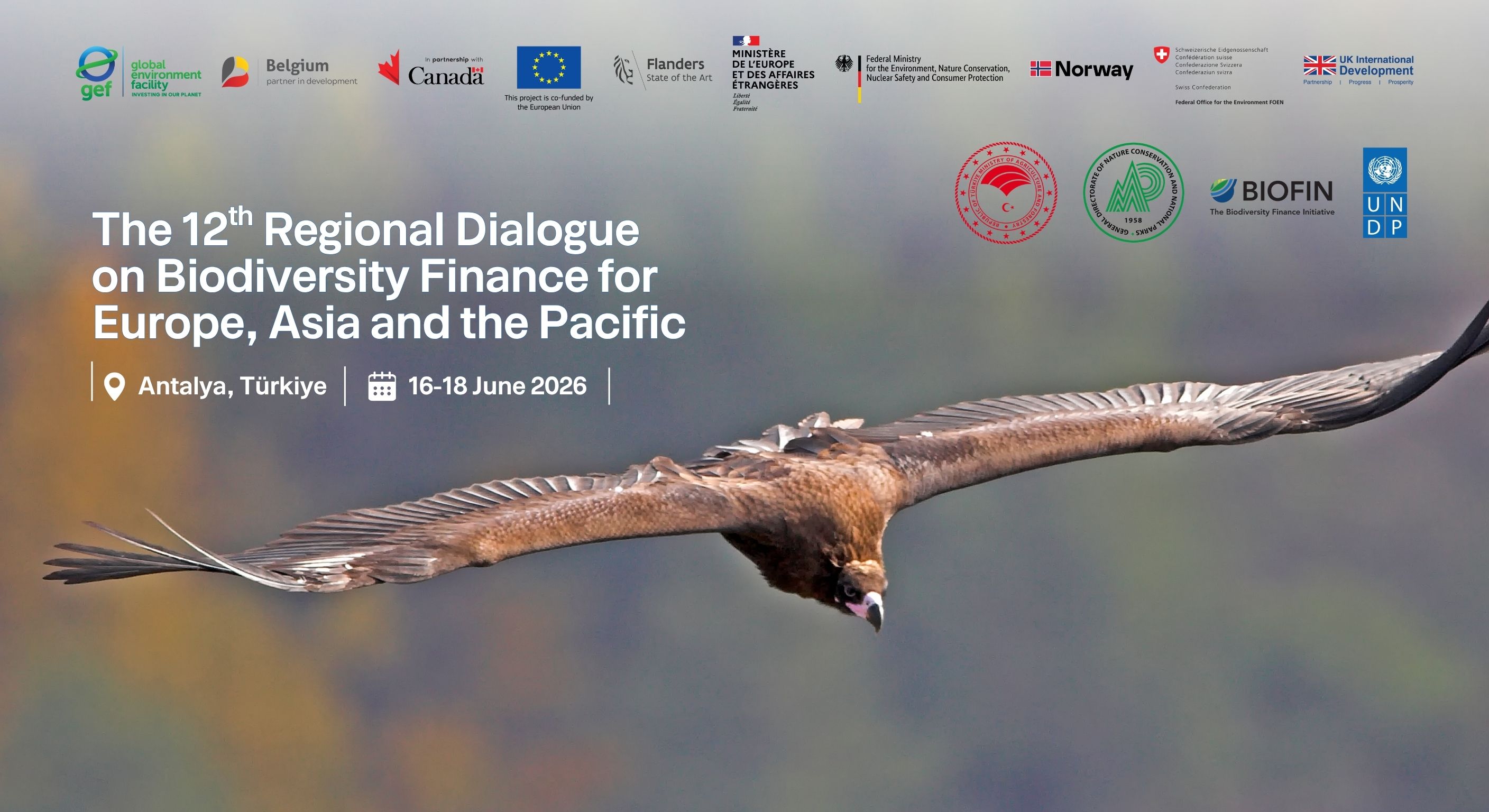
The 12th Regional Dialogue on Biodiversity Finance will bring together policymakers, practitioners and finance experts from across Europe, Asia and the Pacific in Antalya, Türkiye, from 16–18 June 2026.
The event comes at a pivotal moment. More than 90 countries that have recently joined BIOFIN are now developing Biodiversity Finance Plans (BFPs). Some have already completed the first step of the methodology, the Policy and Institutional Review (PIR), and are ready to exchange lessons and experiences.
Here are six themes that will help participants refine their Biodiversity Finance Plans and identify finance solutions:
1. Protected area finance that delivers results
Protected areas remain one of the most important tools for conserving biodiversity, but many still face significant funding gaps.
Countries in the region are already demonstrating practical solutions. In Kazakhstan, public financing for protected areas reached US$202.1 million between 2019 and 2025, while reforms to protected area fees helped increase ecotourism revenues from US$0.6 million to US$2.6 million in just one year. Malaysia's Ecological Fiscal Transfer mechanism has channeled more than US$177 million to states since 2019, supporting the expansion of 350,000 hectares of protected areas.
Participants will learn from these experiences and explore how visitor fees, fiscal transfers, ecotourism and other financing mechanisms can strengthen the long-term sustainability of protected and conserved areas.
2. New approaches to marine finance
For many countries across Asia and the Pacific, healthy oceans are essential for food security, tourism, jobs and climate resilience. Yet financing for marine conservation remains far below what is needed.
The dialogue will showcase emerging marine finance approaches. Thailand's Koh Tao Finance Model generates approximately US$300,000 annually from visitor fees, which support marine conservation and sustainable tourism management. Fiji is reinvesting ecotourism revenues into coral reef and mangrove restoration, while the Maldives is developing a national coral reef insurance mechanism to help ecosystems recover after climate-related damage.
Countries will learn from experiences across the region, including Fiji and the Cook Islands, where innovative approaches are helping connect ocean conservation with sustainable economic development.
3. Blended finance and private-sector investment
Closing the biodiversity finance gap will require more than public budgets. Governments are increasingly exploring how public resources can be used to attract larger private investments.
Several BIOFIN countries are already testing innovative models. Indonesia mobilized US$2.8 million through a biodiversity Sukuk to support conservation activities, while Georgia's Forest Friend Platform combined public and private contributions to mobilize funding for forest restoration.
The dialogue will explore how governments, development banks and investors can work together to de-risk biodiversity investments and create opportunities that generate both environmental and economic returns.
4. Repurposing environmentally harmful subsidies
Governments across the region spend significant resources on subsidies that can unintentionally contribute to biodiversity loss. Increasingly, countries are exploring how these incentives can be redesigned to support nature-positive outcomes instead.
Thailand offers one of the strongest examples. In 2025, the government ended US$285 million in harmful subsidies linked to seawall construction, avoiding an estimated US$17 million in environmentally harmful expenditures annually. Mongolia is redesigning agricultural subsidy programmes to reward environmentally responsible practices, while Bhutan has completed a national assessment of subsidies that may negatively affect biodiversity.
As countries seek to mobilize more resources for nature, subsidy reform is emerging as one of the most powerful tools available.
5. A marketplace of biodiversity finance solutions
One of the most valuable aspects of the Regional Dialogue is the opportunity to learn directly from one another.
This year's programme includes a Finance Solutions Exchange and Biodiversity Finance Bazaar, where participants will showcase experiences ranging from insurance schemes and bonds to digital finance, nature-related risk disclosure, access and benefit-sharing, and community-based conservation.
It is a space to exchange experiences, discuss challenges and how they can be overcome, and share success factors. These exchanges offer a practical opportunity to identify solutions that can be adapted and scaled within participants' own national contexts.
6. Advancing the BIOFIN methodology from analysis to action
As more countries move through the BIOFIN methodology, attention is increasingly shifting from assessments to implementation.
Sessions will focus on key methodological components, including PIRs, FNAs, BERs, biodiversity budget tagging and BFP development. Countries such as Viet Nam, which recently completed an updated Financial Needs Assessment identifying approximately US$4.4 billion in biodiversity financing needs, will share experiences and lessons learned.
With many new Biodiversity Finance Plans expected to be completed in 2027, the dialogue offers an important opportunity for countries to compare approaches, validate findings and strengthen implementation strategies.
Looking ahead
The 12th Regional Dialogue arrives at a critical moment as countries move from planning to implementation. By bringing together experiences from across Europe, Asia and the Pacific, the event will help countries refine their Biodiversity Finance Plans, exchange practical solutions, and accelerate progress toward closing the biodiversity finance gap.
More importantly, it will provide a space for countries to learn from one another and turn innovative ideas into real investments for people and nature.
Categories
Archives
- janvier 2024 (3)
- décembre 2023 (1)
- novembre 2023 (7)
- octobre 2023 (5)
- septembre 2023 (2)
- août 2023 (2)
- juillet 2023 (1)
- juin 2023 (1)
- mai 2023 (45)
- avril 2023 (1)