As Femmi harvests ripe cacao pods from her farm in Tuva Village, it is difficult to imagine that just a few years ago her livelihood looked very different.
Like many smallholder farmers living on the edge of Lore Lindu National Park in Central Sulawesi, she depended almost entirely on cacao to support her family. But ageing trees, declining productivity, volatile cocoa prices and the lasting impacts of the devastating 2018 earthquake made earning a stable income increasingly difficult.
For families like hers, every harvest mattered.
Yet despite these challenges, the forests surrounding her community remained essential. They provide clean water, fertile soils and habitat for one of Indonesia's richest biodiversity landscapes.
Today, Femmi's farm tells a different story.
Her cacao trees are healthier. Harvests have increased. Her income is more stable. And the forests surrounding her community face less pressure from agricultural expansion.
The transformation did not happen by chance.
It began with an investment in people.

Photo: Femmi, a woman cacao farmer from Tuva Village, harvests cocoa pods from her own farm. Cocoa farmers like Femmi face compounding pressures: volatile global prices, climate-driven crop stress, and the lingering impact of natural disasters leave little room for error when a harvest falls short. Photo: UNDP Indonesia.
Investing in farmers to protect nature
Conservation is often associated with protected areas, ranger patrols or restoration projects. But protecting biodiversity also means creating economic opportunities for the people who live alongside nature.
Indonesia's Biodiversity Finance Plan identified Islamic social finance as an innovative opportunity to help fund biodiversity conservation while improving rural livelihoods. Working with Indonesia's National Zakat Agency (BAZNAS), UNDP BIOFIN is helping demonstrate how faith-based finance can support nature-positive livelihoods, creating a model that has the potential to be replicated in other communities across the country.
One result of this partnership is the Sekolah Lapang Kakao (Cacao Farmer Field School) in Tuva Village.
The first field school brought together 60 farmers, including strong participation from women. Rather than simply teaching agricultural techniques, it equipped farmers with practical knowledge to increase productivity, improve bean quality and strengthen their livelihoods—all while reducing pressure on surrounding forests.

Photo: The Cacao Farmer Field School introduces participants to sustainable agricultural practices, from grafting techniques and organic fertilizer production to proper pruning, skills most small-scale farmers in Tuva had never formally learned before. Photo: UNDP Indonesia.
For many participants, it was the first time they had received formal training in sustainable cacao production.
Better farming, better incomes
For Femmi, the lessons quickly translated into results.
After adopting improved pruning, harvesting and farm management techniques, her cacao harvest increased from around 25 kilograms to 35 kilograms every two weeks, providing a more reliable source of income for her family.
Other farmers have experienced similar improvements.
Sahrir, another participant in the programme, estimates that productivity on his farm doubled, from approximately 0.5 kilograms of dry cacao beans per tree to around 1 kilogram, after implementing better pruning, sanitation, harvesting and rehabilitation practices.
Farmers also report improved bean quality, reducing quality deductions from 5–7 percent to around 3 percent, allowing them to receive better prices for their harvests.
For households that depend almost entirely on cacao production, these improvements translate into greater financial security and resilience.

Photo: After harvest, cocoa beans are carefully dried under the sun. For smallholder farmers like Femmi, the quality of every dried batch directly shapes how much of the harvest actually translates into household income. Photo: UNDP Indonesia.
The results show that investing in better farming practices is not only good for biodiversity, it also makes economic sense for farming families.
Growing forests alongside cacao
The benefits extend well beyond higher yields.
Farmers are increasingly adopting agroforestry systems that combine cacao with avocado, coconut, and other crops. Diversifying production provides additional sources of income while making farms more resilient during periods of lower cacao production.
Just as importantly, these practices reduce pressure to expand agriculture into nearby forests.
Research conducted by Tadulako University further demonstrates the environmental benefits of this approach. The study found that cacao grown under agroforestry systems stores 6.3 times more carbon than monoculture plantations while improving soil stability and supporting healthier ecosystems.
The result is a farming system that benefits both people and nature.

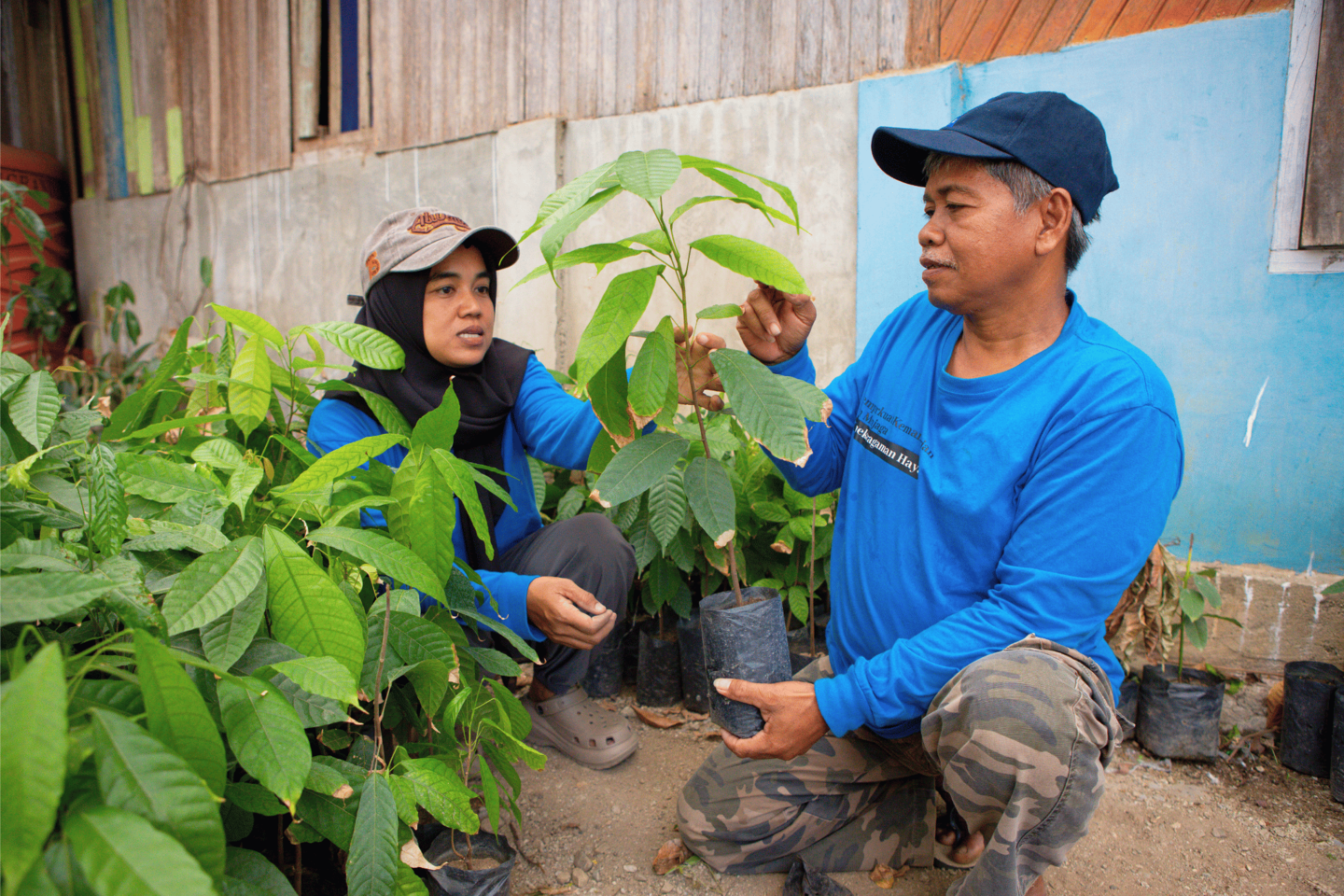
Photo: Femmi and a fellow cacao farmer tend to nurseries established through the Field School, producing seedlings that will be distributed to other participants as part of Tuva Village's broader cacao rehabilitation effort. Photo: UNDP Indonesia.
The nurseries represent an investment in the future, helping restore ageing plantations while ensuring that more farmers can benefit from sustainable production methods.
Biodiversity finance in action
Around the world, biodiversity loss is often driven by economic necessity rather than a lack of awareness. When sustainable livelihoods become more profitable, protecting nature becomes a better economic choice.
That is the principle behind biodiversity finance.
Rather than relying solely on regulations or protected areas, UNDP BIOFIN works with governments and partners to identify innovative financing mechanisms that create incentives for conservation while strengthening local economies.
In Central Sulawesi, the partnership with BAZNAS demonstrates how an existing source of domestic finance can be directed toward biodiversity-positive activities. By mobilizing Islamic social finance to support sustainable agriculture, the initiative is helping farmers improve incomes, strengthen resilience, adopt biodiversity-friendly farming practices and reduce pressure on one of Indonesia's most important protected landscapes.
More importantly, it shows that biodiversity finance is not simply about raising more money for conservation. It is about ensuring that investment reaches the communities whose daily decisions shape the future of nature.
Investing in people, investing in nature
Looking across her farm today, Femmi sees more than healthier cacao trees.
She sees a future where her family can earn a better living while protecting the forest that surrounds them.
That is the promise of biodiversity finance.
By investing in people, it creates incentives to invest in nature.
As countries around the world implement their Biodiversity Finance Plans under the Kunming-Montreal Global Biodiversity Framework, stories like Femmi's demonstrate that protecting biodiversity does not always begin with a new protected area or a large infrastructure project.
Sometimes, it begins with a farmer, a few healthier trees, and the right investment at the right time.
Categories
Countries
Archives
- mars 2023 (2)
- janvier 2023 (4)
- décembre 2022 (19)
- novembre 2022 (4)
- octobre 2022 (3)
- septembre 2022 (5)
- août 2022 (4)
- juin 2022 (3)
- mai 2022 (2)
- avril 2022 (3)