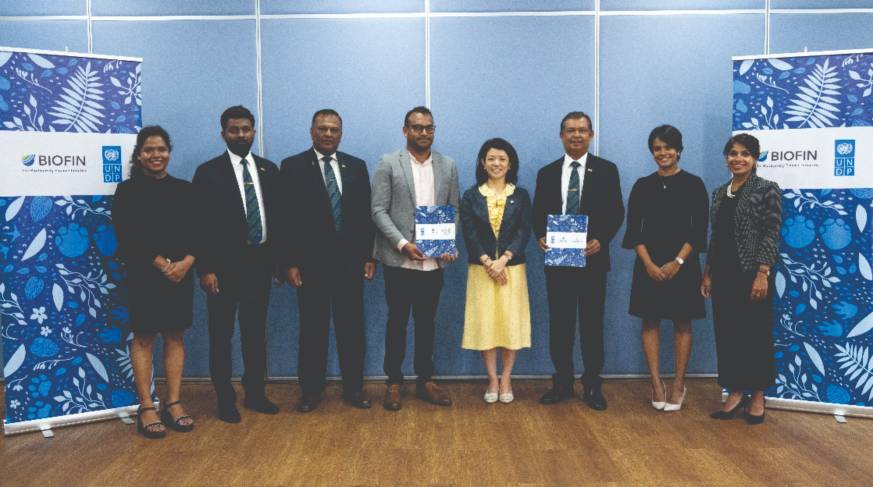
A BIOFIN-supported partnership is demonstrating how businesses can invest in the ecosystems they depend on, creating benefits for biodiversity, communities and the economy.
Healthy ecosystems provide the foundation for many businesses. They regulate water supplies, maintain fertile soils, support biodiversity and help build resilience to climate change. Yet these services are rarely reflected in financial decisions, leaving the natural assets that businesses rely on undervalued and underfunded.
Payment for Ecosystem Services (PES) is helping to change that.
In Sri Lanka, UNDP BIOFIN is working with Hayleys Plantations, one of the country's largest plantation companies, to demonstrate how businesses can invest directly in protecting and restoring the ecosystems that sustain their operations. By recognizing nature as an asset rather than an externality, the partnership is creating new opportunities to finance biodiversity conservation while strengthening long-term business resilience.
What is Payment for Ecosystem Services?
Payment for Ecosystem Services is a finance mechanism that creates incentives for protecting and restoring ecosystems by recognizing the economic value of the benefits they provide.
These ecosystem services include clean water, healthy soil, carbon storage, pollination and biodiversity - services that are essential not only for nature, but also for agriculture, tourism and many other sectors of the economy.
Rather than treating conservation as a cost, PES encourages businesses and other beneficiaries to invest in maintaining the natural systems that underpin their success.
From concept to implementation
Sri Lanka's growing experience with Payment for Ecosystem Services is also captured in BIOFIN's recently published guide, Payments for Ecosystem Services in Sri Lanka. Developed under the Revenues for Nature initiative, the guide moves beyond theory to showcase six real-world case studies where businesses, communities and government institutions are already investing in the ecosystems they depend on.
Building on these experiences, a growing portfolio of partnerships is applying PES principles to strengthen biodiversity conservation and ecosystem management while supporting sustainable business operations.
At Bambarakelly Estate, activities focus on watershed protection, biodiversity conservation, renewable energy and climate resilience, helping safeguard natural resources that are essential for plantation productivity.
At Great Western Estate, ecosystem restoration contributes to improving water security and protecting the landscape that supports both communities and agricultural production.
The initiative also extends beyond plantation management. At Wattagoda Estate, conservation efforts are linked with the Pekoe Trail, illustrating how healthy ecosystems can create new opportunities for sustainable tourism while generating additional incentives to protect biodiversity.
Meanwhile, Halgolla Estate is advancing regenerative agriculture and landscape restoration, demonstrating how restoring ecosystem health can also strengthen agricultural resilience over the long term.
Together, these examples show that investing in nature is not simply an environmental responsibility; it is a practical business strategy.
Creating value for people, nature and business
For companies that depend on natural resources, healthy ecosystems reduce operational risks and support long-term productivity. For communities, they help secure water resources, strengthen livelihoods and protect landscapes that provide economic opportunities. For biodiversity, they generate additional investment in conservation beyond traditional public funding.
This integrated approach reflects one of BIOFIN's core objectives: mobilizing innovative finance solutions that deliver benefits for both people and nature.
As Azusa Kubota, UNDP Resident Representative in Sri Lanka, noted:
"Through the UNDP BIOFIN initiative, we are working with partners across the country to demonstrate how Payment for Ecosystem Services can unlock new investments in biodiversity by recognising the value of the ecosystem services that healthy landscapes provide."
A model for other countries
As more than 90 countries develop National Biodiversity Finance Plans through the BIOFIN methodology, Sri Lanka's experience demonstrates how innovative finance solutions can move from analysis to implementation.
Payment for Ecosystem Services offers a practical framework for engaging the private sector in biodiversity finance by aligning business interests with conservation outcomes. Rather than relying solely on public resources, it creates new partnerships that generate long-term investment in the ecosystems that support economies and livelihoods.
By demonstrating how businesses can invest in the natural capital they depend on, Sri Lanka is providing a practical example that other countries can adapt as they develop and implement their own biodiversity finance solutions.
Source: Suratha News
Categories
Archives
- août 2026 (3)
- juillet 2026 (11)
- juin 2026 (10)
- mai 2026 (4)
- avril 2026 (13)
- mars 2026 (6)
- février 2026 (3)
- janvier 2026 (3)
- décembre 2025 (2)
- novembre 2025 (5)