Tanzania is one of Africa's most biodiverse countries, with globally important forests, savannahs, wetlands, freshwater systems and marine and coastal ecosystems. This natural wealth underpins tourism, fisheries, agriculture and the livelihoods of millions of people. Yet biodiversity is increasingly threatened by habitat degradation, unsustainable resource use, climate change, invasive species and growing pressure on terrestrial and marine ecosystems. Securing sufficient and sustainable finance for conservation is therefore critical to protecting Tanzania's natural capital and the economic activities that depend on it.
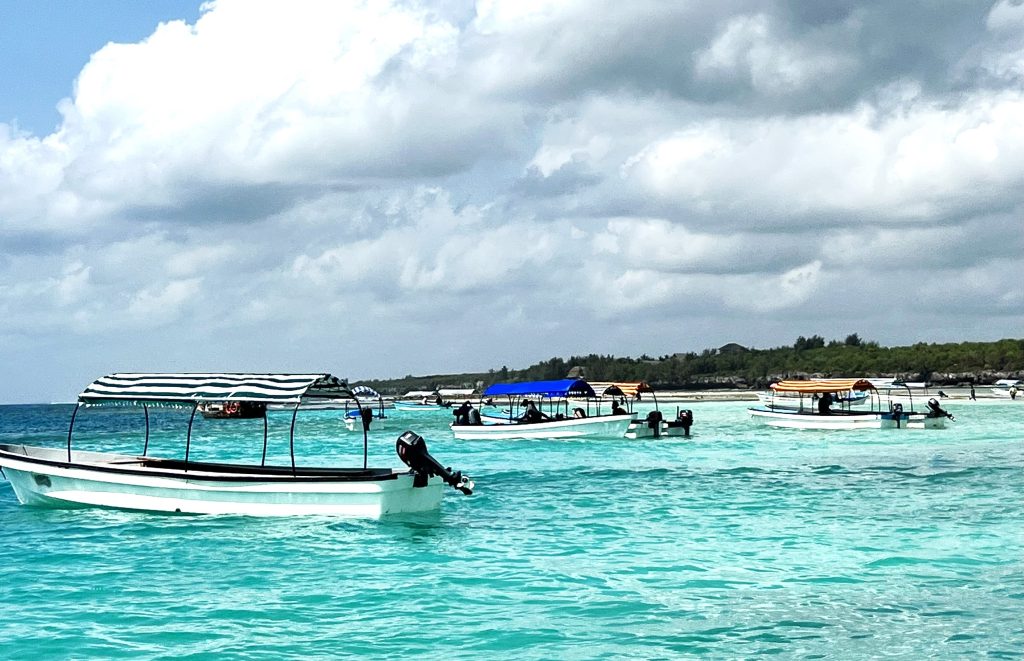
UNDP BIOFIN began its work in Tanzania in 2018, initially focusing on Zanzibar, where marine and coastal ecosystems are particularly important for tourism, fisheries, seaweed farming and local livelihoods. UNDP BIOFIN's assessments estimated that Zanzibar requires approximately US$69.4 million over five years to meet its biodiversity priorities, with a financing gap of around US$43.4 million. In response, the Government endorsed the Biodiversity Finance Plan in 2022, identifying 13 priority finance solutions to mobilize new resources, improve existing expenditure and redirect finance toward biodiversity-positive outcomes.
The programme has since moved from planning to implementation. UNDP BIOFIN is supporting reforms to protected-area fees and digital revenue collection, public–private partnerships, the repurposing of potentially harmful subsidies and other innovative finance solutions. Following Zanzibar's progress, UNDP BIOFIN expanded to mainland Tanzania in 2025, where the Government is developing the evidence and financing framework needed to mobilize greater public and private investment for biodiversity and implement national and global biodiversity commitments.
$4.3M
Annual Revenue
Projected annual revenue from updated protected area fees and the new digital payment system.
13
Finance Solutions
Prioritized finance solutions identified in Zanzibar's Biodiversity Finance Plan.
4M
Wild Animals
Tanzania is home to approximately four million wild animals—the highest concentration per square kilometre globally.
16
National Parks
Tanzania's protected area network includes 16 national parks, alongside game reserves, marine parks and wildlife management areas.
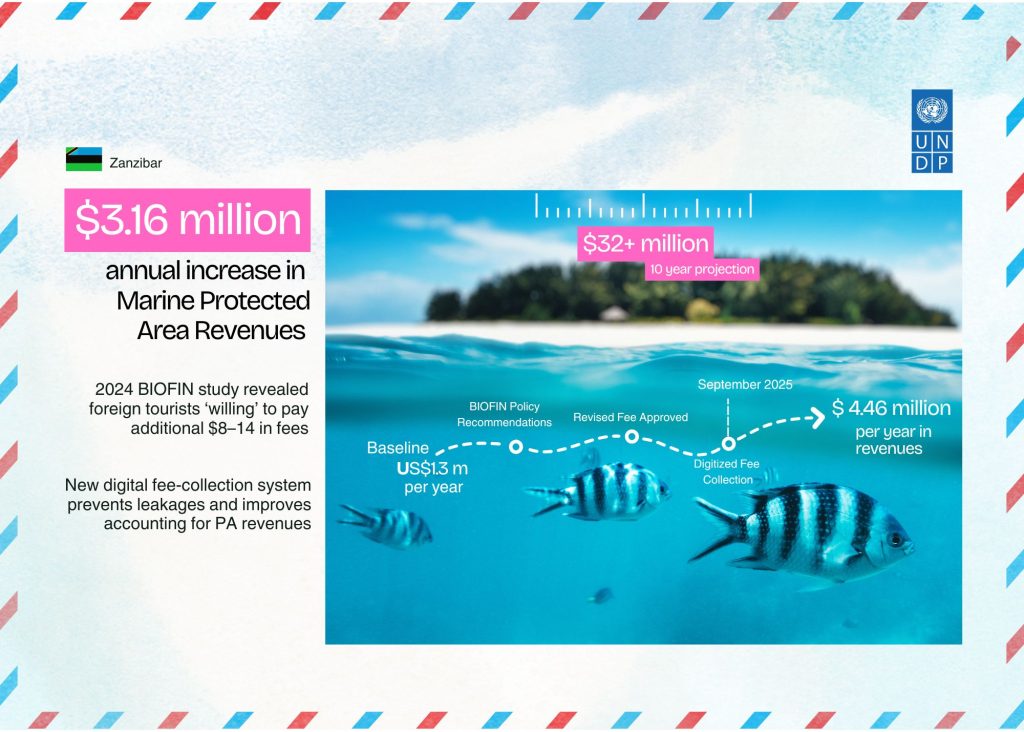
UNDP BIOFIN supported Zanzibar in reviewing visitor fees for marine and terrestrial protected areas and introducing a new fee structure in August 2025. Combined with improved revenue collection, the redesign is projected to increase annual conservation revenues from approximately US$1.3 million to more than US$4.3 million, potentially more than tripling the resources available for protected-area management.
Nearly US$1.9 Million Already Generated
The initiatives are already producing measurable results. Since the new fee structure was introduced in August 2025, Zanzibar generated nearly US$1.9 million in two quarters, already exceeding the revenue collected during the whole of 2024. In the fourth quarter of 2025 alone, revenues reached US$921,530, compared with US$364,827 during the same period in 2024, an increase of approximately 153%.
Digitalizing Conservation Finance
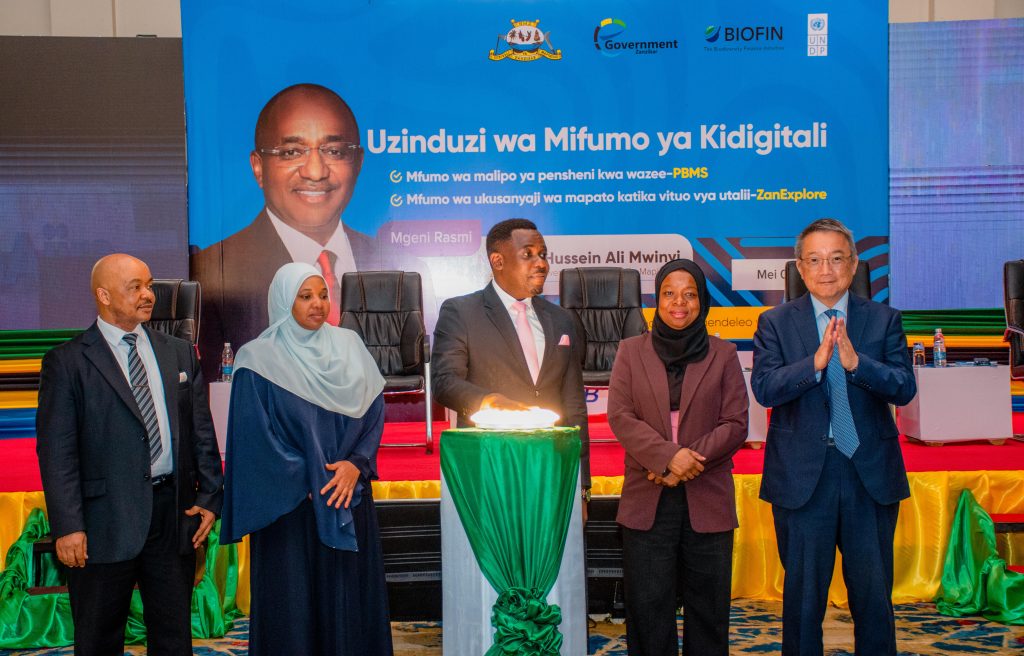
In May 2026, the Revolutionary Government of Zanzibar and UNDP BIOFIN launched a new Digital Cashless and Tourism System for marine and terrestrial protected areas. Visitors can pay conservation fees through mobile money, bank transfers, and credit cards, while authorities can monitor revenues in real time. The system is designed to reduce revenue leakage, increase transparency and strengthen the long-term financial sustainability of protected areas.
UNDP BIOFIN supported Zanzibar in completing its Policy and Institutional Review (PIR), Biodiversity Expenditure Review (BER) and Financial Needs Assessment (FNA), leading to the development and government approval of the Biodiversity Finance Plan in 2022, formally launched in 2023. The Plan identified 13 priority finance solutions to diversify and increase financing for biodiversity.
The Financial Needs Assessment estimated that Zanzibar requires approximately US$69.4 million over five years, or around US$13.9 million annually, while the estimated biodiversity financing gap is approximately US$43.4 million.
Redesigning Harmful Subsidies
Another important UNDP BIOFIN workstream is the identification and redesign of potentially harmful subsidies in fisheries and seaweed farming. These sectors are particularly important to Zanzibar's coastal economy and livelihoods, but poorly designed incentives can contribute to pressure on marine ecosystems. The Biodiversity Finance Plan therefore prioritizes repurposing harmful fisheries subsidies and promoting more sustainable seaweed production.
Mobilizing Private Investment for Biodiversity
UNDP BIOFIN is also supporting the integration of biodiversity into Zanzibar's Public-Private Partnership framework. Tourism, the blue economy, fisheries, agriculture, forestry and other sectors have been identified as opportunities for mobilizing private investment that can simultaneously support economic development and biodiversity conservation.
Expanding UNDP BIOFIN to Mainland Tanzania
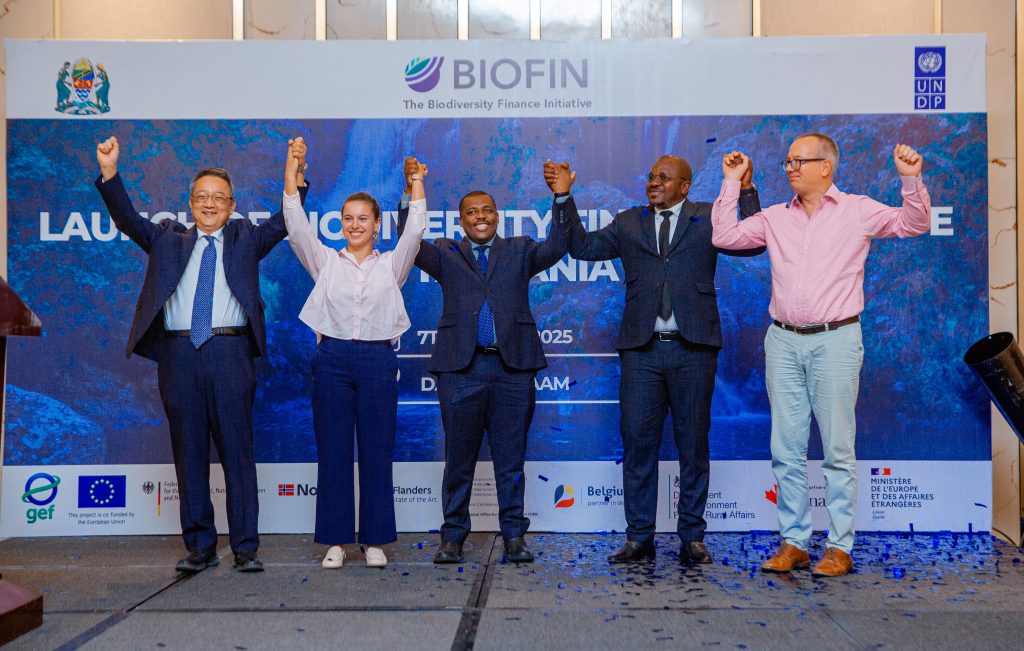
Following the pioneering implementation of UNDP BIOFIN in Zanzibar, the Vice President's Office and UNDP formally launched UNDP BIOFIN in mainland Tanzania in March 2025. The programme is establishing the evidence base needed to identify Tanzania's biodiversity financing needs, assess existing expenditure and develop a Biodiversity Finance Plan aligned with national priorities and the Kunming–Montreal Global Biodiversity Framework.
Finance solutions
The Biodiversity Finance Plan serves as a meticulously devised strategy, outlining 13 prioritized financial solutions, itemized below. The implementation of these solutions is anticipated to substantially mitigate the identified financial gap concerning the conservation of biodiversity within Zanzibar. These solutions are:
Crowdfunding for restoration of degraded key forests and/mangroves in selected Community Forest Management Areas (CoFMAs);
Establish Payment for Ecosystem Services (PES) Programme for CoFMAs and other forests generating significant water ecosystem service.
Repurpose potentially harmful subsidies in the fisheries sector;
Establish and operationalize public-private partnership (PPP) framework for “Re-greening Zanzibar Program” (coastal and inland areas);
Repurpose potentially harmful subsidies for sustainable seaweed farming;
Secure Debt-for-nature swaps for sustainable BLUE economy (coral reefs restoration);
Establish Blue Fund for BLUE Economy implementation;
Establish crowdfunding for restoration of degraded coastal and beach areas;
Identify and develop a new program for scaling up of REDD+ initiatives;
Introduce subsidies for clean energy sources (e.g., gas and electricity) for household energy;
Increase Corporate Social Responsibility (CSR) contributions from the private sector for biodiversity conservation;
Review tourist’s entrance fee structure for protected areas and adopt a Digital Voucher System for the fees collection; and
Review and strengthen the revenue retention framework/Scheme for terrestrial PAs and Marine Conservation Areas (MCAs).
Key documents
The Policy and Institutional Review (PIR) for Zanzibar analyzed the biodiversity related policy framework, strategies, trends and drivers for biodiversity degradation and recommends a set of options to support development of Biodiversity Finance Plan. The PIR identified around 25 sectors, agencies, institutions and organizations with direct and indirect mandates, functions and initiatives related to biodiversity resources conservation and utilization. About 15 non-government actors particularly the private sector, NGOs, research and academic institutions were also identified.
The PIR identified key threats and drivers of biodiversity and ecosystem trends in Zanzibar. It also noted that, the National Biodiversity Strategy and Action Plan (NBSAP), ended in 2020, dis not comprehensively address Zanzibar’s unique island ecosystem and biodiversity priorities.
Key recommendations from the PIR laid a basis for Biodiversity Expenditure Review (BER) and the Financial Needs Assessment (FNA) that concurrently culminated in the development of a Biodiversity Finance Plan and Finance Solutions for Zanzibar. Several recommendations, grouped in three categories, were geared to enhance, improve, amend or modify existing policies and practices to achieve positive and prevent negative biodiversity and ecosystem status and trends:
Those aiming to improve Biodiversity Conservation by integrating biodiversity issues in national planning, integration and synchronized policy approaches to undo institutional overlaps and enhance efficient resources mobilization;
Those aiming to enhance participatory biodiversity conservation through co-management approaches, promoting and supporting a community livelihoods and sustainable income generating initiatives;
Those aiming to facilitate sustainable use of natural resources both on land and in the marine environment with specific actions on enhancing public-private sector engagement through strengthening the private sector engagement.
Biodiversity Expenditure Review (BER) outlines biodiversity-relevant activities from budgets of Ministries, Departments and Agencies (MDAs) as well as budgets of non-government entities. This BER report aims to: i) estimate past and future biodiversity expenditures across the public, private, and civil society sectors, ii) identify what activities these biodiversity expenditures are targeting and map them according to biodiversity categories, and iii) determine policy alignment and spending efficiencies for the main biodiversity actors. The budget allocation with respect to the BIOFIN categories was mostly on promoting sustainable use; Biodiversity development and planning; biodiversity awareness and knowledge, restoration of marine and forest areas; Green economy, and pollution management.
Overall, budget allocation attributed to biodiversity expenditure was extremely low, less than half of a percent of the total government budget. The trends for budget allocation and actual expenditure for most MDAs indicated a declining allocation and more so for the development budget. The Private sector plays a significant role in biodiversity-related initiatives. The forecasted biodiversity expenditure under the most likely scenario indicated that an average of USD 4,655,659 per year will be spent by both government and non-government entities in the next five years based on the financial data collected from different sources.
The Zanzibar Biodiversity Strategy and Action Plan (ZABSAP) is highly recommended to help for a systematic framework to plan, fundraise and track the performance of national biodiversity goals as well as financing biodiversity-related activities. It will ensure biodiversity is prioritized in the respective sectors and in the government planning processes. A mechanism and monitoring framework to track biodiversity financing by the private sector and other non-government entities are recommended.
The Financial Needs Assessment (FNA) is a comprehensive estimate and analysis of the human resources, capital investments and financial resources needed to fund biodiversity-related activities in Zanzibar. It intended to achieve the following objectives in attaining eighteen (18) identified targets for biodiversity conservation and management in Zanzibar:
Reviewing national biodiversity targets to identify strategies and actions needed to achieve the stated targets;
Translating identified strategies and actions into “costable actions” with clear results;
Preparing a detailed budget for each costable action;
Consolidating budgets for each costable action into a national budget for meeting biodiversity financing needs; and
Estimating the finance gap between business-as-usual biodiversity expenditure projections (from the BER) and financial needs identified in the FNA.
The projected biodiversity financing need is USD 69,413,043 (using the exchange rate of 1 USD=TZS 2310), at an average of USD 13,882,608 per year. Large portion of the Finance needs was located to Target 4 (22.2%), that “by 2028, investments in systems of production and consumption based on sustainable, eco-friendly practices increased”, followed by Target 7 (15.1%) that, by 2028, all forms of pollution from water and land-based activities are brought to levels that are non-detrimental to biodiversity-ecosystem functions”, and Target 5 (14.9%) that, “by 2028, the rate of degradation and fragmentation of ecosystems and the loss of habitats is significantly reduced”. It was further found that, based on the biodiversity financing needs by BIOFIN categories (2022/23 to 2027/28), the biodiversity and Development planning category accounts for 49% of the financing needs and about 70% of the financing gap for biodiversity in Zanzibar. The FNA concludes that, these financial needs require attention. All identified national biodiversity targets require substantial financing. Ensure that institutions, policies, financing mechanisms and procedures are in place/improved and operational. The following are also recommended:
Close engagements with non-government entities for them to understand that they are an integral part of the biodiversity management efforts in Zanzibar;
Adopting FNA findings as inputs into the government planning and budgeting exercise. This would help in the efficient allocation of resources required to achieve national biodiversity targets; and
Zanzibar to develop its own Biodiversity Strategy and Action Plan (ZABSAP).
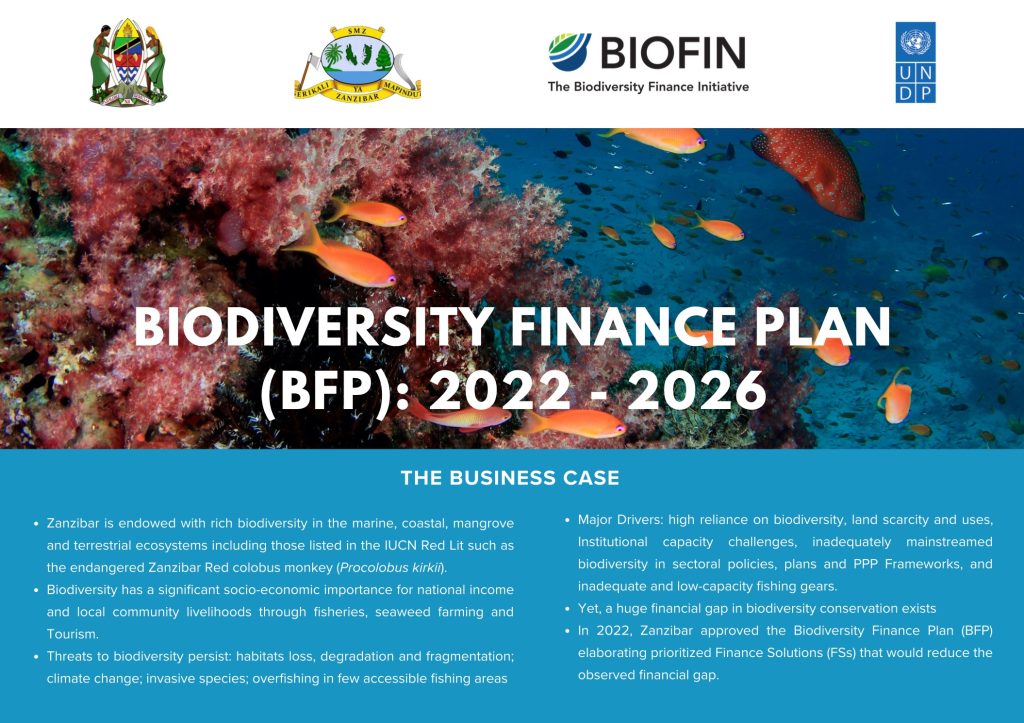
The BFP in Zanzibar, officially launched on 22nd June, 2023, presents a coherent and comprehensive approaches for mobilizing additional financial resources for biodiversity conservation. It guides on the implementation of the 13 prioritized finance solutions for the next 5 years (2022 – 2026). The FSs were generated through a rigorous consultative approach in accordance with the BIOFIN WorkBook of 2018. In Zanzibar, there is conducive environment for BFP implementations:
National and International commitments,
High political will, with enabling policy environment,
The BIOFIN coordination structure to implement the BFP is well institutionalized, embedded in the First Vice President’s Office, connected to Steering Committee and focal persons at Ministries, Departments and Agencies,
National BFP Implementation Strategy in place,
The established Zanzibar Green Legacy Initiative for re-greening Zanzibar,
The Blue Economy Policy of 2020 and Implementation Strategy, and
Accomplishing the Marine Spatial Planning (MSP) that focuses on sustainable uses, likely to align any subsidy in the fisheries and seaweed farming.
Generally, the BFP presents that, the Revolutionary Government of Zanzibar experiences a large financial gap in biodiversity conservation. However, it promises that the prioritized 13FSs, if they are well implemented, would reduce the identified finance gap, ultimately contributing to the Zanzibar Vision 2050, SDGs and the AICHI Biodiversity Targets. To realize this, integrated efforts are needed from public and private sectors, CSOs and partners for effective implementations.