Egypt
One of the newest countries to join BIOFIN, the land area of Egypt is composed of desert (92%) and agricultural land (8%). The country comprises 22 main habitat groups such as: Gebel Elba; Mountains and Wadies of the Eastern Desert; Red Sea Littoral Habitats; Red Sea Islands; Red Sea Marine Habitats; Mountains and Wadies of South Sinai; Central and North Sinai; Mediterranean Wetlands; Nile Valley and Delta; Gebel Uweinat and Gilf Kebir; Western Desert Depressions and Oases; Sand and Dunes of the Western Desert; Western Desert Mediterranean Coast and Mediterranean. The main features of these dry land areas are rocky surfaces, eroded pavement, gravel desert, sand dunes, slopes, cliffs, yet the composition of plants in these areas differs one from the other.
Three hundred and twenty-four species of fauna, and many species of flora, that exist in desert habitats are considered of ecological importance, especially in Sinai. Along with deserts, wetlands also constitute an important ecosystem, with 80 plants, 100 animals and 82 fish, notably along the Nile, spread over 1,530 km of the national territory. Overall, Egyptian biodiversity comprises 143 types of globally important species, 800 species of non-flowering plants, 2,302 flowering plants, 111 species of mammals, 480 species of birds, 109 species of reptiles, 9 species of amphibians, and more than 1,000 species of fish. There exists a large number of invertebrates, 10,000 to 15,000 species of insects, more than 200 types of coral species, 800 species of mollusks and over 1,000 crustaceans. Eighteen indigenous coral species are considered to be the world’s best as a result of not having been subjected to coral bleaching. Two types of mangroves (Avicennia marina and Rhisphora mucronata) provide shelter for numerous species (40 species of insects, 72 species of butterflies, 65 molluscs, 17 polychaetes, 22 species of fish).
Yet the abundance in species is likely to decline in the coming years. Overall, 51 species of mammals are already endangered, along with 26 bird species and 26 reptile species. In coastal ecosystems, which represent one of the most threatened natural habitats, endangered mammals amount to at least 17 species, sharks to 20, birds to 300, fish to 150, algae to 80, coral species to 20, molluses to 80, crustaceans to 60, with many seaweed species also currently at great risk. The mangrove ecosystem is also vulnerable in spite of its area having increased from 525 hectares in 2002, to 800 hectares by the end of 2007, as a result of the establishment of a protection program. In terms of mountain ecosystems, many of the 600 plant types, found primarily on Mount Sinai (Jabel Saraba), Mount Katrina, are now endangered. Further, the Sinai Tiger has not been seen for 20 years.
The genetic components of some fauna and flora species support the development of medicinal, agricultural and industrial products as well as the basic daily needs of local communities. In addition, biodiversity supports the development of many new industries (e.g. ecotourism) which provide high economic return.
Threats to biodiversity in Egypt are either directly or indirectly related to human impacts, with the former including excessive hunting, clear-cutting and deforestation, and the latter linked to habitat destruction for developmental purposes and all pollution types, including refuse from industry and human settlements. Excessive hunting is endangering several species of resident and migratory birds as well as a number of hoofed animals (e.g. gazelles). Pollutants in the air, water and soil (especially in rural areas) are also threatening a large number of plants and animals as well as leading to a substantial increase in other harmful exotic ones (e.g. species of rats, birds, red spider, American cotton worm). A famous example is the detrimental effect of the introduction of the water hyacinth (Eichhornia crassipes) on life in the Nile River. Major threats to marine ecosystems include unregulated tourism, exploitation of marine resources, overfishing and fishing in illegal areas (e.g. breeding grounds) and coastal pollution.
At present, 20% of Egyptians live in coastal areas which are also visited annually by 11 million tourists. In addition, more than 40% of industrial activity occurs in the coastal zone. Threats are accentuated by increases in the level of desertification due to climate change as well as in human populations. Many plant and animal species are located at the limits of their geographical or ecological distribution ranges. Under such conditions, these species have limited tolerance for ecological pressures, as is exemplified by corals in the Red Sea, the Gulf of Suez and the Gulf of Aqaba.
BIOFIN’s team of experts work across the world to develop Biodiversity Finance Plans - roadmaps towards a more sustainable future. The experts draw on qualitative and quantitative data, innovative methodologies, and input from a variety of sectors to create an agenda for action. As a new BIOFIN country, Egypt is now commencing this process.
Step 1: Finance Policy and Institutional Review: Assess the policy, institutional, and economic context for biodiversity finance and map existing finance solutions.
Step 2: Biodiversity Expenditure Review: Measure and analyse current biodiversity expenditures from the public and private sectors, donors, and non-governmental organizations (NGOs).
Step 3: Biodiversity Financial Review Assessment: Make a reliable estimate of the finances needed to achieve a country’s biodiversity goals, and compare this to current biodiversity expenditures and other resources available.
Step 4: Biodiversity Finance Plans: Develop a Biodiversity finance plan that identifies and mobilizes the resources and policies required to implement the most suitable finance solutions.
Biodiversity finance solutions are extremely varied – BIOFIN has compiled a list of over 150 available online.
Solutions can rely on a number of factors, which can be:
- Public or private revenues or contributions.
- Built around voluntary or compulsory schemes.
- Guided by markets or regulations.
- Available on a short- or longer-term basis.
- Associated with particular conditions set by the finance providers.
- Available in different currencies.
With BIOFIN's knowledge and unique approach, we are working to expand our work worldwide to ensure a greener, safer future for nature and society.
Learn more about BIOFIN's Methodology here.
3 April 2024
9 January 2024
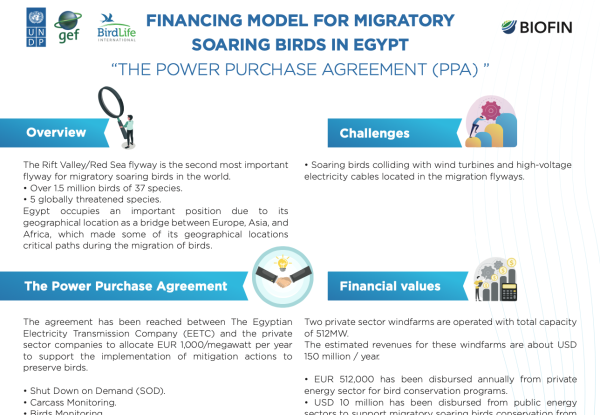
The Biodiversity Finance Plan (BFP) sets out the following priority solutions:
- Adjust entrance fees for protected areas, digitize the collection process, and improve the retention of revenues for protected area management and investment.
- Revise concession and permit fees for protected areas and systematize the investor selection and contracting process.
- Promote Corporate Social Responsibility (CSR) funding for biodiversity.
- Explore and integrate biodiversity-positive carbon credits into the carbon market.
- Enhance Performance-Based Budgeting (PBB) to improve budget allocations and the efficient use of financial resources.
- Explore insurance schemes addressing risks to biodiversity.
- Establish a roadmap for biodiversity offsets and integrate them into Environmental Impact Assessment (EIA) policies and practices.
- Foster Public-Private Partnerships (PPPs) to finance and implement biodiversity projects.
- Mobilize international funding flows for biodiversity conservation.

Egypt’s Biodiversity Finance Policy and Institutional Review (PIR) highlights the significant national financing gap for biodiversity conservation, while recognizing Egypt’s growing commitment to addressing this challenge through policy reform and international engagement. The review situates biodiversity as a key driver of Egypt’s economy, supporting sectors such as agriculture, fisheries, tourism, and energy, and underscores the substantial economic value of ecosystems such as coral reefs, protected areas, and rangelands. It finds that Egypt has a strong strategic and institutional foundation for biodiversity conservation, anchored in the National Biodiversity Strategy and Action plan (NBSAP) and Egypt Vision 2030, and related national strategies on climate change, energy, tourism, agriculture, water, and urban development. However, biodiversity remains underfunded within the national budget, despite increasing allocations to green investments and ongoing reforms to phase out environmentally harmful subsidies.

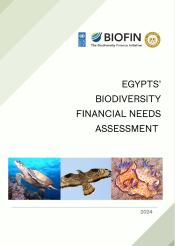
The Biodiversity Financial Needs Assessment (FNA) provides a systematic estimate of the financial resources required for Egypt to achieve its national biodiversity targets and compares these needs with projected biodiversity expenditures to identify the financing gap. Developed using the BIOFIN methodology and aligned with the Policy and Institutional Review (PIR), Biodiversity Expenditure Review (BER), and Egypt’s National Biodiversity Strategy and Action Plan (NBSAP), the FNA supports evidence-based prioritization of biodiversity actions. By assessing national strategies and plans related to biodiversity, climate, and sustainable development, the FNA highlights the scale of investment required to effectively implement biodiversity objectives and integrate them into broader development planning.

Egypt’s National Biodiversity Finance Plan (BFP) 2024–2030 sets out a comprehensive, evidence-based framework to mobilize sustainable financing for biodiversity conservation, recognizing biodiversity as a cornerstone of economic growth, social equity, and environmental resilience. Aligned with Egypt Vision 2030, the Global Biodiversity Framework (GBF), and the National Biodiversity Strategy and Action Plan (NBSAP), the BFP was developed using the BIOFIN methodology and is underpinned by the Policy and Institutional Review (PIR), Biodiversity Expenditure Review (BER), and Financial Needs Assessment (FNA). These assessments identified a biodiversity financing gap of USD 291.9 million for 2024–2030, guiding the prioritization of nine high-impact and feasible finance solutions through an inclusive, multi-stakeholder process that balances biodiversity impact, financial potential, and likelihood of success.