Knowledge Base

Knowledge Hub

Access BIOFIN's library of resources, including flagship publications, country reports, finance solution case studies, webinars, explainer videos, podcasts, and more.

Key Publications
Publications

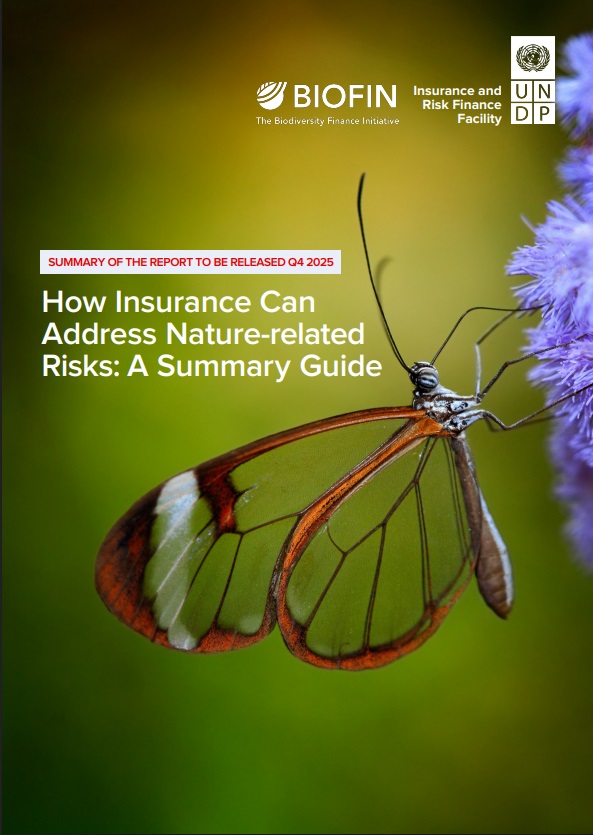
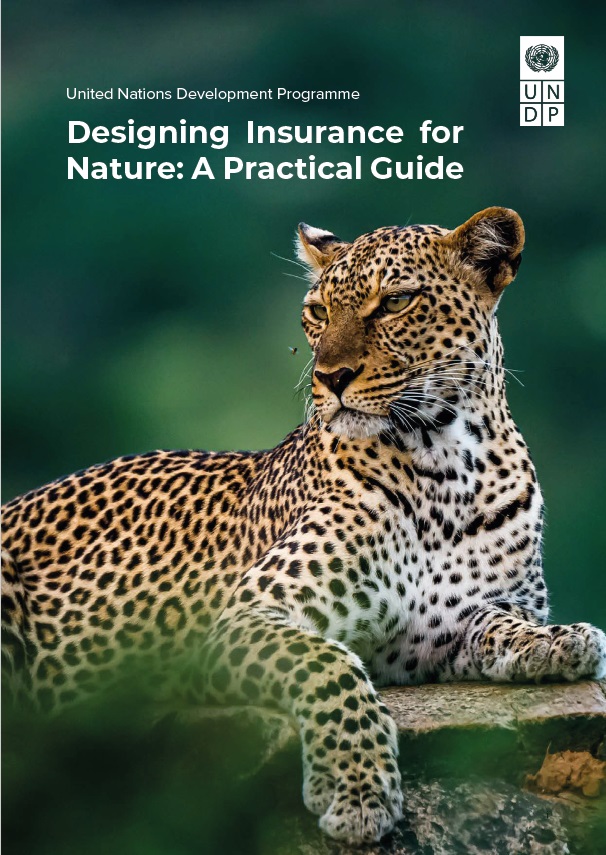
Insurance can play a crucial role in biodiversity conservation by providing financial protection against risks to natural assets, incentivizing sustainable practices, and securing key investments.
Publications

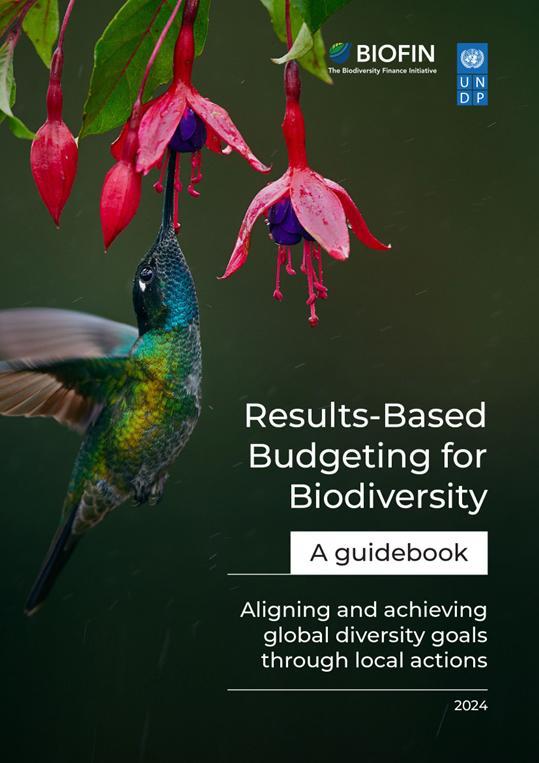
In 2022, countries adopted new global biodiversity targets under the Kunming-Montreal Global Biodiversity Framework (GBF), revisiting many goals that had gone unachieved or underachieved over the past decade.
Publications

Global Biodiversity Expenditure (GLOBE) is a taxonomy that categorizes all potential public expenditures for biodiversity.

The taxonomy consists of two components:
Publications

The BIOFIN Workbook 2024 provides detailed guidance to design and implement national biodiversity finance plans.  These are not mere plans. They set out a process to engage a coalition of actors around the issue of biodiversity finance for an extended time.
Publications

At the Conference of the Parties to the Convention on Biological Diversity 15 (CBD COP 15) in 2022, countries agreed to review and update their National Biodiversity Strategy and Action Plans
Publications

Well-intentioned subsidies aimed at socio-economic goals can have unintended negative impacts on the environment, including biodiversity. The BIOFIN team has developed a step-by-step guide to repurpose such subsidies and improve their positive impacts on people and nature.
Publications

The Kunming-Montreal Global Biodiversity Framework (GBF) calls for a whole-of-society approach to halting and reversing nature loss.

Publications

The Little Book of Investing in Nature provides an essential overview of the area of biodiversity finance at a time when governments and international negotiators are urgently seeking pragmatic solutions for the twin crises of climate change and the loss of nature.

E-LEARNING

Learning for nature: our free biodiversity finance certified e-learning course

Take our free biodiversity finance certified e-learning course. Master the methodology, connect with experts, and gain certification.

Start E-Learning
Browse the Knowledge Platform
645 Results
Publications

Uno de los retos más importantes en la conservación de la biodiversidad es la diversificación de esquemas de financiamiento efectivos que ayuden al cumplimiento de los objetivos y metas nacionales e internacionales. En México estos compromisos provienen principalmente del Convenio sobre la Diversidad Biológica (CDB) y la Estrategia Nacional de Biodiversidad.

Dentro del esquema de diversificación del financiamiento para biodiversidad, se encuentra la asociación de recursos públicos y privados de financiamiento, como el caso del programa de Mecanismos Locales de Pago por Servicios Ambientales (MLPSA) a través de Fondos Concurrentes de la Comisión Nacional Forestal (CONAFOR).

Este esquema busca principalmente acercar recursos a los dueños de los bosques para su conservación y mantenimientos y de los flujos de servicios ambientales que proveen.

Los MLPSA son una herramienta valiosa para incentivar la conservación de ecosistemas críticos. Para fortalecer y ampliar estos mecanismos, BIOFIN desarrolló un proyecto en colaboración con la CONAFOR para promover el involucramiento de los Distritos y Unidades de Riego en la protección de áreas de biodiversidad en cuencas hidrográficas, que desempeñan un papel esencial en la regulación y suministro de agua para actividades agrícolas.

Publications

In December 2022, the International Finance Corporation (IFC), United Nations Development Program (UNDP) and South African National Parks (SANParks) commissioned the development of a financing strategy for the Greater Kruger Strategic Development Programme (GKSDP). This publication – Unlocking finance for Greater Kruger – tables the results, findings and recommendations of this assignment, which was carried out over a period of six months by a consortium of partners: Conservation South Africa, Endangered Wildlife Trust, ENS Africa and Rand Merchant Bank. The United Nations Convention on Biological Diversity recognizes that there is a significant gap in funding for biodiversity conservation across land uses – from formal protected areas to area-based conservation measures implemented to secure ecological connectivity and habitat integrity in rapidly changing landscapes. As the world aims for the ambitious target known as ‘30 x 30’ adopted in 2022 – to protect or conserve 30% of land and oceans by 2030 – the funding gap continues to widen. It is up to the conservation sector to address this chasm, which demands new ways of mobilising investment in the absence of effective traditional conservation financing mechanisms. The Greater Kruger Finance Strategy responds to this challenge with a holistic approach to landscape-level finance that incorporates core conservation areas as well as the interconnected ecological areas that surround and support them. The strategy makes a bold attempt not only to address existing financing needs but also to address human development needs in a nature-positive way that will attract finance to the landscape as a whole. The strategy is a first attempt to work at this scale from a financing perspective; although it will require ongoing refinement and realignment as practical lessons are learnt, it constitutes a strong foundation upon which to shift to more ambitious financing goals to support even greater protection. The approach puts people and protected areas at the heart of landscape-level conservation financing efforts to ensure long-term integrity of the National Park as well as the communities and species that depend on its sustainability as a wholly functional, nature-positive landscape. The strategy recognizes the importance of inclusivity. It follows, therefore, that this report is intended for a broad audience – from potential interested funders, through to project participants, decision-makers and beneficiaries. The report includes high-level due diligence of Greater Kruger and its investment landscape (via a top-down–bottom-up approach), identification and application of eight mechanisms (in various stages of development),1 and a suggested prioritization and phased implementation plan, with recommendations of tools and resources to drive and sustain this plan. The research conducted for this strategy strongly supports the use of nature-positive landscape investment to finance diverse activities that enhance natural capital and in so doing underlines the ways in which nature improves lives. This aligns very cleanly with the two core strategic objectives of the GKSDP: securing the natural capital base of the Greater Kruger landscape and, increasing employment and sustaining livelihoods – objectives that are not only nature-positive but also pursue a positive socioeconomic outlook.

Publications

More than 50% of the global economy relies on biodiversity, and about USD 44 trillion, is moderately or highly dependent on nature and its services. The Global Futures Initiative estimates that a business-as-usual scenario will see biodiversity loss cause financial losses of USD 10 trillion between 2011 and 2050.  Over the last three to five years there has been a rapidly emerging narrative around the materiality of nature-related risks and impacts globally. There is a realization amongst key actors that the private sector has a key role to play in biodiversity conservation and how nature poses double materiality which will ultimately affect the private sector bottom lines. For the financial community, nature finance is about both crystallizing and taking account of nature related financial risks and valuing the place of natural capital and ecosystem services in investment. 

Objectives:

  • Profile the current pre-investment and seed funding ready biodiversity investment opportunities in South Africa and other BIOFIN countries
  • Sharing of emerging BIOFIN finance solutions such as disclosure frameworks, repurposing harmful subsidies, insurance, and risk management  
  • Facilitate experience sharing and technical discussions around using private sector finance to bridge the biodiversity funding gap. 
  • Improved BIOFIN countries' network    
Publications

The Kunming-Montreal Global Biodiversity Framework (GBF) calls for a whole-of-society approach to halting and reversing nature loss. UNDP BIOFIN and UNEP FI, supported by the Global Environment Facility, released a briefing note on how the NBSAP review can successfully engage public and private finance simultaneously. This will help prepare financial institutions to play their role in contributing to the goals and targets of the NBSAP in their respective countries. While relevance to each country’s circumstances, starting point, and key relevant sectors will vary, this briefing suggests some broad approaches and signposts to existing tools and guidance toward engaging the financial sector.

This briefing paper will help policymakers identify the private finance sector actors involved in nature, and how they can support the delivery of the Kunming-Montreal Global Biodiversity Framework. It also explores enhancement of portfolio alignment with nature targets by shifting financial flows away from nature-negative activities. Policymakers will also discover methods to unlock more private finance domestically while looking at available options to regulate the financial sector concerning biodiversity. Finally, the briefing will discuss the potential future for public-private collaboration on biodiversity finance.

FRENCH

SPANISH

ENGLISH

Publications
Publications

Este documento construido de forma participativa es una memoria técnica y un instrumento legal que contengan los criterios y lineamientos para créditos verdes, realizada con las diferentes áreas del MAATE, actores estratégicos sectoriales, sector financiero público y privado y entidades de control. El producto final consta de una memoria técnica que describe la metodología, proceso y actividades realizadas y los resultados fueron incorporados en una propuesta de acuerdo ministerial que da cumplimiento al artículo 789 del Reglamento del Código Orgánico del Ambiente y que, a su vez, está alineado al Marco Común de Taxonomías de Finanzas Sostenibles para América Latina y el Caribe, (CAF, Banco Mundial y PNUD publicado en Julio de 2023).

La propuesta de instrumento legal establece su aplicación de forma facultativa para las instituciones financieras en el Ecuador, y no implicaría efectos adversos en el acceso a crédito debido a que su aplicación se refiere exclusivamente a operaciones y productos crediticios denominados como “verdes” por parte de las mismas instituciones financieras. Se señalan criterios mínimos para identificarlos y divulgarlos relacionados al cumplimiento de la normativa ambiental y de uso de suelo vigente, la implementación de un sistema de administración de riesgos ambientales y sociales; y, que se sujeten a un catálogo referencial de destinos elegibles organizado por objetivo y beneficio ambiental. Finalmente se establece un listado de actividades, destinos y localizaciones no elegibles que, debido al criterio de no hacer daño significativo, excluiría a operaciones crediticias en su denominación como “crédito verde”.

El informe consta de las siguientes partes: 1) Definiciones generales de créditos verdes y su sujeción a criterios de contribución substancial y no hacer daño significativo; 2) Definición y articulación de objetivos y beneficios ambientales conforme la política ambiental nacional; 3) Criterios mínimos que definen una operación crediticia como verde; 4) Catalogación de a) actividades, destinos y localizaciones no elegibles, b) destinos elegibles y c) certificaciones, normas y reconocimientos ambientales que se incluyen como anexos a la propuesta de acuerdo; y 5) Mecanismos de apoyo, monitoreo e intercambio de información.

Publications

This report provides a perspective of the general institutional readiness of the South African financial sector in responding voluntarily, or mandatory, to the emerging nature risk narrative.

Over the last three to five years there has been a rapidly emerging narrative around the materiality of nature-related risks and impacts globally. In support of this narrative, which together with climate change, is seen as ‘two-sides of the same coin’, robust nature-related risk management and disclosure frameworks such as the Taskforce on Nature-related Financial Disclosures (TNFD) have been launched to support a shift towards more nature-positive business practices and outcomes (TNFD, 2022). Such frameworks are intended to provide a practical guideline that can be applied broadly in a variety of sectors and business activities.

This report provides a perspective of the general institutional readiness of the South African financial sector in responding voluntarily, or mandatory, to the emerging nature risk narrative.

The report includes:

  • An assessment of institutional, policy and regulatory gaps and opportunities for readiness of disclosure of nature-related financial disclosures in South Africa.
  • An assessment of the institutional arrangements and readiness, capacity, and competency of national and local economic agents for nature-related reporting; and
  • Recommendations on nature-related reporting integration into the South African finance sector.
BIOFIN Videos
SEE ALL