Knowledge Base

KNOWLEDGE HUB

Knowledge Hub

Access BIOFIN's library of resources, including flagship publications, country reports, finance solution case studies, webinars, explainer videos, podcasts, and more.

Key Publications

Publications

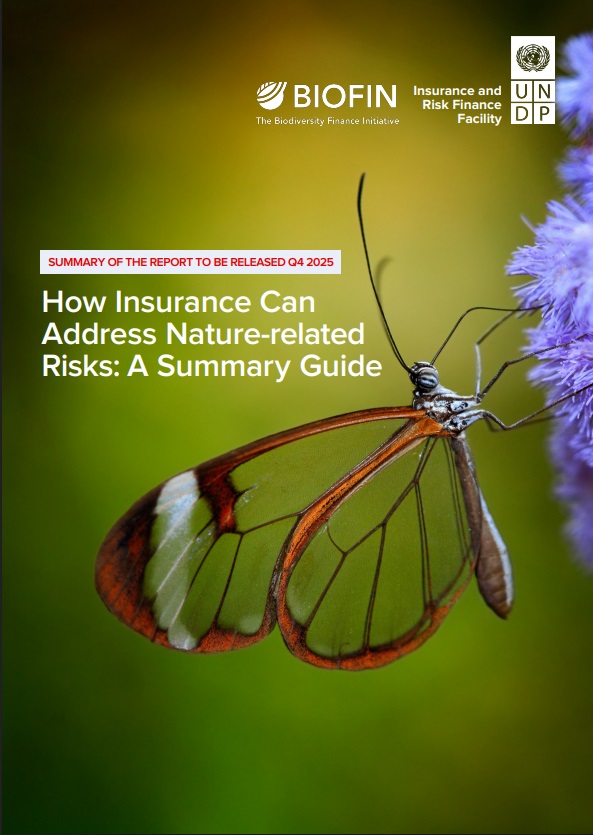
Insurance can play a crucial role in biodiversity conservation by providing financial protection against risks to natural assets, incentivizing sustainable practices, and securing key investments.
Publications

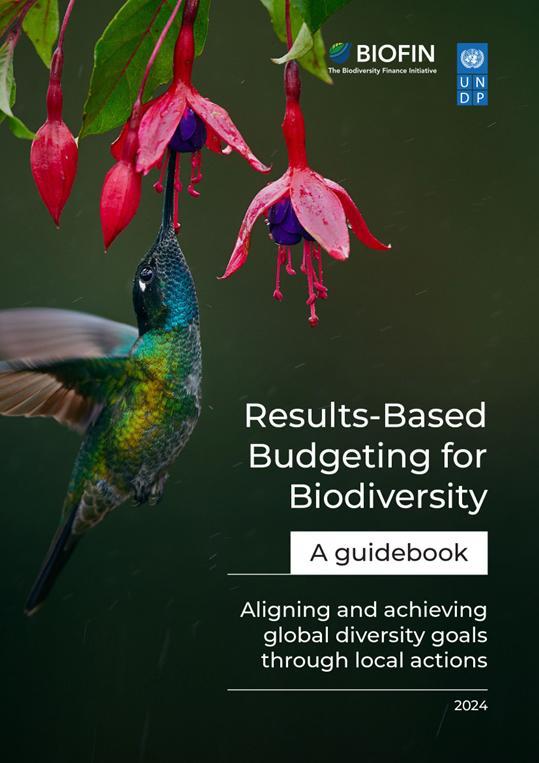
In 2022, countries adopted new global biodiversity targets under the Kunming-Montreal Global Biodiversity Framework (GBF), revisiting many goals that had gone unachieved or underachieved over the past decade.
Publications

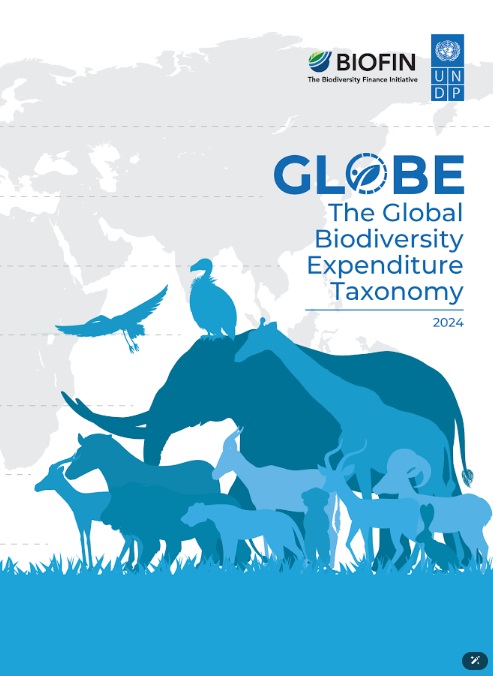
Global Biodiversity Expenditure (GLOBE) is a taxonomy that categorizes all potential public expenditures for biodiversity.

The taxonomy consists of two components:
Publications

The BIOFIN Workbook 2024 provides detailed guidance to design and implement national biodiversity finance plans.  These are not mere plans. They set out a process to engage a coalition of actors around the issue of biodiversity finance for an extended time.
Publications

At the Conference of the Parties to the Convention on Biological Diversity 15 (CBD COP 15) in 2022, countries agreed to review and update their National Biodiversity Strategy and Action Plans
Publications

Well-intentioned subsidies aimed at socio-economic goals can have unintended negative impacts on the environment, including biodiversity. The BIOFIN team has developed a step-by-step guide to repurpose such subsidies and improve their positive impacts on people and nature.
Publications

The Kunming-Montreal Global Biodiversity Framework (GBF) calls for a whole-of-society approach to halting and reversing nature loss.

Publications


The Little Book of Investing in Nature provides an essential overview of the area of biodiversity finance at a time when governments and international negotiators are urgently seeking pragmatic solutions for the twin crises of climate change and the loss of nature.

E-LEARNING

Learning for nature: our free biodiversity finance certified e-learning course

Take our free biodiversity finance certified e-learning course. Master the methodology, connect with experts, and gain certification.

Start E-Learning
Browse the Knowledge Platform
636 Results
Publications
Publications

In this executive summary, BIOFIN Mexico compiles the results of Phase I of the project, as well as the finance solutions for biodiversity that the initiative will be implementing during Phase II. 

Publications

This report presents the results of the integration of public and private expenditure on climate change over the period 2014-2017, both constitute the total climate financing for Guatemala. The objective of this report is to create relevant information for decision making and the allocation of resources by public and private actors in order to align expenses to an efficient prioritization according to the environment status and the defined sectorial goals. The National Action Plan on Climate Change was used to guide and organize the information. The results showed that the main executing institutions of the expenditure are: five public institutions (MARN, MAGA, CONAP, INAB, CONRED) and two private sector components (international cooperation and private sector). The most important source of financing for climate change comes from loans from the national financial sector to the private sector (Q 4,220.91 million). The second source corresponds to external loans to the private sector (Q 4,206.36 million), followed by the private sector’s resources (Q 3,687.58 million). The fourth source comes from the public sectors and from the current income, particularly from taxes collection (Q 1,830.79 million); The fifth source of financing is made up of external donations from the international cooperation (Q 969.71 million). The national expenditure on climate change for the period 2014-2017 is equivalent to Q 15,661.67 million, 84% of this amount was allocated to mitigation actions and the remaining 16% was allocated to adaptation actions. By relating this information with the GDP, the total national expenditure on climate change remains on 0.77% of GDP. Finally, the report also identifies that measurement of private expenditure on climate change presents greater methodological and institutional challenges than the measurement of public expenditure. 

Publications

Sri Lankan FNA estimated the additional financial requirement (assuming that the government will maintain its current level of investments for the next six years) to implement four national level action plans (including NBSAP) which contained biodiversity related outputs. Altogether Sri Lanka needs approximately 31 Billion LKR (190 million USD) within next seven years.

Publications

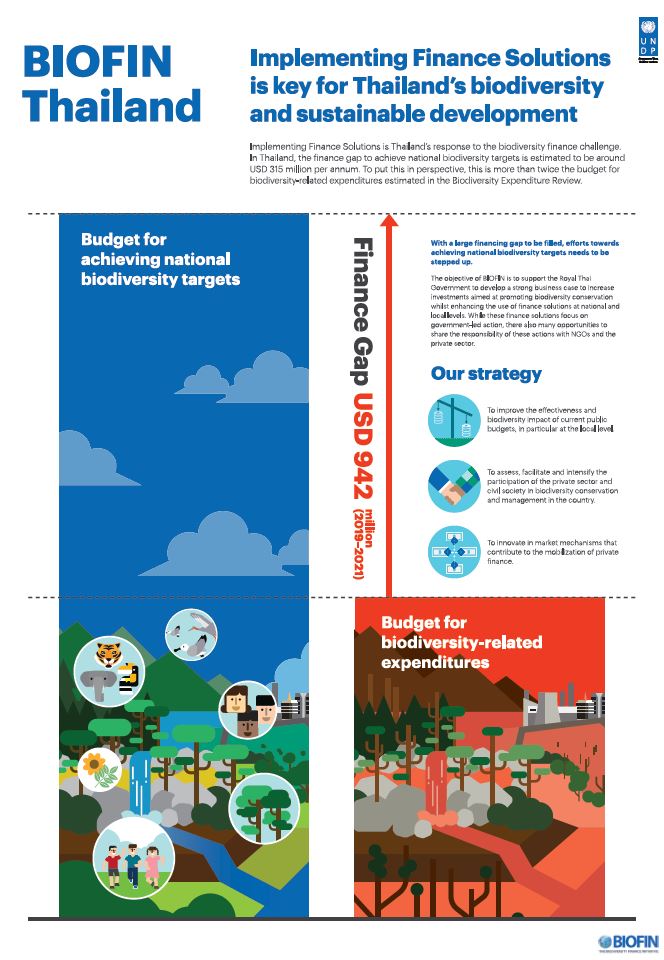
Following the BIOFIN methodology, the Biodiversity Financial Needs Assessment (FNA) aims to make a comprehensive estimate of the financial resources required to achieve national biodiversity targets. This FNA builds on the findings of Thailand’s BER, which showed that the main domestic source of biodiversity funding in Thailand is from the government’s budget allocation, which mostly pays for the operations of the core environmental agencies. The total expenditure for the core agencies accounted for around 80 percent of the overall biodiversity related budget in 2015. The finance gap as the difference between the BAU budget allocation scenario and the required budget to execute the actions in the target areas amounts to $942 million (THB 31,978 million) for the remaining three-year period of the current NBSAP (2019-2021).

Publications

Aunque Colombia cuenta con un conjunto de instrumentos económicos y financieros, éstos no son suficientes para abordar las problemáticas en la gestión sostenible de los bosques en particular y de los recursos naturales en general. Por tal razón, tanto la política de PSA como la estrategia Bosques Territorios de Vida, han identificado como un instrumento estratégico al Certificado de Incentivo Forestal de Conservación(CIF-c), por su potencial impacto en el mantenimiento de servicios ecosistémicos como regulación hídrica, así como el aporte de éste al impulso de un manejo forestal sostenible.

Bajo ese contexto, la Iniciativa de Financiación de la Biodiversidad (BIOFIN) y ONU Medio Ambiente a través del Programa ONU-REDD Colombia, de manera conjunta con el Ministerio del Ambiente y Desarrollo Sostenible (MADS) han impulsado un análisis de viabilidad jurídica, financiera y operativa del CIF-c, como una propuesta que integra los enfoques de un CIF-c bajo un PSA tradicional y un CIF-c desde una perspectiva de manejo.

El Análisis de Viabilidad, desarrollado en el presente documento se constituye en una información clave para la toma de decisión al brindar elementos jurídicos, financieros y operativos que orienten la puesta en marcha del CIF-c. Bajo esa perspectiva, el documento realiza:

• Un análisis de las barreras identificadas para la implementación del Certificado de incentivo Forestal de Conservación

• Propuesta de ajuste del CIF-c en el marco del PSA • La estimación de la demanda y oferta de recursos financieros para el CIF-c para ambos enfoques (PSA y manejo)

• Propone un conjunto de proyectos de inversión para la financiación; y v) realiza recomendaciones de ajuste del CI-c considerando los lineamientos de la EICDGB.

El Análisis de Viabilidad del Certificado de Incentivo Forestal para la conservación (CIF-C), presenta un conjunto de recomendaciones jurídicas, financieras y operativas a tomar en cuenta para que la puesta en marcha de este instrumento responda y aproveche las oportunidades que le brinda al contexto nacional de políticas, con la ley de Pagos por Servicios Ambientales y la estrategia Bosques Territorios de Vida. De esta forma, se brinda información sobre las barreras para la implementación del CIF-C, así como una propuesta de ajuste del CIF-C y los distintos escenarios de demanda y oferta de financiamiento requeridos.