Knowledge Base

Knowledge Hub

Access BIOFIN's library of resources, including flagship publications, country reports, finance solution case studies, webinars, explainer videos, podcasts, and more.

Key Publications

Publications

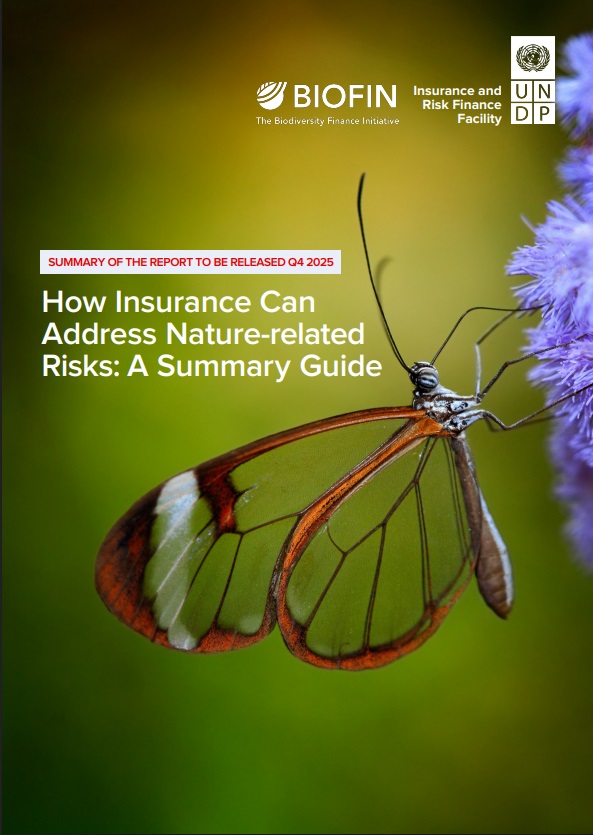
Insurance can play a crucial role in biodiversity conservation by providing financial protection against risks to natural assets, incentivizing sustainable practices, and securing key investments.
Publications

In 2022, countries adopted new global biodiversity targets under the Kunming-Montreal Global Biodiversity Framework (GBF), revisiting many goals that had gone unachieved or underachieved over the past decade.
Publications

Global Biodiversity Expenditure (GLOBE) is a taxonomy that categorizes all potential public expenditures for biodiversity.

The taxonomy consists of two components:
Publications

The BIOFIN Workbook 2024 provides detailed guidance to design and implement national biodiversity finance plans.  These are not mere plans. They set out a process to engage a coalition of actors around the issue of biodiversity finance for an extended time.
Publications

At the Conference of the Parties to the Convention on Biological Diversity 15 (CBD COP 15) in 2022, countries agreed to review and update their National Biodiversity Strategy and Action Plans
Publications

Well-intentioned subsidies aimed at socio-economic goals can have unintended negative impacts on the environment, including biodiversity. The BIOFIN team has developed a step-by-step guide to repurpose such subsidies and improve their positive impacts on people and nature.
Publications

The Kunming-Montreal Global Biodiversity Framework (GBF) calls for a whole-of-society approach to halting and reversing nature loss.

Publications

The Little Book of Investing in Nature provides an essential overview of the area of biodiversity finance at a time when governments and international negotiators are urgently seeking pragmatic solutions for the twin crises of climate change and the loss of nature.

E-LEARNING

Learning for nature: our free biodiversity finance certified e-learning course

Take our free biodiversity finance certified e-learning course. Master the methodology, connect with experts, and gain certification.

Start E-Learning
Browse the Knowledge Platform
645 Results
Publications

The United Nations Development Programme (UNDP), the International Union for Conservation of Nature (IUCN) and its World Commission on Protected Areas (WCPA) as well as WildArk- A Movement for the Wild present the inaugural Pathfinder Award.

The Pathfinder Award recognises outstanding and innovative solutions for protected and conserved areas, developed and implemented by individuals, organisations or groups.

Insufficient investment of finance and other resources in protected areas are persistent challenges that impede and weaken conservation efforts and effective management of protected areas around the world.

Available research indicates that the funding gap for protected areas globally is estimated at US $30 - 35 billion dollars per year. Yet, protected areas provide an economic return of as much as 50 to 1, in addition to providing multiple other non-economic benefits.

There is a clear need to find solutions that can increase the level of funding and resourcing for protected and conserved areas, many examples of which may already exist and are not widely known.

This year’s award focuses on identifying and celebrating solutions from around the world that have addressed this problem. Solutions should demonstrate:

  • Success in sustainable financing or resources: adopting new types of sustainable financing or resourcing for one or more protected/conserved areas;
  • New and additional sources of revenues or means to address priorities sustainably;
  • Significant finance or resourcing breakthrough: dramatically increasing protected area revenues or access to resources without compromising integrity;
  • Successful partnerships for financing/resourcing: new partnerships developed with private sector or civil society that achieves new financing or resourcing;
  • New technologies: new approaches or methods to mobilise, collect, administer or disburse financial and other resources for protected areas;
  • Management for investment: new management approaches to attract and enable investment or achieve new efficiencies.

The 2018 awards are made up of a cash grant as well as several other areas of recognition, taking into account submissions across all thematic areas listed above.

  1. Overall winner (individual or organization): US$ 10,000
  2. Runner-Up (individual or organization): US$ 2,000
  3. Special commendation (to be awarded to up to three individuals or organizations): US$ 1,000 each

The winners will also receive a plaque and certificate of achievement, promotion and visibility, and an invitation to the awards ceremony. The inaugural award will be presented at the 14th meeting of the Conference of the Parties to the Convention on Biological Diversity (COP 14), which will be held in Sharm El-Sheikh, Egypt, between 17 and 29 November 2018.

This year’s award is organised in co-operation with the UNDP-Biodiversity Finance Initiative (BIOFIN) and the PANORAMA – Solutions for a Healthy Planet initiative.

Submit your nomination now (self-nominations are accepted) through the following 2 steps:

  1. Completing the online nomination form: (https://www.surveymonkey.com/r/PathfinderAwardENG)
  2. Submitting a description of the solution/innovation that is being nominated as a “Full Solution” on the PANORAMA web platform: https://panorama.solutions/en/solution/add
Publications

The purpose of the integrated Policy and Institutional Review (PIR) report is to provide an overview of the policy and institutional context that concerns the management and utilization of Thailand’s biodiversity resources. The report is structured around four main ecosystems in Thailand, namely, terrestrial ecosystem, wetland ecosystem, coastal and marine ecosystem, and urban biodiversity. The specific policies and legal contexts with economic implications that drive both positive and negative trends in biodiversity and ecosystems in the country have been identified. The final Section summarizes preliminary policy recommendations and possible biodiversity finance solutions that will guide Thailand to further its Biodiversity Finance Plan.

Publications

Biodiversity Expenditure Review in Sri Lanka reviewed the 2010-2015 period to assess the investments made on the biodiversity sector. It revealed the government has increased investments on biodiversity by 125% during the period but still couldn't facilitate the full achievement of national biodiversity targets. Annual projected investment from the government side is approximately 7 billion LKR which is equivalent to 45 million USD.

Publications

Aichi Biodiversity Targets - Mongolian version 

Publications

The terminology “biodiversity” was first introduced when Mongolia ratified the Convention on Biodiversity (1992), and it has been mainstreamed in policy and planning documents as a synonymous term for the umbrella environmental issues including environmental protection1, preserving ecological balance, conservation of protected areas, protection of endangered flora and fauna species. Biodiversity is a complex system consists of all aquatic and terrestrial living organisms, their genetic diversity, habitats in biosphere and ecosystem diversity. In this sense the National Biodiversity Programme (NBP) is an umbrella programme covering environmental protection, biodiversity conservation, sustainable use of natural resources and restoring of depleted resources.

Publications

a)    The policy and institutional landscape in Zambia is diverse and relatively adequate to finance and manage national biodiversity subject to various policy and implementation adjustments.

b)    The economic and financial drivers of biodiversity change are driven by economic and financial interaction between society and biological resources that positively or negatively impacts biodiversity.

c)    Economic valuations of biodiversity have indicated potential revenues from the natural assets base ranging from a low of $51-$135 million (2002-2007) from fisheries resources, $396m/annum from wood production, $6/ton of Carbon, to $17 billion/annum by 2017 from mineral resources.

d)    Biodiversity dependent revenues are primarily through penalties, licensing, environmental impact assessments, fees and charges.

e)    Key biodiversity conservation departments and statutory bodies are spread over eleven ministries. To avoid fragmented coordination and implementation of biodiversity and environmental programmes, there is need to revisit the setup of the biodiversity conservation departments and institutions and ensure that departments with similar mandates fall under one Ministry.

f)    There is inadequate holistic policy and legal framework to involve the private sector and civil society in the direct implementation of the activities in the National Biodiversity Strategy and Action Plan.

g)    There is need for legislative change that will ensure that the revenue generated from biodiversity sectors is spent on conservation; increased budgetary allocations and timely releases of funds for planned activities in the biodiversity sectors.

Publications

a)    Between 2010 to 2017, donor funding financed 73% of Zambia’s national budget towards environmental protection. Government needs to take leadership in financing environmental protection given the dwindling Overseas Development Assistance (ODA).

b)    Between 2010 to 2018, budgetary allocation towards environmental protection remained at an average of 0.6% of the total national budget against 2.29% allocated towards agriculture subsidies over the same period (Farmer Input Support Programme-FISP). Given the failure of FISP to deliver against its primary objectives of increasing productivity and poverty reduction over the years of its existence, it is recommended that this subsidy be reformed i.e. greening it.

c)    Fiscal revenue that are derived from environmental or biodiversity fiscal measures must not be pooled in the consolidated account. Instead, they should have a separate account earmarked to fund environmental or biodiversity conservation projects only.

d)    Non-tax revenues collected by Ministries, Provinces, and Spending Agencies (MPSAs) charged with biodiversity conservation must be allowed to retain a substantial component of the revenue collected (i.e. 60%) to be ploughed back into biodiversity conservation.

e)    The minimum investment threshold of US$500,000 for investments to qualify for incentives under the Zambia Development Agency (ZDA) Act is too high. This needs to be revised downwards i.e.$50,000 if the country is to attract investments for pro-biodiversity conservation investments.

f)    Key biodiversity sectors notably fisheries, wildlife and water ought to explicitly be designated as priority sectors in the ZDA Act for potential investments in such sectors to qualify for fiscal incentives. The specific qualifying areas of investment outlined in the second schedule of Statutory Instrument No.17 of 2014-ZDA Act also needs to be revised to include these pro-biodiversity conservation investment areas.

g)    There has been a concentration on regulatory, fiscal, debt and grant instruments to finance biodiversity conservation in Zambia. It is essential to begin focussing on innovative financing instruments notably those that are market oriented (offsets, carbon markets, green or social and development Impact Bonds, impact investments etc), supported by risk mitigation instruments such a sovereign/public guarantees as well as disaster risk and related insurance products.

BIOFIN Videos
SEE ALL