Knowledge base

Browse the Knowledge Platform

636 Results
Webinars

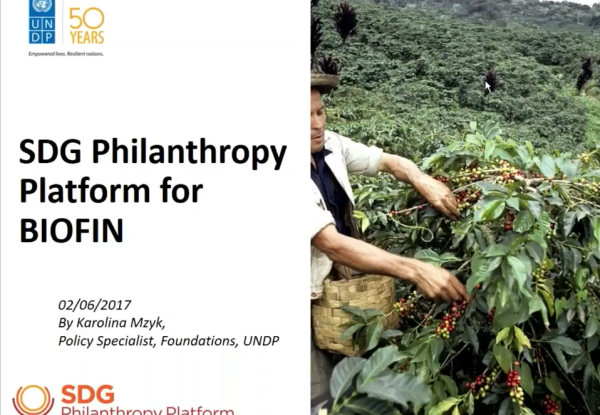
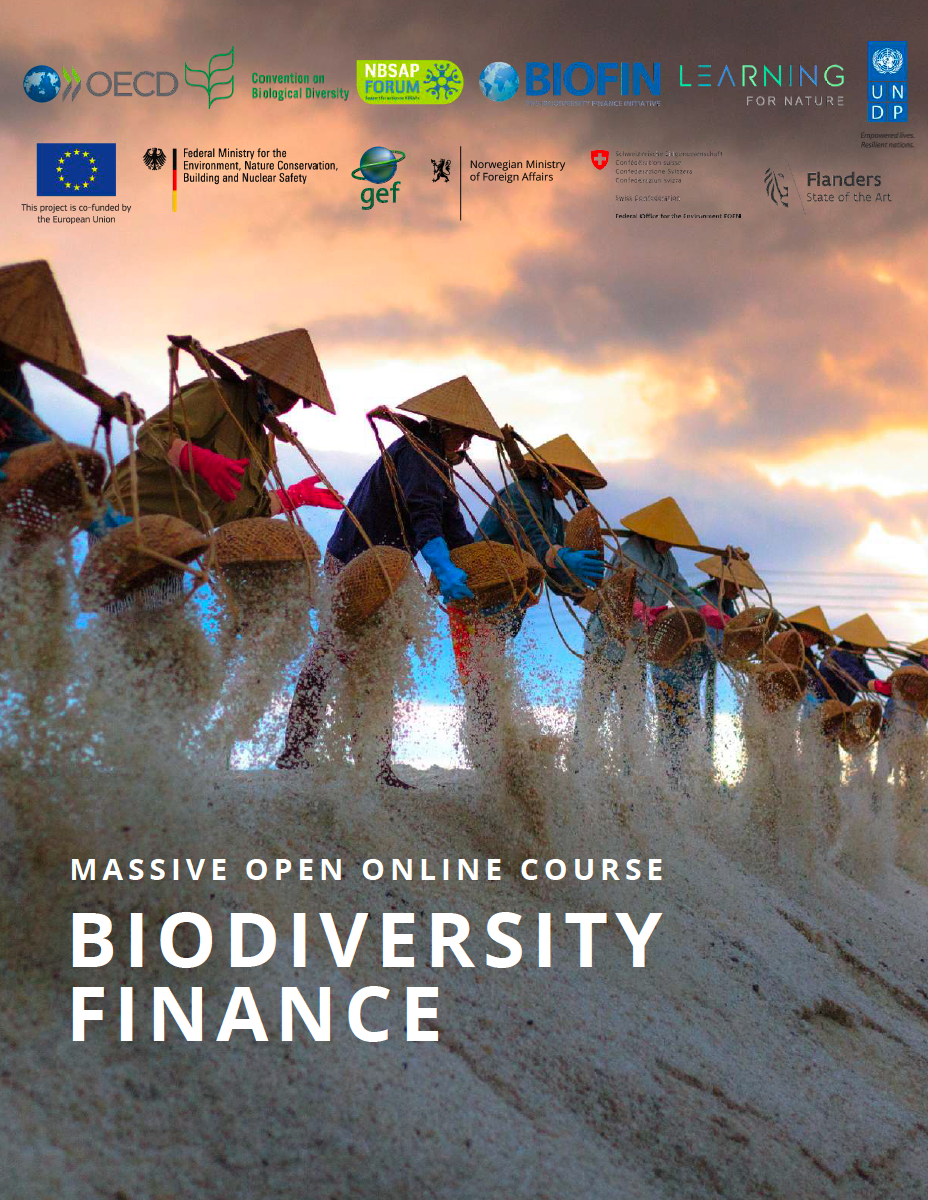
Este seminario web fue un componente del Curso en Línea Masivo y Abierto Curso sobre Finanzas de la Biodiversidad, que tuvo lugar del 15 de abril al 31 de mayo de 2019.

El curso fue ofrecido por la Iniciativa de Finanzas para la Biodiversidad (BIOFIN) del Programa de las Naciones Unidas para el Desarrollo (PNUD), en asociación con el Programa Mundial sobre la Naturaleza para el Desarrollo del PNUD, el Foro ENBPA, la Secretaría del Convenio sobre la Diversidad Biológica (CDB) y la Organización para la Cooperación y el Desarrollo Económicos (OCDE). El apoyo financiero fue proporcionado por los gobiernos de la Unión Europea, Flandes, Noruega, Alemania y Suiza, y el FMAM.

Puede acceder a las presentaciones presentadas en este seminario web aquí:https://learningfornature.org/es/topi.... Para ver las presentaciones, es necesario crear una cuenta en Learning for Nature (https://learningfornature.org/es/regi...) e iniciar sesión.

El curso a su propio ritmo sobre Finanzas de la Biodiversidad es gratuito y está abierto para todos a partir del 1 de julio de 2019 en este enlace: https://learningfornature.org/es/cour.... Si tiene alguna pregunta, comuníquese con info@learningfornature.org

Webinars


This webinar was a component of the Massive Open Online Course on Biodiversity Finance, which took place on 15 April – 31 May 2019. 

Publications
Publications

The Viet Nam Biodiversity Expenditure Review (BER) was undertaken as part of the Global Biodiversity Finance Initiative (BIOFIN) project, managed by UNDP in partnership with the European Commission (EU) and the governments of Germany, Switzerland, Norway and Flanders. The overall goal of the project is to explore national and subnational level biodiversity expenditures by different government organizations, agencies, ministries, NGOs and private sector actors, providing inputs for the better implementation of actions to reach national biodiversity targets both technically and financially.

The Viet Nam BER follows guidance provided by the BIOFIN global team, embedding a number of adjustments to ensure alignment with the specific contextual conditions of the country. The BER was completed with inputs from various sources at both the national and provincial level, such as: the Ministry of Agriculture and Rural Development (MARD), the Ministry of Natural Resources and Environment (MONRE), the Ministry of Science and Technology (MOST), Provincial Departments of Agriculture and Rural Development (DARDs), Provincial Departments of Natural Resources and Environment (DONREs), National Parks (NPs), Nature Reserves (NRs), etc. All collected data and information was analyzed following the guidance provided in the BIOFIN Workbook (2016). Two consultation workshops were also organized, to collect comments and feedback from relevant stakeholders and interested parties, which were used to frame this final report and its recommendations.

Publications

The Viet Nam FNA follows guidance provided by the BIOFIN global team, with a number of adjustments to ensure alignment with the specific contextual conditions of the country. The FNA was completed with inputs from various sources at both the national and provincial level, including the Ministry of Agriculture and Rural Development (MARD), the Ministry of Natural Resources and Environment (MONRE), the Ministry of Science and Technology (MOST), relevant subordinate ministerial Administrations, Agencies and Departments, Provincial Departments of Agriculture and Rural Development (DARDs), Provincial Departments of Natural Resources and Environment (DONREs), National Parks (NPs), Nature Reserves (NRs), etc. All collected data and information were analyzed following the guidance provided in the BIOFIN Workbook (UNDP, 2016). Two consultation workshops were organized, to collect comments and feedback from relevant stakeholders and interested parties, which were used to frame this final report and its recommendations.

The FNA is the BIOFIN report estimating the anticipated financial needs to achieve the specific targets as formulated in the Viet Nam National Biodiversity Strategy (VN NBS) to 2020, vision to 2030. The FNA adopted Decision 45/QD-TTg, dated 08 January 2014 on Approval for Master Plan of Nation-Wide Biodiversity Conservation by 2020, with a vision to 2030 as quantitative guidance for the anticipated expanding Viet Nam’s Terrestrial Protected Area (TPA) and Wetland PA (WPA) systems, and Decision 742/QD-TTg, dated 26 May 2010, approving the Plan on the system of Viet Nam’s marine conservation zones through 2020 as quantitative guidance for Viet Nam’s expanding Marine PA (MPA) network. Specific targets related to forest cover, mangroves, sea grass beds and coral reefs as well as degraded critical ecosystems are also assumed to be achieved through managing an expanding PA system. In addition, the FNA assumed that the poorly to not-quantifiable specific targets of the VN NBS, on endangered, rare and precious species, avoidance of species extinction and genetic resources, can be represented by the proxy target of “administration expenditures for biodiversity conservation management at provincial level and central level”.

The FNA estimated the finance needs for optimal management1 of biodiversity conservation in Viet Nam’s existing and planned PAs, using a bottom-up Activity Based Costing (ABC) approach to obtain a unit-cost-per-hectare for different PA types based on quantitative information provided by sample PAs for 8 cost categories (e.g. salaries, annual operational and maintenance costs, costs for biodiversity conservation activities), as well as one-time investment costs for infrastructure and facilities in new PAs. The administrative expenditures for biodiversity conservation management at the provincial and central levels were costed using an Incremental Budgeting Approach (IBA), based on actual expenditures for 2015 obtained from the BIOFIN Viet Nam Biodiversity Expenditure Review (BER). Both estimates were summed to obtain the total finance needs to achieve the targets of the VN NBS, and compared with the actual biodiversity expenditures as forecasted in the BER report, to obtain the quantified financial gap for achieving the Viet Nam NBS.

The FNA assessed the finance needs for the optimal management of biodiversity in Viet Nam to 2030 against 2 scenarios: (i) Finance needs for optimal biodiversity management in Viet Nam to 2030 based on the PA network established prior to 2018; and (ii) Finance needs for optimal biodiversity management in Viet Nam to 2030 based on an annually expanding PA network. Scenario 1 is “lower-optimum” scenario, estimating financing needs for optimal biodiversity management only for PAs existing in 2018, equal to 7.5% of the country’s surface area. Scenario 2 is the “optimum” scenario, estimating finance needs for optimal biodiversity management including for a PA network expanded in line with adopted government policies, to achieve a PA coverage in 2030 equal to 9.6% of the country as stipulated in the VN NBS.


Publications

The Seychelles Policy and Institutional Review report represents the first assessment document for the country under the BIOFIN initiative. An extensive desk review of the legal and policy framework, pertaining to biodiversity with a focus on the financial provisions. 

The setting up of the BIOFIN Steering Committee which was co-chaired by the Ministry of Environment, Energy and Climate Change and at the time the Ministry of Finance, Trade and Blue economy, allowed for a thorough consultative process with stakeholders (for the PIR), and attendance by civil society representatives and key government officials involved in biodiversity conservation. 


Publications

The Seychelles FNA  was in essence a Costing of the NBSAP 2011-2015 which amounts to SCR320 million.

Publications

The Biodiversity Expenditure Review was the first of its kind in Seychelles. It estimated total expenditure on biodiversity across the Public Sector, NGOs and the Private Sector at an average SCR150 million per annum for the period 2011-2015. Of this amount an average of SCR100 million was expended by the Public Sector alone. It should be underscored that total spending on biodiversity was less than 2% of the total public sector budget.

Publications

The Seychelles BFP aimed to present a coherent and comprehensive national approach to biodiversity finance, including a mix of finance solutions, by engaging the public sector, private sector and civil society, in support of the implementation of the current and future NBSAPs.


Publications

The Biodiversity Plan for Sri Lanka presents a detailed and prioritized set of financial solutions to achieve nationally set biodiversity targets within the period of 2018-2024.It showcase 13 different solutions that could be used in an innovative way to bridge the existing financial resource gap.

Knowledge Partners

Biodiversity and Ecosystem Services Network logo
Biodiversity finance resources library and forum.
Sustainable Development Finance Platform logo
Guidance and detailed descriptions of finance solutions for sustainable development.

NBSAP logo
Support for action on National Biodiversity Strategy and Action Plans