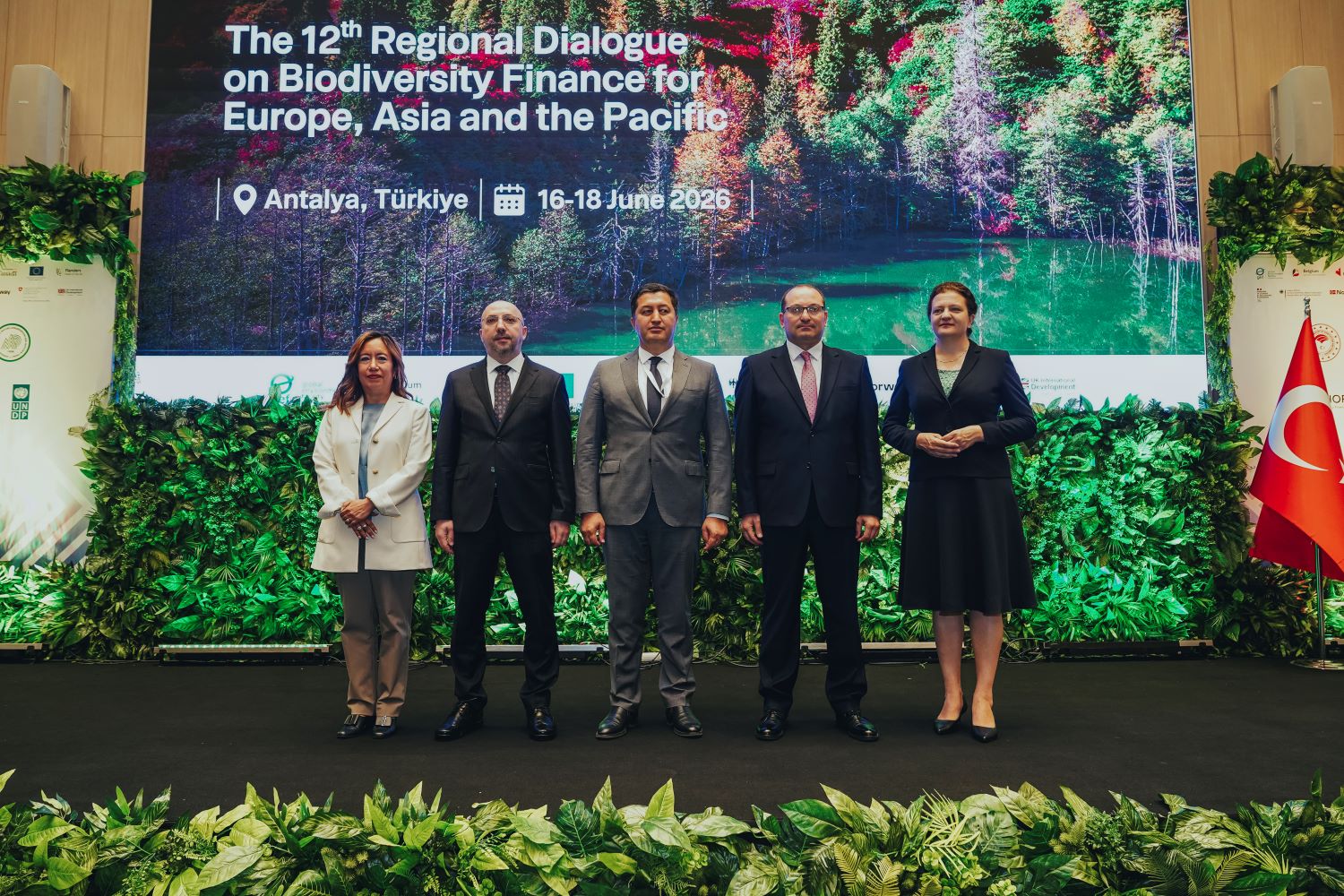
Antalya, Türkiye, 16 June 2026 — As countries approach the halfway mark to global biodiversity targets for 2030, public sector action across Europe, Asia and the Pacific is playing a growing role in advancing biodiversity protection and mobilizing the finance needed to meet global targets.
At a time when businesses across the region are aligning with sustainability outcomes, governments are demonstrating how public finance can help translate biodiversity commitments into results.
Notable progress in unlocking biodiversity finance is in focus this week in Antalya, where policymakers, practitioners, and finance experts have gathered for the 12th EAPAC Regional Dialogue on Biodiversity Finance.
Representatives from ministries of finance and environment, biodiversity finance practitioners, technical experts, and development partners from across the three regions are being hosted by the Government of Türkiye, convened by UNDP’s Biodiversity Finance Initiative (BIOFIN) to map and replicate successful approaches that can lead to action on biodiversity finance at scale.
The event takes place in a year marked by heightened attention to the interconnections between biodiversity, climate, and land. As countries advance action across the Rio Conventions, the Dialogue will underline the importance of integrated approaches that recognize nature finance as essential for climate resilience, sustainable land management, food security, water security and economic stability.
“Today, humanity is battling multi-dimensional crises such as biodiversity loss, climate change, and ecosystem degradation,” said Kadir Çokcetin, the Director General of the General Directorate of Nature Conservation and National Parks (NCNP) in Türkiye, at the opening of the Dialogue.
“While countries develop policies in the face of these crises, lasting solutions require resolute and concrete steps at the global level. The success of these steps depends on a strong financing structure and an effective organization,” he added.

Photo: Kadir Çokçetin, the Director General of the General Directorate of NCNP
“This Dialogue creates space for a broader conversation about how biodiversity finance supports solutions that benefit all aspects of development, beyond the environmental agenda,” said Monica Merino, UNDP Resident Representative in Türkiye, speaking at the opening.
“BIOFIN has become a cornerstone of UNDPs nature portfolio by providing the financial architecture to translate National Biodiversity Strategy and Action Plans (NBSAPs) into sustainable financing solutions. And serving as an integrator connecting policies, institutions, financing mechanisms, and investment opportunities”, she added.

Photo: Monica Merino, UNDP Resident Representative in Türkiye
From Ambition to Action
The Dialogue comes at a pivotal moment for the region, as 33 countries move from planning to implementation of Biodiversity Finance Plans (BFP), developed with support from UNDP’s Biodiversity Finance Initiative.
These plans are designed to help governments identify financing needs, review public expenditure, assess policies and institutions, and develop concrete finance solutions to mobilize and align resources for biodiversity.
“The US$3.3 billion unlocked by countries with UNDP support shows that biodiversity finance can deliver measurable results when countries have the right tools, data, and long-term partnerships in place,” said Martin Cadena, BIOFIN Global Manager at UNDP.
“As more countries develop Biodiversity Finance Plans, we have a major opportunity to accelerate progress and help governments mobilize and align the resources needed to implement the Kunming-Montreal Global Biodiversity Framework,” he said.
“This is the moment to move from planning to investment, and from individual success stories to action at scale.”
Türkiye is also among the countries developing a Biodiversity Finance Plan, signaling growing momentum across the region to strengthen national systems for financing nature.
The Dialogue will focus on how countries can accelerate progress toward key global biodiversity targets, including Target 19 on resource mobilization, Target 18 on reforming incentives harmful to biodiversity, and the 30x30 goal to conserve at least 30 percent of land and sea areas by 2030.
Protected and conserved areas are a central part of this story. They remain among the most important tools for conserving biodiversity and achieving the 30x30 target, but many continue to face significant financing gaps. Several countries in the region are showing how realigning public spending can strengthen the long-term sustainability of protected areas.

Biodiversity Finance Impact in EAPAC
Notable nature finance results across the sub-regions will feature in the Dialogue:
- In Malaysia, Ecological Fiscal Transfers have channeled more than US$177 million to sub-national governments since 2019, supporting the expansion of 350,000 hectares of protected areas.
- In Kazakhstan, public financing for protected areas crossed US$200 million between 2019 and 2025, while revised protected area fees helped increase ecotourism revenues from US$0.6 million in 2024 to US$2.6 million in 2025.
- Mongolia has seen a 217% increase in environmental protection budgets following efforts to implement a natural resource fee that was already in place.
- The Philippines has increased protected area budgets by $122 million since the adoption of the Expanded National Protected Areas Law in 2018.
- Fiji’s first-ever Sovereign Blue Bond, with a ceiling of approximately US$9 million, is mobilizing private capital for ocean conservation, climate resilience and sustainable blue economy development, with support from UNDP and the United Kingdom’s Blue Planet Fund.
For countries across Europe, Asia and the Pacific, financing nature is also an investment in climate resilience.
Protected areas, restored forests, healthy reefs, mangroves, and wetlands can reduce disaster risks, support water and food security, and strengthen the adaptive capacity of communities. This is especially important for coastal and island states, where ecosystems often provide the first line of defence against climate impacts.

Marine finance for Pacific resilience and the 30x30 target
Marine finance will be a major focus of the Dialogue, particularly for six Pacific Island nations attending the event, where ocean health underpins food security, livelihoods, cultural identity, tourism, and climate resilience.
This agenda is closely linked to Target 3 of the Kunming-Montreal Global Biodiversity Framework, which calls for at least 30 per cent of terrestrial, inland water, coastal, and marine areas to be effectively conserved and managed by 2030. For island and coastal states, achieving this goal will require not only expanding marine protected and conserved areas, but also ensuring they are sustainably financed over the long term.
The Dialogue will demonstrate how countries across the Pacific are already exploring practical ways to connect ocean conservation with national development.
Fiji is reinvesting ecotourism revenues into coral reef and mangrove restoration, while countries including Niue and the Cook Islands are advancing approaches that link large-scale ocean conservation with sustainable financing and local benefits. Experiences from the Philippines and other coastal countries in the wider region will also help inform discussions on marine protected area fees, community-based conservation, sustainable fisheries, and mechanisms that can generate reliable resources for ocean protection and coastal communities.

Photo: Steliana Nedera, Director, UNDP Regional Hub Istanbul
An Economic and Finance Shift
These examples point to a wider, often under-recognised shift: biodiversity finance is not only about finding new money, but also about using existing public finance more effectively, aligning incentives with nature-positive outcomes, and ensuring that protected areas have the resources they need to deliver for people, economies and ecosystems.
The Antalya Dialogue will also examine how countries are addressing incentives that are harmful for nature. Thailand’s work on harmful incentives linked to seawall construction offers one of the region’s strongest examples of how policy reform can avoid environmentally damaging expenditure and support more sustainable coastal management.
Such reforms are directly aligned with Target 18 of the Kunming-Montreal Global Biodiversity Framework, which calls on countries to identify, eliminate, phase out or reform incentives, including subsidies, that are harmful for biodiversity.
Participants will also exchange experiences on ecological fiscal transfers, biodiversity expenditure reviews, protected area fees, blended finance, biodiversity budget tagging, digital finance, insurance mechanisms, green bonds, ecotourism revenues, and other practical finance solutions.

Impact at Scale
Since 2018, BIOFIN-supported solutions have helped partner countries unlock more than US$3.3 billion in finance for nature. This growing body of results demonstrates how country-led biodiversity finance planning can help governments move from analysis to implementation and accelerate progress toward the global biodiversity targets.
For countries across Europe, Asia and the Pacific, the challenge is no longer only to define biodiversity priorities, but to finance them. By bringing together governments, practitioners, and partners from across the region, the Antalya Dialogue aims to strengthen practical cooperation, accelerate the development of Biodiversity Finance Plans, and support countries in turning global commitments into measurable results for people and nature.
Categories
Countries
Archives
- April 2023 (1)
- March 2023 (2)
- January 2023 (4)
- December 2022 (19)
- November 2022 (4)
- October 2022 (3)
- September 2022 (5)
- August 2022 (4)
- June 2022 (3)
- May 2022 (2)