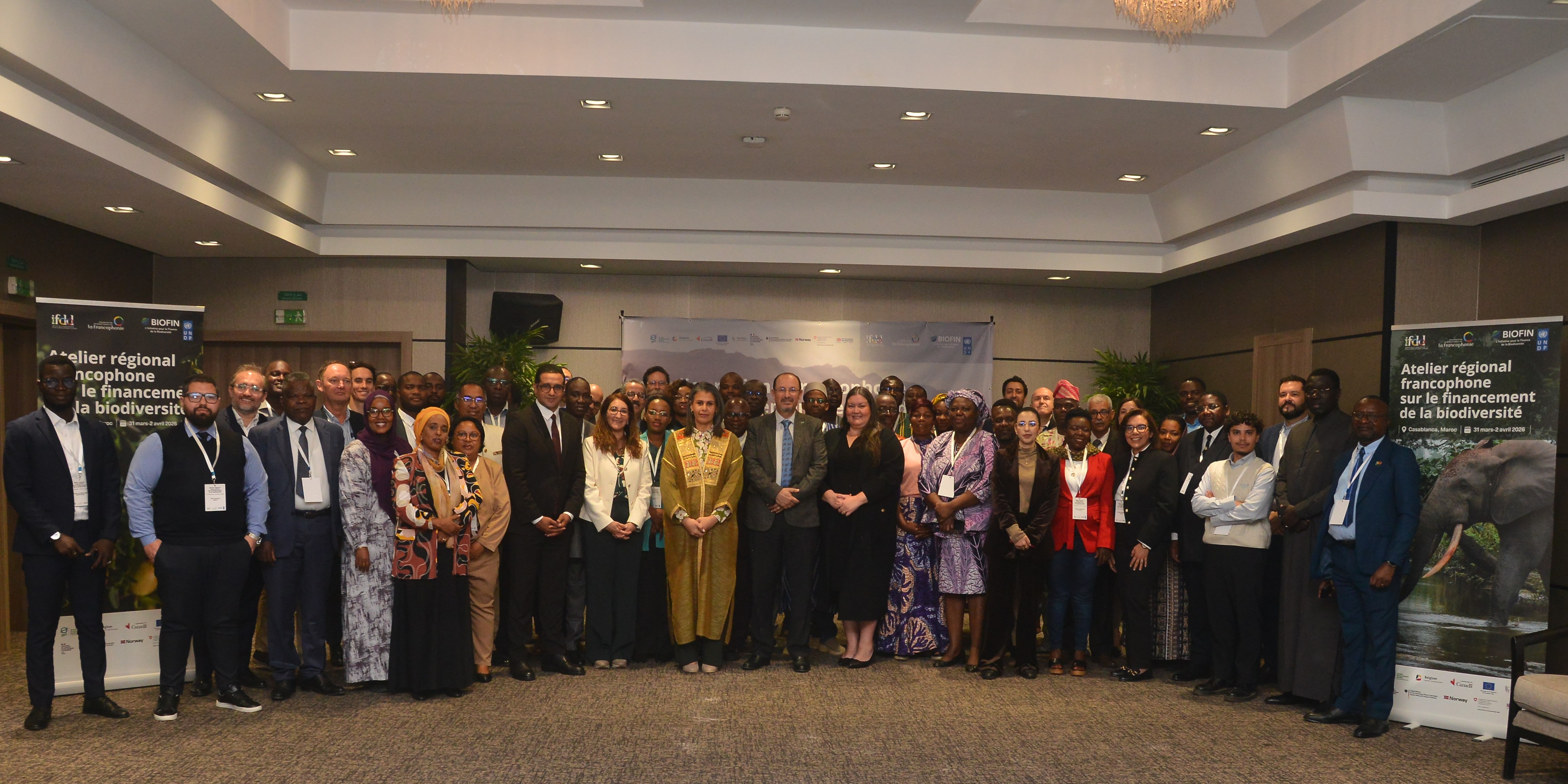
A landmark workshop will equip 24 French-speaking nations with the tools to close their biodiversity finance gap, with support from UNDP-BIOFIN, IFDD and the Global Environment Facility
Casablanca, Morocco, March 31, 2026
The forests of the Congo Basin shelter more species than almost anywhere on Earth. Madagascar is home to plants and animals found nowhere else on the planet. The Guinean Forests of West Africa are among the most biodiverse ecosystems in the world. And yet the countries responsible for protecting these irreplaceable habitats are struggling to finance their conservation efforts.
This week, 24 French-speaking nations are gathering in Casablanca in an effort to change that. The Regional Francophone Workshop on Biodiversity Finance (March 31-April 2) has been co-organized by UNDP's Biodiversity Finance Initiative (BIOFIN), the Institut de la Francophonie pour le dévelopement durable (IFDD) and the Global Environment Facility (GEF).
“Morocco is fully committed to integrating biodiversity into public policies and financial mechanisms, through the development of its National Biodiversity Finance Plan. Strengthening synergies between climate and biodiversity finance is an essential lever for accelerating the implementation of the Global Framework,” said M. Bouzekri Razi, Secretary General at Morocco’s Ministry of Energy Transition and Sustainable Development.

The goal is both practical and urgent: to equip participating countries with the technical tools, peer networks, and the Biodiversity Finance Plans they need to protect their natural heritage.
“Biodiversity and ecosystem services are recognized as the foundation of our economies, our food security, our climate resilience, and the well-being of our populations, especially in rural, coastal, and mountain areas,” said Noëlla Richard, Deputy Resident Representative at UNDP Morocco.
“Our shared ambition is now clear,” she explained, “to support each country in developing an operational roadmap, tailored to its national context, to close the financing gap in favor of nature, better orient public and private expenditure, and firmly embed biodiversity at the heart of development strategies and economic decision-making.”
Biodiversity Finance Plans are globally recognized as an important ‘enabling action’ for countries that signed the Kunming-Montreal Global Biodiversity Framework (KMGBF), a 2022 landmark international agreement to protect and restore biodiversity.
The KMGBF set ambitious targets for 2030: protecting 30% of the planet's land and oceans, eliminating harmful subsidies, and — crucially — closing a biodiversity finance gap estimated at over $700 billion a year.
Developed and implemented with support from UNDP’s Biodiversity Finance Initiative, these plans have enabled 41 partner countries to unlock over US$2.7 billion in finance for nature since 2018.

With support from the Global Environment Facility, BIOFIN is supporting an additional 91 countries to develop their Biodiversity Finance Plans, including the 24 countries that attended the workshop.
"We are at an inflection point,” explained Mariana Bellot, Global Manager at UNDP’s Global Biodiversity Finance Programme.
“Solutions across 41 countries have unlocked $2.7 billion in nature finance. But with 91 additional countries now supported through the partnership with the GEF, we are putting the architecture in place for something much larger.
As those countries move from planning into implementation, the potential to shift the needle on the biodiversity finance gap becomes real in a way it has not been before,” she said.
“Through this regional Francophone workshop with BIOFIN and the GEF, we reaffirm our commitment to supporting member states and governments in strengthening capacity to mobilize credible, structured financing suited to biodiversity challenges. IFDD representative on their priorities in supporting the Francophone workshop,’ said Cécile Martin-Phipps, Director at IFDD.
With COP17 — the next major UN biodiversity summit — on the horizon, pressure is mounting on governments to show measurable progress. Countries will be expected to demonstrate not just intent, but delivery: updated national biodiversity strategies, new finance mechanisms, and evidence that money is flowing to where nature needs it most.
For many francophone nations in Africa, that pressure is acutely felt. Rich in biodiversity, they are also among the countries with the greatest financing constraints and, until recently, the least access to technical support in their own language.
Over three days, delegates — two per country, typically the national CBD focal point and the BIOFIN country coordinator — will work through the full BIOFIN methodology, share experiences across borders, and begin developing concrete concepts for national finance solutions adapted to their own contexts.

BIOFIN's methodology guides countries through four interconnected steps: a policy and institutional review, a biodiversity expenditure assessment, a financial needs analysis, and the development of a National Biodiversity Finance Plan tailored to each country's context.
The peer exchange element is, by many accounts, as valuable as technical training. Countries that have already advanced through BIOFIN's methodology will share what worked and what didn't, giving newer participants a more honest and grounded picture of implementation than any manual can provide.
By the end of the workshop, participants are expected to leave with strengthened technical capacity, a prioritized set of finance solutions suitable for their national contexts, and the foundation of a sustained francophone network for biodiversity finance.
The workshop's outcomes are also designed to feed directly into COP17 discussions — contributing evidence, lessons, and country-level data that can shape global decision-making on GBF targets 14, 15, 16, 18, and 19, which together cover finance mobilization, private sector engagement, harmful subsidy reform, and international support to developing countries.
The biodiversity loss unfolding across francophone Africa is not abstract. Scientists warn that the Congo Basin — the world's second-largest tropical rainforest — is under increasing pressure from agricultural expansion and illegal logging.
The premise of this week's workshop and of the broader BIOFIN initiative is that closing the knowledge and capacity gap is a prerequisite for closing the funding gap.


Categories
Countries
Archives
- November 2024 (5)
- October 2024 (14)
- September 2024 (6)
- August 2024 (9)
- July 2024 (7)
- June 2024 (3)
- May 2024 (6)
- April 2024 (5)
- March 2024 (3)
- February 2024 (6)