Latest Data reveals 41 countries have leveraged UNDP-BIOFIN support to unlock $3.3 billion in nature finance since 2018
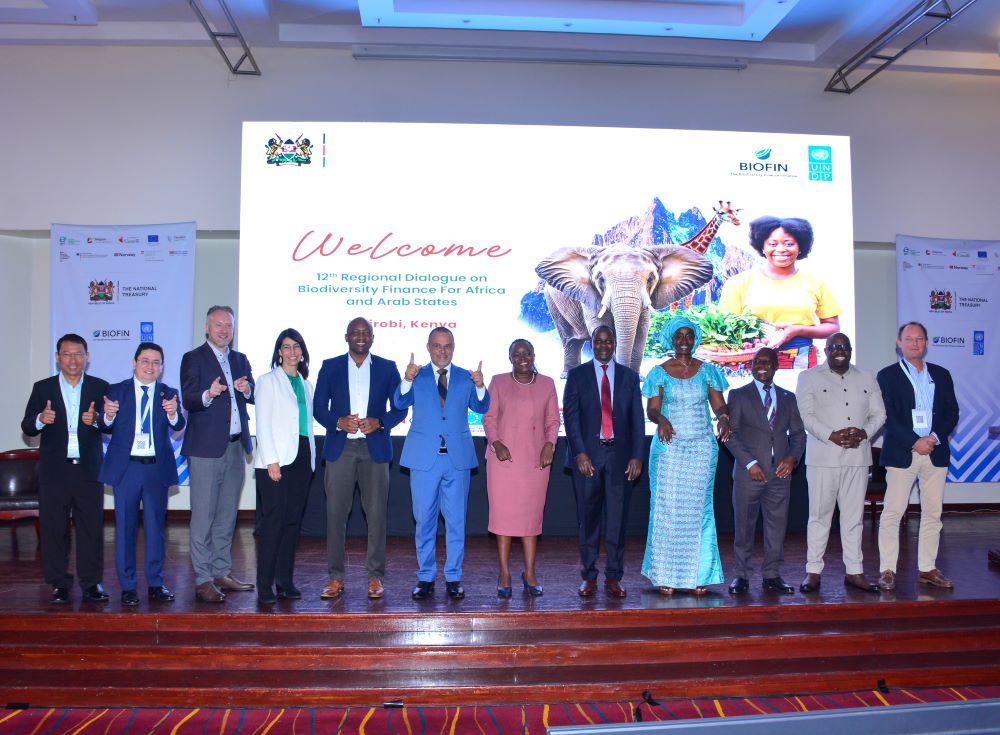
Nairobi, Kenya – April 28 — Ministries of finance and environment, private sector leaders and development partners from 56 countries are in Nairobi this week for the 12th Regional Dialogue on Biodiversity Finance for Africa and Arab States, the largest event of its kind across the two regions.
The significance of this Dialogue is underscored by a growing body of success stories emerging across Africa, where practical solutions are already delivering results.
From tourism fee reforms and digital payment systems to green bonds and emerging biodiversity markets, countries are demonstrating that nature finance can deliver real results.
Hosted by the Government of Kenya, UNDP and its flagship Biodiversity Finance Initiative (BIOFIN), the Dialogue comes at a pivotal moment, as countries move from designing biodiversity finance plans to implementing them at scale, and as global attention turns toward COP17 under the Convention on Biological Diversity.
Kenya is among 91 countries developing Biodiversity Finance Plans that can unlock new sources of financing for nature.
“The National Treasury is committed to ensuring that Kenya’s biodiversity finance architecture not only protects ecosystems but also uplifts people, women, youth, Indigenous Peoples, and local communities,” said Hon. John Mbadi, Cabinet Secretary of the National Treasury in Kenya, speaking at the launch of the Dialogue. “I take this opportunity to applaud UNDP for championing BIOFIN in Kenya,” he said.
BIOFIN support has already delivered tangible results across 41 countries where BIOFIN-supported solutions have helped unlock over $3.3 billion in nature finance.
At the center of the transition is UNDP BIOFIN’s country-led methodology, which supports governments in assessing financing needs, identifying policy and financial solutions, and integrating them into national systems.
“Africa is at the forefront of a global shift where biodiversity is not treated as a secondary concern, but as a strategic investment. Innovative instruments like green bonds and ecosystem fees are helping unlock the capital needed to safeguard the natural wealth that sustains 1.3 billion livelihoods,” said Jean-Luc Stalon, UNDP Kenya Resident Representative.

Photo: Jean-Luc Stalon, UNDP Kenya Resident Representative
“Our ambition in Nairobi is clear: to position biodiversity as a core economic asset shaping growth across the continent,” he said.
“We must move away from viewing biodiversity financing as a cost to be borne, and instead recognize it as a strategic investment in economic resilience, climate adaptation, and long-term sustainability,” said Hon. Dr. Deborah Mlongo Barasa, Cabinet Secretary for Environment, Climate Change and Forestry in Kenya.
Across Africa and the Arab States, countries are increasingly embedding nature into financial decision-making, public policy, and investment strategies. Together, the two regions are signaling a broader shift: from ambition to implementation, and from protecting nature in principle to backing those commitments with real financing.
This shift is unfolding against a complex global backdrop: environmental risks are intensifying, with biodiversity loss and ecosystem collapse ranking among the most severe threats to economic stability, while Official Development Assistance (ODA) is tightening, forcing a rethink of how nature is funded.
Countries attending the dialogue are building on a growing body of experience from early movers across the continent who have already tested and implemented innovative finance solutions, from green bonds in Zambia to protected area fee reforms in Botswana, Zanzibar and Rwanda, as well as emerging approaches to biodiversity credits.
These examples help to de-risk new approaches, demonstrate what works in different contexts, and accelerate uptake across countries.
The Regional Dialogue is designed precisely to enable this shift, bringing countries together to translate lessons into action, adapt proven solutions, and fast-track implementation so that finance can begin to flow at scale.

Group photo
A model for scaling finance for nature
A central theme emerging from the Dialogue is a shift in how concessional finance is used in an era of declining ODA.
BIOFIN is enabling countries to deploy ODA as catalytic capital, supporting governments to design policies and financial instruments that generate larger, recurring domestic flows through fees, taxes, markets and budget reforms.
This “finance for finance” model, at the core of BIOFIN’s approach, is helping countries move beyond short-term funding gaps toward systems change, strengthening institutions, building capacity, and creating more predictable, long-term financing for nature.
For example: In Zambia, BIOFIN-supported reforms have helped establish a green bond market, unlocking more than US$150 million in nature-positive renewable energy investments to date.
In Botswana, reforms to protected area fees have increased revenues by approximately US$37.5 million annually.
In Zanzibar, the shift from traditional transactions to digital payments for protected area fees has increased revenues by 152 percent compared to the 2025 baseline, achieved within just one quarter of implementation. Annual collections are projected to rise from US$1.5 million to US$4.3 million in the coming years.
In Rwanda, biodiversity finance has been integrated into Environmental Impact Assessments, alongside the establishment of a biodiversity-focused funding facility under the Rwanda Green Fund.
Egypt has developed a framework for Collaborative Management Partnerships for the country’s protected areas.
For Africa and the Arab States—home to globally significant ecosystems and rapidly growing economies—this shift is particularly significant.
It demonstrates that nature finance is not separate from economic policy, but increasingly part of it, shaping sectors such as agriculture, tourism, water and energy.
As more countries move into implementation, the region is emerging as a global reference point for how biodiversity finance can be mobilized at scale in a resource-constrained world.

Photo: UNDP Kenya
COP17 and the push to accelerate implementation
This year carries particular significance for global biodiversity action. Countries are preparing for the COP17 conference under the Convention on Biological Diversity, as well as the Conferences on Climate and Land Degradation, in a tri-COP year that represents a key moment to assess progress and accelerate implementation on biodiversity.
“In a year marked by pivotal decisions on major environmental issues - biodiversity, climate stability, and land degradation, Africa and the Arab States demonstrate how tailor-made and action-oriented finance for nature can be a catalyst for tackling these challenges in an integrated, triple-win approach,” said Martin Cadena, Global Manager at BIOFIN.
With 2030 biodiversity targets fast approaching, attention is shifting from commitments to action, especially on resource mobilization.
The global biodiversity finance gap remains substantial, with estimates commonly placing it at hundreds of billions of dollars per year—driven by the mismatch between the scale of investment needed to protect and restore ecosystems and the relatively limited public and private financing currently directed toward nature.
The Kunming–Montreal Global Biodiversity Framework (KMGBF) responds to this through two critical targets. Target 19 calls for mobilizing at least US$200 billion per year by 2030 from all sources—public, private, domestic and international—for biodiversity, while also increasing international financial flows to developing countries.
Target 18 focuses on reducing harmful incentives, including repurposing or eliminating at least US$500 billion per year in subsidies that are damaging to biodiversity. Importantly, the KMGBF also recognizes the need for enabling actions to achieve these targets.
In decisions adopted at the previous COP, countries highlighted Biodiversity Finance Plans and the UNDP BIOFIN methodology as a practical approach to help governments assess finance needs, identify solutions, and implement strategies to mobilize and align financial flows for biodiversity.
Categories
Archives
- February 2024 (6)
- January 2024 (3)
- December 2023 (1)
- November 2023 (7)
- October 2023 (5)
- September 2023 (2)
- August 2023 (2)
- July 2023 (1)
- June 2023 (1)
- May 2023 (45)