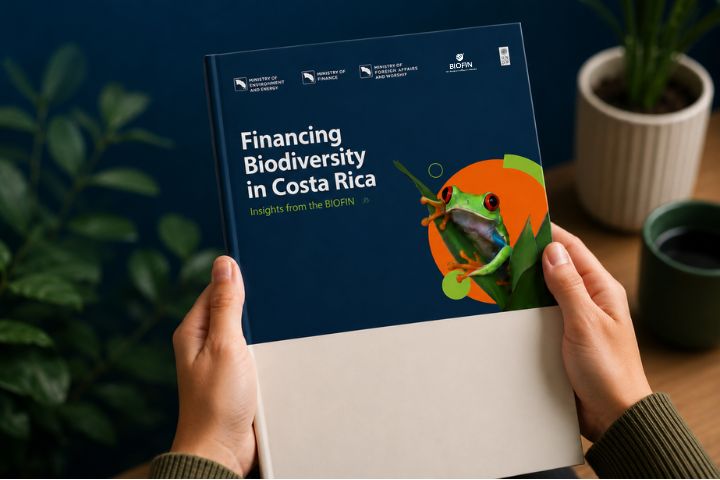
Costa Rica is widely recognized as one of the world's leaders in biodiversity conservation. Nearly a quarter of its land is protected, its Payment for Ecosystem Services programme has become an international reference, and nature lies at the heart of its economy.
Yet even a country with such a strong conservation record faces an important question: how do you finance biodiversity over the long term?
A new UNDP BIOFIN policy brief brings together more than thirteen years of experience supporting biodiversity finance in Costa Rica. Rather than focusing solely on funding gaps, it demonstrates how evidence-based analysis can help governments identify financing priorities, strengthen institutions and implement practical finance solutions for nature.
Good decisions begin with good evidence
BIOFIN's methodology begins with understanding the country's biodiversity finance landscape before recommending solutions.
This starts with a Policy and Institutional Review (PIR), which examines the policies, institutions and governance arrangements that shape biodiversity finance. It is followed by a Biodiversity Expenditure Review (BER) to understand where public and private resources are already being invested, and a Financial Needs Assessment (FNA) to estimate the financing required to achieve national biodiversity goals. Together, these analyses provide the evidence needed to develop a Biodiversity Finance Plan (BFP) that identifies the most appropriate finance solutions for each country.
Costa Rica's policy brief illustrates the value of this analytical foundation. The country's Policy and Institutional Review analysed 432 biodiversity-related policy instruments, mapped 82 institutions involved in biodiversity governance and identified 39 fiscal instruments that generate environmental revenues. Combined with the Biodiversity Expenditure Review, these analyses provide a comprehensive understanding of how biodiversity is financed and where opportunities exist to improve the system.
The findings also reveal an important contrast. Costa Rica's natural capital is valued at approximately US$14.5 billion, while annual public expenditure on biodiversity amounts to US$169.8 million, or 0.18% of GDP.
From analysis to implementation
The purpose of BIOFIN's methodology is not simply to produce reports. Its objective is to help governments identify and implement finance solutions capable of mobilizing additional resources for biodiversity.
Costa Rica demonstrates how evidence generated through the PIR, BER and other analytical assessments can be translated into practical action.
Over thirteen years, BIOFIN Costa Rica has helped catalyse US$98.3 million for biodiversity through a portfolio of finance solutions. More than 8,300 people have benefited directly from BIOFIN-supported activities, with women representing 56% of beneficiaries. More than half of the mobilized finance supports initiatives led by women, demonstrating how biodiversity finance can also contribute to inclusive economic development.

Innovation requires a portfolio of finance solutions
The final stage of the UNDP BIOFIN methodology focuses on implementing finance solutions that respond directly to the challenges identified during the analytical phase.
Costa Rica's experience illustrates that no single finance solution can close the biodiversity finance gap.
Instead, UNDP BIOFIN has developed a portfolio that includes green bonds for protected area infrastructure, reforms to ecosystem service payments, biodiversity credits, public-private partnerships, sustainable tourism, bioeconomy financing, crowdfunding, sustainable finance taxonomies and support for adopting the Taskforce on Nature-related Financial Disclosures (TNFD).
Together, these initiatives demonstrate how governments can combine public policy, private investment and innovative financial instruments to mobilize finance for nature.
Lessons for countries developing Biodiversity Finance Plans
Costa Rica's experience reinforces an important lesson: effective biodiversity finance is built step by step.
A thorough understanding of policies, institutions, existing expenditures and financing needs provides governments with the evidence required to design finance solutions that are realistic, country-owned and aligned with national priorities.
This is precisely the approach being followed today by more than 90 countries developing Biodiversity Finance Plans through UNDP BIOFIN. While every country's biodiversity, economy and institutions are different, the methodology provides a common framework for identifying practical pathways to finance nature.
Costa Rica shows what becomes possible when that framework is applied consistently over time, from evidence generation to implementation and measurable impact.
Categories
Countries
Archives
- May 2021 (6)
- April 2021 (3)
- March 2021 (5)
- February 2021 (4)
- December 2020 (2)
- November 2020 (1)
- August 2020 (2)
- July 2020 (2)
- June 2020 (3)
- May 2020 (1)