Belize
Belize is built on natural assets which plays an important role in meeting our socio-economic needs such as food security, energy, medicines, clean air and water, which promote good health as well as foster economic growth and stability through opportunities such as tourism and recreational activities which contribute to more than 40% of GDP in 2017.
Today, Belize's biodiversity is preserved through the establishment and management of the National Protected Areas System (NPAS), which presently encompasses 35.8% of the nation's landmass and 19.8% marine environment. The NPAS is a systemic method for increasing the effectiveness of biodiversity management. The primary purpose of the NPAS is to ensure that biodiversity conservation becomes an essential and integral aspect of national growth.
Currently, Belize retains 60% of its natural forest cover, with 35.8% found within NPAS. Belize is also home to approximately 118 internationally threatened species (32 endangered, 9 critically endangered, and 77 vulnerable), as well as 62 near threatened species. Experiencing Belize's wide range of biodiversity is unlike anything else on the planet.
Protected areas is the most important conservation tool utilized in Belize in its efforts to achieve national targets outlined in the National Biodiversity Strategy and Action Plan, as well as those outlined in the Convention on Biological Diversity. Belize is assisting in achieving the world's desired future of living in harmony with nature while securing the well-being of future generations.
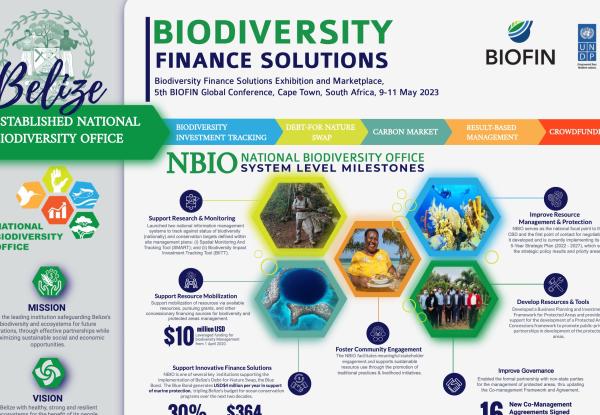
The Global Biodiversity Finance Initiative (BIOFIN) seeks to steer financing from all available sources toward global and national biodiversity objectives in mostly all developing countries, such as Belize. So far BIOFIN Belize has made great strides in assisting the country in all biodiversity investment and strategic planning and conservation. For instance, key results of BIOFIN Belize include:
- The establishment of the National Biodiversity Office within the Ministry of Sustainable Development, Climate Change and Disaster Risk Management.
- The development of a Business Planning and Investment Framework for Protected Areas in Belize.
- The design of a Biodiversity Investment and Impact Tracking Tool
- Essential personnel have been hired, and now influence transformation within the government and private sector.
1. Environmental Funds
This approach suggests that Belize's existing national environmental funds (EF) be optimized. The solution attempts to examine the regional and national landscape for EFs in Belize, as well as offer an optimization technique for EFs to use. National EFs are expected to use the optimization method and best practices to improve fund operation and management, investment management, and resource mobilization.
2. Green Debt
The Green Debt solution provides a tax incentive for financial institutions (banks, credit unions, and other financial organizations) to support "green" initiatives. Providing this tax subsidy would encourage local financial institutions to fund "green" initiatives, allowing the private sector to participate in the implementation and attainment of the NBSAP.
3. Crowdfunding
The use of donation crowdfunding platforms to fund initiatives and the conservation and management of Protected Areas (PAs) in Belize is proposed in this proposal. Using crowdfunding to diversify PA financing and infuse extra revenue into the NPAS would be beneficial. Revenues that can help with financial sustainability and can be used to fund long-term development projects in these PAs.
4. Compensation for Planned Environmental Damage
The Compensation for Planned Environmental Damage approach recommends incorporating a restoration sub-programmed/component into Belize's Environmental and Social Impact Assessment (ESIA) program. Private or public land developers who alter essential ecosystems (such as resource exploitation, pollution, and/or land-use change) would be required to restore other degraded ecosystems under the program (through payment for restoration works, carrying out the restoration or setting up a performance bond).
5. Debt for Nature Swap
The Debt-for-Nature Swap (DNS) approach offers the implementation of a debt-swap arrangement including repayment (partial or total) of Belize's foreign debt in return for future contributions (by GOB) to carry out conservation and preservation activities in Belize's prioritized ecosystems. A Debt-for-Nature Swap arrangement can allow Belize to lessen its debt payment load, freeing up budgetary space for public sector biodiversity investment and other investments/expenditures.
6. Carbon Market
Through the construction of a Clean Development Mechanism, the Carbon Market solution investigates the possibility of Belize participating in voluntary regional and worldwide Greenhouse Gas (GHG) emissions trading (CDM).
7. Establishment of a Biodiversity Office/ Department
The creation of a Biodiversity Office (BiO) inside the Ministry of Sustainable Development, Climate Change, and Disaster Risk Management to promote biodiversity management and NBSAP implementation was recommended as part of this proposal. The NBSAP's execution necessitates coordination between government ministries and agencies, as well as NGOs and the corporate sector. The Biodiversity Office will provide the necessary administration and coordination for Belize's NBSAP to be implemented efficiently.
8. Grants
This method offers getting grant financing for environmental work within protected regions. A evaluation of current PAs in Belize is designed as part of this solution, with the goal of creating best practice recommendations for business model creation and piloting this method inside PAs. The goal of this funding option is to gain funds for PAs that may be used to buy land for "corridors" or other conservation and preservation projects.
9. Results-based budgeting
The establishment of a Results Based Budgeting (RBB) framework for use by government agencies and PA managers is proposed in this solution. The framework would make it easier to plan and manage conservation funds using a results-based approach.
10. Biodiversity Investment and Impact Tracking Tool
This solution suggests improving the current Biodiversity Impact Investment Tracking Tool, which would be used to categorize/classify biodiversity expenditures using a methodology based on the BER classifications. The tool is expected to be implemented at the Biodiversity Office and throughout Belize's NPAS. The tracking tool would help the Biodiversity Office maximize its effectiveness in matching actions with national biodiversity goals.
11. Blended Finance Model
By using charitable donations or grants, private equity, and/or concessionary loan financing inside the PA system, this strategy aims to expand on PA business models. Both investors and the national PA system should benefit from an effective Blended Finance (BF) framework.

The nature of BIOFIN implementation in Belize, makes it uniquely positioned to influence policy. Through a joint collaboration assessment between the Protected Areas Trust of Belize and the BIOFIN initiative, an assessment of the current environment for investments in protected areas has recommended critical policy changes. These changes are in line with changes in tax incentives for public/private partnerships and other investments in protected areas and the re-positioning of the Ministry’s operational structure to facilitate biodiversity investments, among others. These have set the stage for the BIOFIN PIR which is currently in the final stages of data collection and analysis. The PIR continues to be highly consultative and participatory process in Belize.

A desktop review of the priority sectors for carrying out this assessment is on the way. The BER is currently reviewing existing data sources and sectoral focal points for facilitating the BER implementation.

The NBSAP for Belize has been developed and was endorsed by Cabinet in 2016. The team is currently carrying out a desktop review of the NBSAP and other development frameworks for prioritisation of targets within the NBSAP.

BIOFIN Belize is undertaking a desktop review of priority targets within the NBSAP, as well as the cataloguing of current Finance Solutions and areas of recommendation for policy and regulatory reform in Belize.