ENGLISH
UNDP supports five countries to pioneer integrated climate and nature finance solutions
The United Nations Development Programme (UNDP) has launched a new initiative through its Funding Windows to support Côte d’Ivoire, Ecuador,…








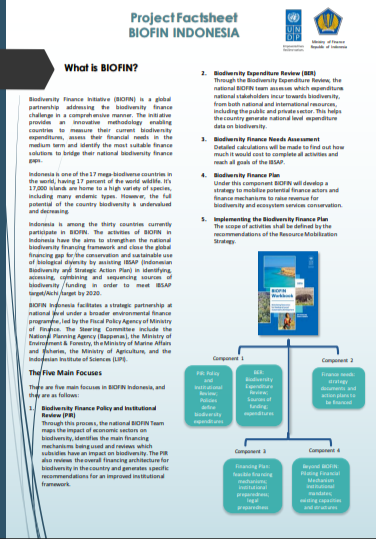
Indonesia is one of the world's 17 megadiverse countries, home to approximately 17% of the world's known species across more than 17,500 islands. This extraordinary biodiversity underpins the country's economy, supporting agriculture, fisheries, forestry, tourism, and the livelihoods of millions of people.
Since joining the UNDP Biodiversity Finance Initiative (BIOFIN) in 2015, Indonesia has worked to strengthen its biodiversity finance framework and mobilize new resources for nature. BIOFIN's Biodiversity Expenditure Review estimated that Indonesia faces a biodiversity financing gap of 82–87%, with annual investment needs of IDR 118.5–163.8 trillion to achieve its national biodiversity targets.
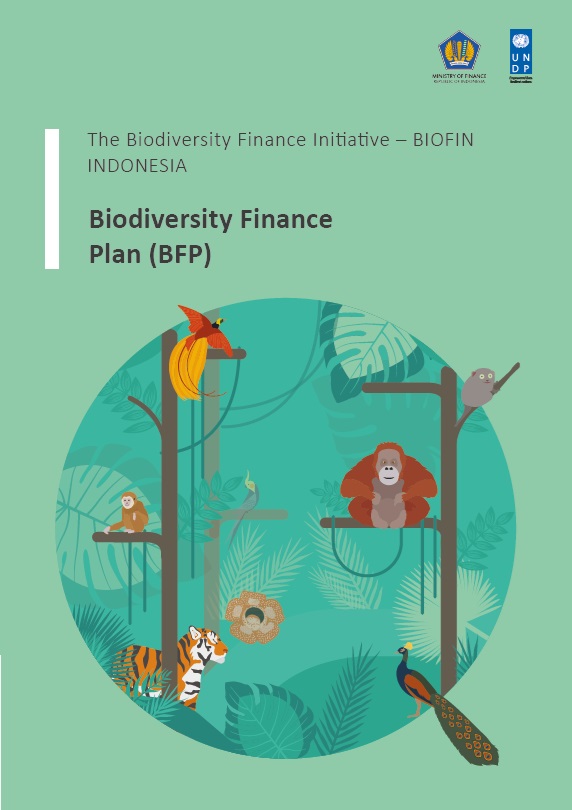
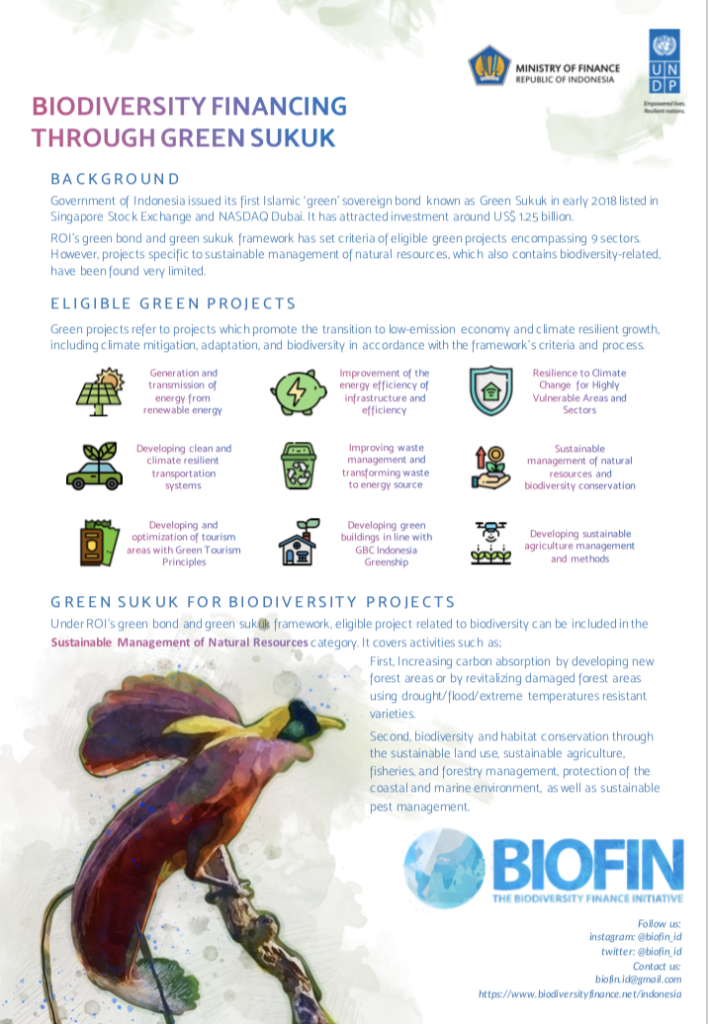
To help close this gap, BIOFIN has developed a comprehensive Biodiversity Finance Plan and is supporting the implementation of innovative finance solutions, including Green Sukuk, Islamic social finance (Zakat), biodiversity credits, and biodiversity-friendly agricultural finance. These efforts are helping Indonesia diversify funding sources, strengthen public and private investment in nature, and integrate biodiversity into national development planning.
1. Unlocking Sukuk for Biodiversity Project Financing
Realizing the importance of the sukuk’s project preparation stage, the finance solution intends to institutionalize the process of accessing sukuk financing for biodiversity through provision of technical support to proponents and expanding the work with other interested ministries with biodiversity projects.
2. Leveraging Faith-based Fund for Biodiversity
This solution intends to expand the work to explore other faith-based fund initiatives such as how much potential fund can be generated and whether the distribution of the fund would include environmental interest such as biodiversity and the way in which such fund be implemented as biodiversity financing.
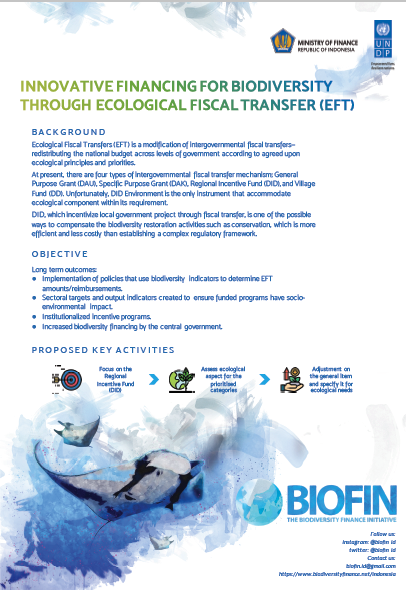
3. Ecological Fiscal Transfer
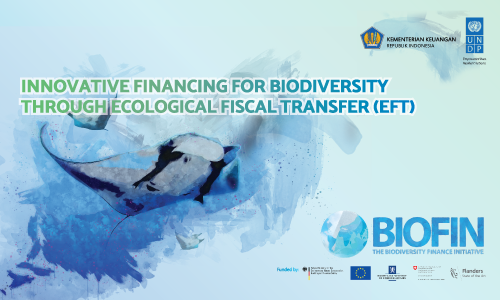
The finance solution intends to support facilitation of ecological fiscal transfer implementation at regional government mainly from the provincial government to the district and/or from the district to village level. Determining environmental/biodiversity criteria is instrumental to operationalize an effective transfer mechanism as well as ensuring the criteria are measurable. This will be mediated through intense policy advocacy and multilevel government’s capacity building.
4. Institutionalize Result-based Budget Tracking for Biodiversity Expenditure
This solution intends to migrate the ongoing work of biodiversity expenditure assessments from a manual into the online system, with the aim to promote the institutionalization of the biodiversity expenditure into the performance-based budgeting system. This will be done by analyzing biodiversity expenditure classification at the Ministry/Institution while helping the relevant key ministries to implement biodiversity budget tracking through guideline and capacity development for key ministerial staffs. The existing online platform (KRISNA) will be enhanced to include biodiversity budgets.
5. Debt for Nature Swap
This finance solution intends to promote debt for nature swap (DFNS) solutions for biodiversity conservation in Indonesia. Two models were implemented for DFNS in Indonesia. First, the line ministry implemented a program that is specific to the swap agreement, and second, the swap fund was managed by a fund manager and channeled through a grant-making organization and then solicited the proposal from NGOs/community groups for program implementation in the field. In this situation, the BIOFIN will facilitate the feasibility and option for DFNS implementation as well as capacity building and policy advocacy for government.
6. National Gap Analysis of Indonesia’s Biodiversity Offset System
The finance solution intends to develop options for biodiversity offsets through understanding the institutional context to help build an enabling environment for offsets. Indonesia currently implements a quasi-offset policy in forestry sector. It is applied when the underground resources, such as minerals and geothermal sources beneath protected forests, need to be extracted. The government can release the use of forest for exploration and extraction with minimal impact. Thus, the project leases the forest and pays compensation to the government as another tax income.
7. Developing a Financing Plan for Agro-Ecotourism in Bali
This finance solution intends to leverage biodiversity financing from private sector, particularly financial sectors. The solution focuses on facilitating village readiness and capacity building for agro/marine ecotourism. It also seek finance option with Financial Service Authority (OJK) guidance and implement them with finance institutions. Matching village projects with financial institutions will be followed by guideline development.
Building Indonesia's Biodiversity Finance Framework
UNDP BIOFIN completed Indonesia's Policy and Institutional Review (PIR), Biodiversity Expenditure Review (BER), Financial Needs Assessment (FNA), and Biodiversity Finance Plan (BFP), providing the country's first comprehensive assessment of biodiversity finance. The analyses identified an 82–87% biodiversity financing gap, estimated annual financing needs of IDR 118.5–163.8 trillion, and a portfolio of finance solutions to mobilize public and private investment for biodiversity conservation. The PIR also recommended establishing a dedicated biodiversity management institution to strengthen governance and coordinate biodiversity financing.
Unlocking Innovative Finance for Nature
UNDP BIOFIN has successfully moved from planning to implementation by advancing innovative finance solutions. The programme supported the development of Green Sukuk financing for biodiversity projects, including a US$2.7 million conservation investment, and developed guidance with Bappenas and the Ministry of Finance to expand biodiversity financing through sovereign green bonds. More recently, BIOFIN has partnered with Bappenas to develop Indonesia's national framework for biodiversity credits, including a white paper and pilot projects that position Indonesia among the first countries in Asia to establish a biodiversity credit market.
Mobilizing Islamic Social Finance
UNDP BIOFIN has worked with Indonesia's National Alms Agency (BAZNAS) to unlock Islamic social finance (Zakat) for biodiversity conservation. The programme developed a programmatic approach to channel Zakat toward biodiversity-friendly livelihoods, ecosystem restoration, and sustainable development while strengthening impact assessment methodologies linked to the Sustainable Development Goals.
Demonstrating Biodiversity-Friendly Agriculture
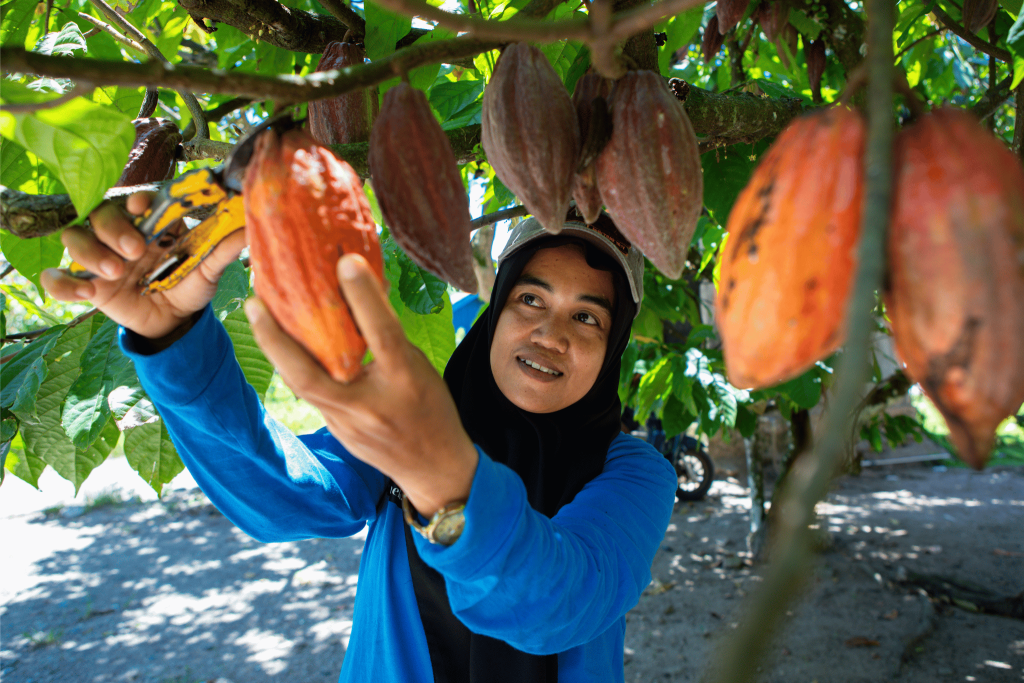
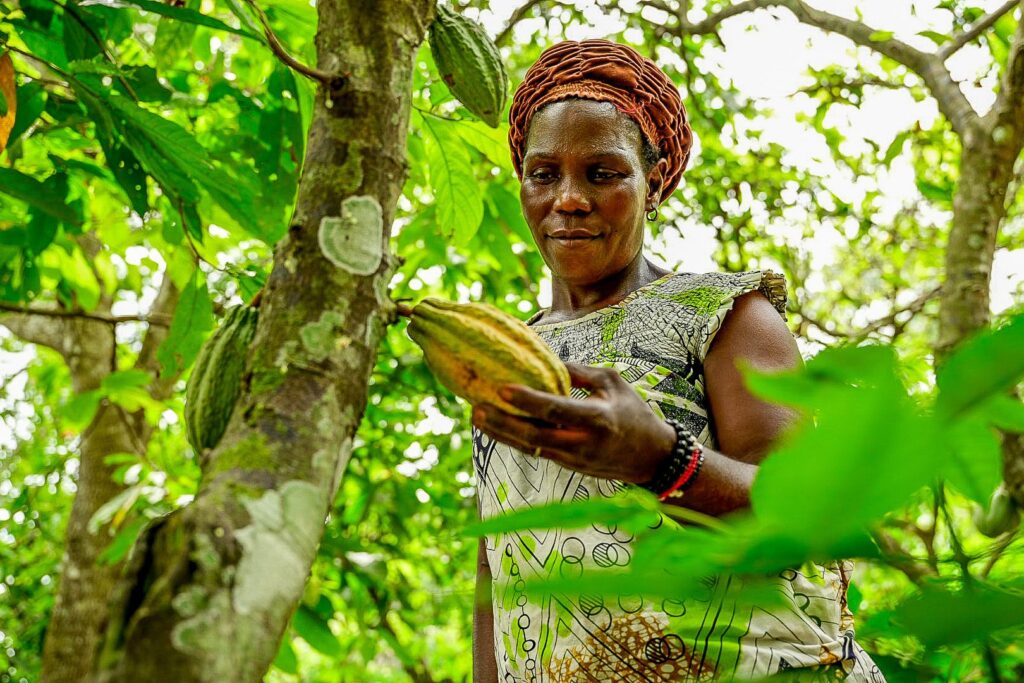
UNDP BIOFIN is supporting sustainable cacao production in Central Sulawesi as a model for biodiversity-positive agriculture. Farmers adopting agroforestry practices have achieved yield increases of up to 35%, while agroforestry systems store 6.3 times more carbon than conventional cacao plantations. The initiative demonstrates how biodiversity finance can simultaneously improve livelihoods, restore ecosystems, and strengthen climate resilience.
No posts found.