Madagascar is one of the world’s most important biodiversity hotspots, home to an exceptional concentration of species and ecosystems, many of which are found nowhere else on Earth. Its forests, wetlands, freshwater, coastal and marine ecosystems provide essential services and support agriculture, fisheries, tourism and the livelihoods of millions of people. This natural capital is also fundamental to the country’s economic, social and cultural development.

Yet Madagascar’s biodiversity faces severe pressures from deforestation, habitat degradation, land and coastal erosion, unsustainable use of natural resources and the loss of endemic species. Historically low levels of investment in biodiversity have further constrained conservation efforts, highlighting the need to increase available resources, improve the effectiveness of existing expenditure and diversify sources of finance for nature.

Madagascar joined UNDP BIOFIN in 2019 to develop a more systematic approach to financing its biodiversity priorities. Following assessments of biodiversity-related policies, expenditure and financing needs, the country finalized and validated its Biodiversity Finance Plan in 2022, providing a framework for mobilizing and better aligning public, private and innovative finance with national biodiversity priorities.

Since 2023, UNDP BIOFIN has focused on implementing priority finance solutions, including results-based budgeting, sustainable financing for protected areas, reform of forestry-sector taxes, fees and royalties, and financing for the sustainable blue economy and fisheries. The programme is also strengthening engagement with the financial sector, including through an assessment of Madagascar’s readiness for nature-related financial disclosures, helping create an enabling environment for greater private and financial-sector investment in biodiversity.ed financial disclosures was also conducted.

$900M

Finance Needs

Estimated funding required to implement Madagascar's NBSAP (2022–2025).

14

Finance Solutions

Priority finance solutions identified in Madagascar's Biodiversity Finance Plan.

Finance solutions

Four financing solutions are currently being implemented:

Financing solution 1: Improve budget formulation and budget exécution procedures of the Ministry in charge of the environment at the central and regional levels through results-based budgeting (RBB) :

This support aims to strengthen the capacity of the Ministry in charge of the environment-appointed technicians involved in drawing up the Ministry's budget at the central and regional level, and in implementing it using results-based budgeting methodology.

Financing solution 2: Diversify and increase funding sources for institutions financing Protected Areas management:

The solution is being carried out with two local financial partners (FAPBM Biodiversity and Protected Areas Foundation and Tany Meva Foundation) and the main manager of Protected Areas in Madagascar (Madagascar National Park). This solution aims to diversify and increase the sources of funding for Madagascar's protected areas. The selected finance solutions include Biodiversity offsetting for FAPBM, capitalization of an endowment fund for Tany Meva, for community projects around Protected Areas, and impact investing/PPP for ecotourism for MNP

Financing solution 3: Mobilize financial resources to ensure sustainable management of forest resources:

The financing solution aims to mobilize additional financial resources for sustainable forest management by revising existing fees, royalties, fines, and penalties related to the forestry sector, improving their collection, and supporting the capitalization and operationalization of the National Forest Fund (FFN) currently being created.

Financing solution 4: Develop and implement a sustainable finance strategy for marine conservation and the sustainable use of coastal and marine resources in the blue economy:

The proposed financing solution aims to support the Malagasy new policy and institutional framework on blue economy (the National Blue Economy Strategy) by designing a sustainable financing strategy for biodiversity activities with climate change co-benefits, as outlined, and to prioritize and implement financing mechanisms that are expected to have a positive impact on nature or ensure the prevention of further loss of nature.

Key results

Policy and Institutional Review (PIR). Although Madagascar’s sustainable development depends heavily on biodiversity, biodiversity considerations remain weakly integrated into national planning, sectoral policies, and the budget process. Stakeholders face limited human and financial resources, and the NBSAP is only partially implemented.

Biodiversity Expenditure Review (BER). Public spending on biodiversity conservation is low—under 3% of the national budget—and there is heavy reliance on donor funding, which is often irregular and unpredictable.

Financial Needs Assessment (FNA). The estimated financing required to implement the NBSAP over 2022–2025 is about US$900 million.

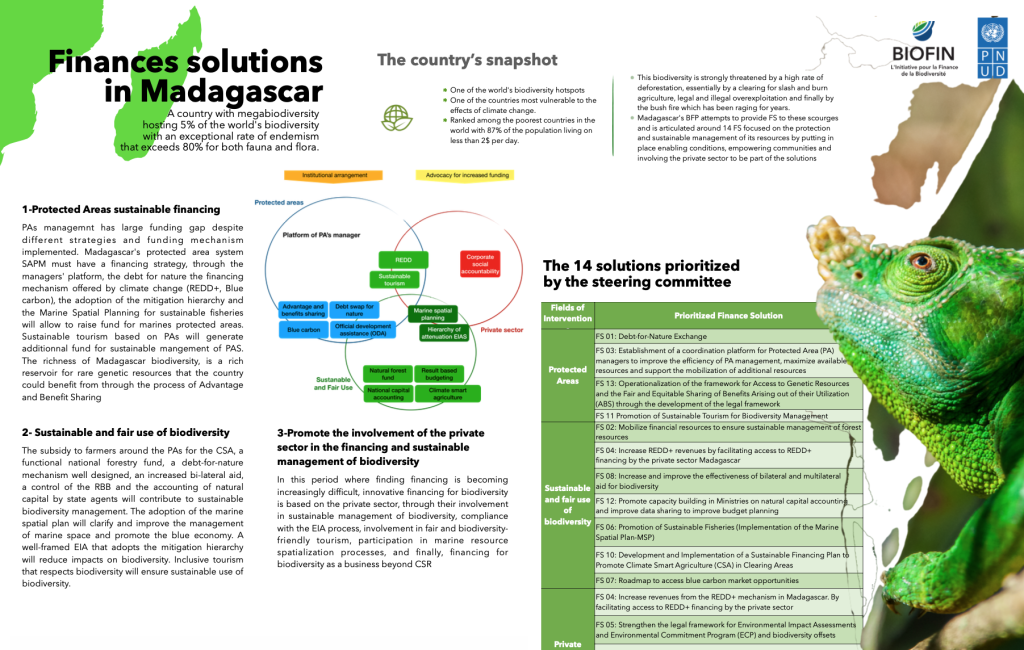
Biodiversity Finance Plan (BFP): 14 validated priority solutions

  • Increase and improve the effectiveness of bi- and multilateral aid for biodiversity.
  • Increase revenues from REDD+ by facilitating private-sector access to financing.
  • Improve public budget execution through Results-Based Management (RBM).
  • Operationalize Access and Benefit-Sharing (ABS), including a legal framework for bioprospecting.
  • Pursue debt-for-nature swaps.
  • Conduct a feasibility study on a conservation-agriculture subsidy to reduce deforestation.
  • Develop a roadmap to access blue-carbon market opportunities.
  • Mobilize additional resources to expand terrestrial and marine protected-area networks.
  • Enable the National Forest Fund (FFN) to deploy earmarked forest revenues for sustainable forest management.
  • Promote sustainable fishing (implementation of the Marine Spatial Planning, MSP, framework).
  • Promote sustainable nature-based tourism.
  • Promote natural capital accounting.
  • Strengthen the legal framework for Environmental Impact Assessments (EIAs), ERIPs, and biodiversity offsetting.
  • Advance corporate social responsibility (CSR) in favor of biodiversity.

Support to the Ministry of Environment and Sustainable Development on Results-Based Budgeting (RBB).

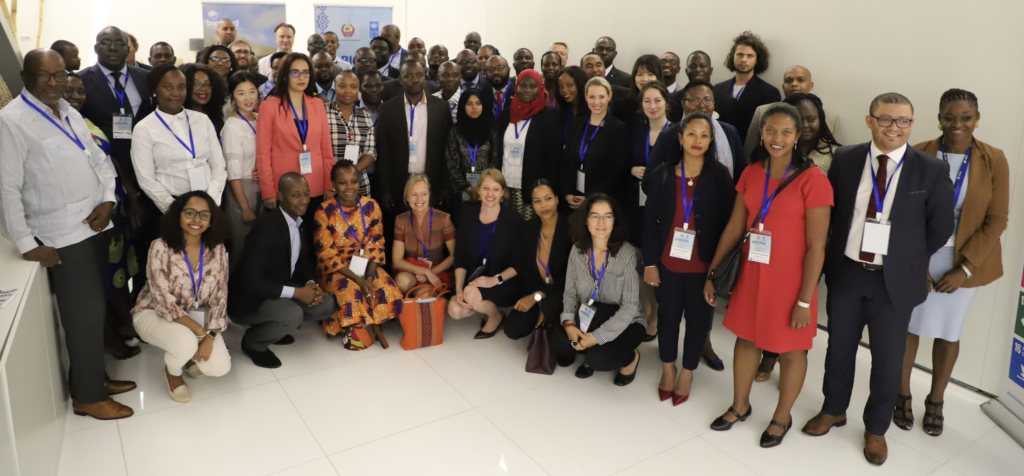
Activities began with decentralized, in-person training across all regional directorates, involving ~150 planning and budgeting staff. Materials were redesigned to prioritize practical group exercises while providing essential theory. Sessions covered: a refresher on RBM, programme budgeting, principles and methods for developing a Medium-Term Expenditure Framework (MTEF) at the ministerial level, strategic planning, Priority Sectoral Action Plans (PASP), performance documents, and budgeting. Following the training and consultations, two ad hoc commissions were created in June 2025: the Monitoring and Evaluation System Commission and the MTEF Commission.

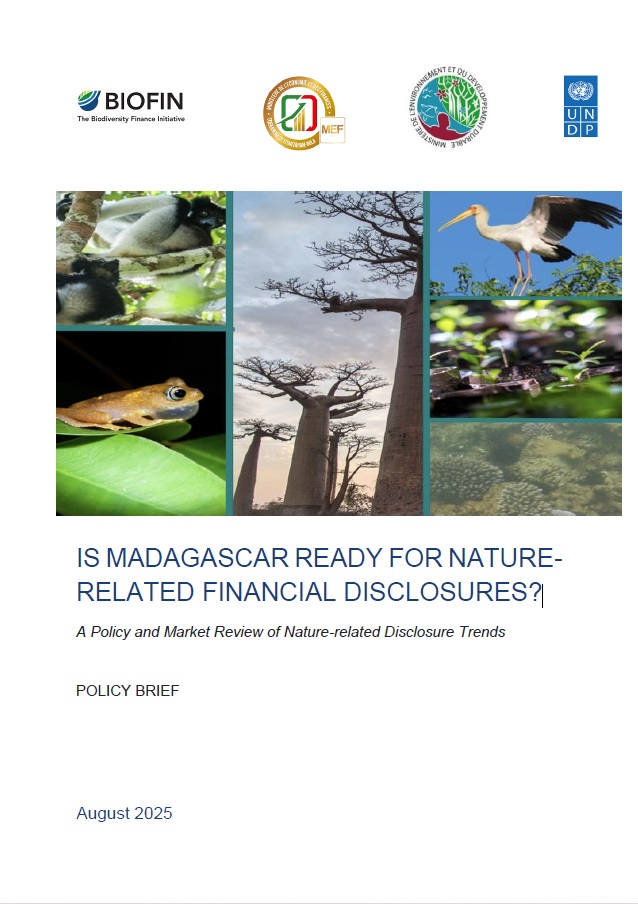
Readiness for nature-related financial disclosures.

Biodiversity loss could reduce Madagascar’s GDP by 4.2% by 2050, threatening forestry, fisheries, and tourism. In this context, nature-related financial disclosure aligned with the TNFD is essential to reconcile profitability with environmental stewardship. The financial system remains underdeveloped (no stock exchange and no specific green-lending framework), though initiatives such as green bonds are emerging. Financial authorities have not yet integrated biodiversity risks, and corporate reporting on nature impacts is rare, aside from compliance with international parent-company standards. The study underscores the importance of double materiality (companies’ impacts on nature and nature’s impacts on companies). While the current context does not yet support mandatory disclosure, momentum from BIOFIN and broader sustainable-finance initiatives provides a strong foundation. Recommended next steps include progressively establishing an adapted regulatory framework, strengthening institutional and private-sector capacity, and creating reliable environmental-data platforms.

Key documents