

Mongolia will need an estimated MNT 2.8 trillion—approximately US$780 million—to implement its National Biodiversity Strategy and Action Plan (NBSAP) for 2026–2030.
This represents approximately 0.5–0.7 percent of the country’s gross domestic product annually. With as much as 58 percent of the required finance expected to come from private and international sources, Mongolia’s biodiversity ambitions cannot be financed through the state budget alone.
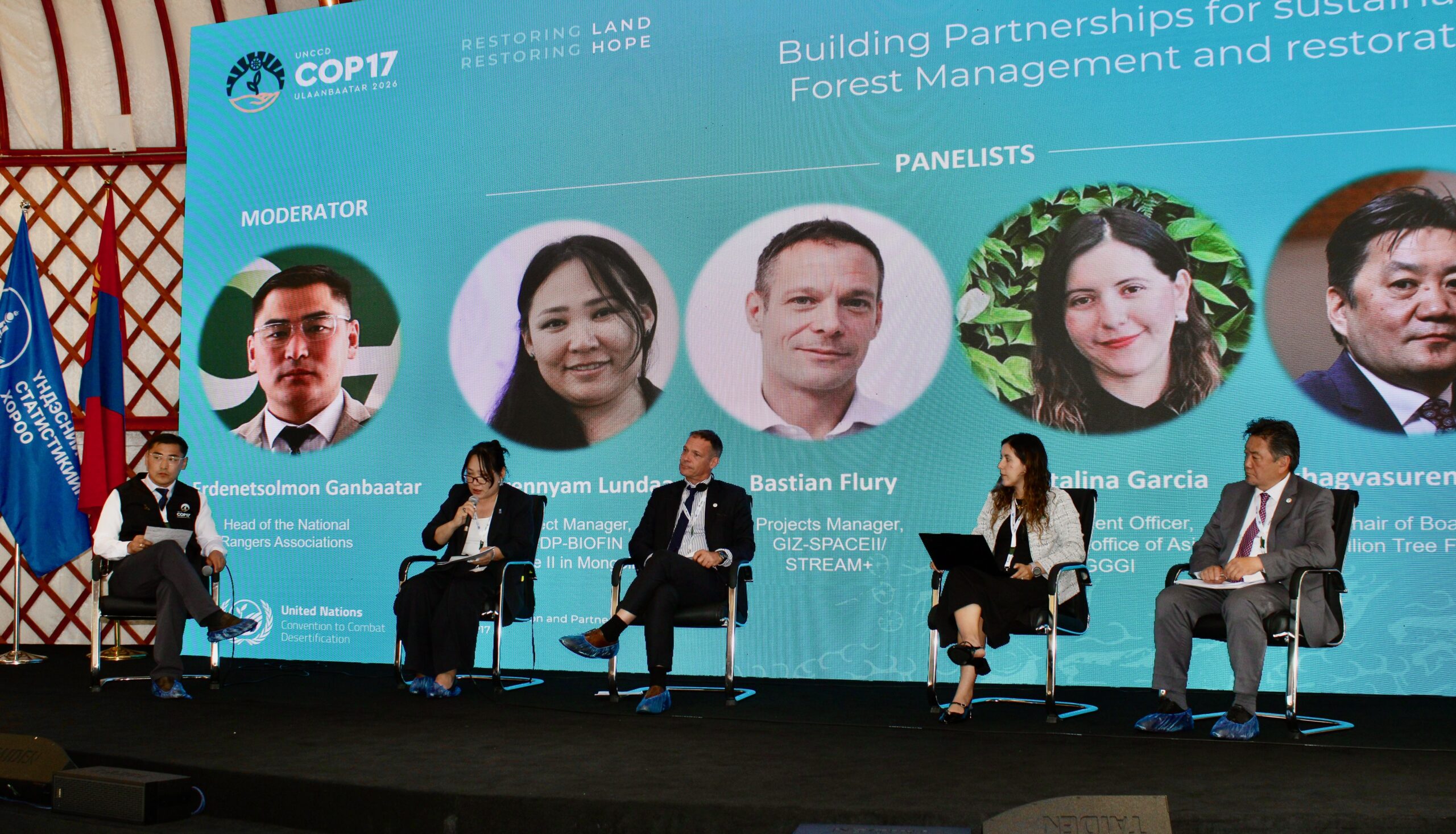
During the 17th Conference of the Parties to the United Nations Convention to Combat Desertification (UNCCD COP17), held in Ulaanbaatar from 17 to 28 August 2026, the Government of Mongolia and UNDP’s Biodiversity Finance Initiative (BIOFIN) presented how the country is beginning to address this challenge.
The discussions demonstrated the close connections between biodiversity, land, water and finance in Mongolia. They also highlighted three priorities from the country’s Biodiversity Finance Plan: reforming financial flows that harm nature, strengthening the Billion Tree Fund and improving the collection and use of natural resource revenues.
Financing Mongolia’s biodiversity commitments
Mongolia launched its NBSAP 2026–2030 on 18 August during UNCCD COP17. Following the presentation of the strategy by the Ministry of Environment and Climate Change and the NBSAP project, UNDP BIOFIN presented an assessment of the finance needed to put it into practice.
The analysis showed that implementing the strategy will require both an increase in biodiversity-positive investment and a reduction in public and private financial flows that negatively affect nature.
“The Government of Mongolia is working consistently to expand public-private partnerships in the conservation sector, increase green investment and develop innovative financing mechanisms,” said Ts. Sandag-Ochir, Minister of Environment and Climate Change. “We do not view biodiversity conservation as a cost—we see it as a foundational investment in sustainable development and a responsibility we owe to future generations.”
Mongolia’s Biodiversity Finance Plan identifies six priority solutions for mobilizing and using finance more effectively:
- improving enforcement of the Natural Resource Use Fees Law;
- strengthening the Billion Tree Fund to attract private investment in nature-based solutions;
- reforming subsidies harmful to biodiversity;
- supporting the private sector’s early adoption of nature-related financial disclosures;
- introducing results-based management for national and subnational environmental governance; and
- improving entrance fees and other visitor-related charges for protected areas.
Several of these solutions were discussed during BIOFIN-supported events at COP17.
Reforming financial flows that harm nature
One of the discussions focused on how the pricing of water can influence its use and conservation.
Mongolia’s ecological-economic valuation of water has not been updated since 2011 or subsequently adjusted for inflation. As a result, current charges may not reflect water’s increasing scarcity or ecological value—particularly in groundwater-dependent regions such as the Gobi, where water resources face growing pressure from mining, urbanization and climate change.
At a session organized with the Ministry of Environment and Climate Change and the National Water Agency on 25 August, participants examined how underpriced water and exemptions that are not based on clear ecological criteria can function as implicit subsidies. Such arrangements can encourage inefficient consumption and reduce incentives to invest in water-saving technologies.
Addressing this issue would support Mongolia’s implementation of Target 18 of the Kunming-Montreal Global Biodiversity Framework, which calls on countries to identify and reform incentives, including subsidies, that are harmful to biodiversity. Reforming biodiversity-negative financial flows is also included in Mongolia’s NBSAP as a national commitment for 2030.
Strengthening the Billion Tree Fund
Mobilizing private and international capital will also require institutions capable of managing finance transparently and effectively.
During COP17, UNDP BIOFIN highlighted its collaboration with the Billion Tree Fund, the financing vehicle supporting Mongolia’s Billion Trees National Movement. The partnership aims to strengthen the Fund’s governance, environmental and social safeguards, and investment policies in line with international good practices for conservation trust funds.
Strong governance and accountability can give public institutions, development partners and private investors greater confidence that funds will be managed effectively and deliver measurable environmental results.
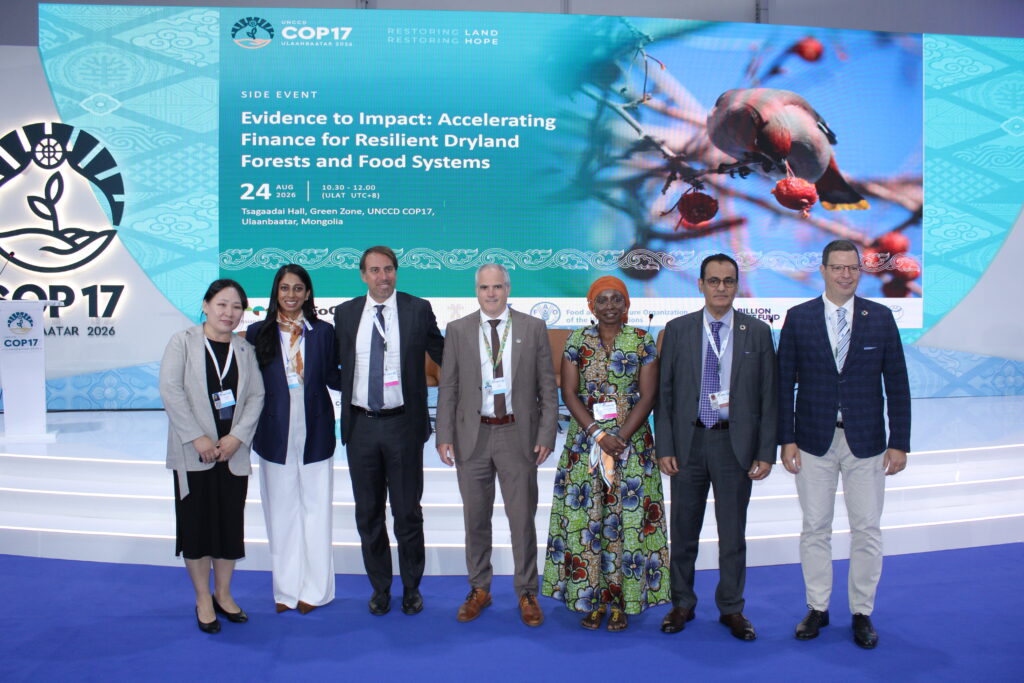
The cooperation was presented at several COP17 events, including a forest-investment event in the Blue Zone on 21 August, a Finance Day session on drylands on 24 August and a joint Billion Tree Fund–BIOFIN pavilion session.
A stronger institutional foundation could eventually help Mongolia explore a wider range of financing instruments, including green bonds, carbon markets, biodiversity credits and debt-for-nature mechanisms. Each instrument requires careful assessment and appropriate safeguards, but strengthening the Fund’s governance is an important step towards attracting and managing additional investment.
Building on higher natural resource revenues
Mongolia’s efforts to finance biodiversity are already producing measurable results.
Since 2016, UNDP BIOFIN has supported the Government in strengthening implementation of the Natural Resource Use Fees Law, which requires revenues collected from the use of forests, water, plants, wildlife and land to be allocated to environmental protection and natural resource rehabilitation.
The overall rate of implementation rose from 29.7 percent in 2016 to a peak of 64.3 percent in 2024. Over the same period, the revenue collected under the law nearly tripled.
Government budgets approved by the Ministry of Finance for environmental protection and natural resource rehabilitation have also increased significantly, rising close to threefold since 2020.
The next challenge is to ensure that this growing finance delivers demonstrable results for nature and communities. UNDP BIOFIN and its partners therefore plan to bring revenue, budget-allocation and expenditure data together through a digital monitoring system. Mongolia also intends to introduce results-based management to improve how environmental funding is planned, spent and assessed.
From planning to implementation
Mongolia used UNCCD COP17 not only to present the cost of its biodiversity commitments, but also to demonstrate how it is beginning to build the systems required to finance them.
The country is strengthening the collection of domestic revenues, examining financial incentives that contribute to environmental pressure and improving the governance of an institution intended to attract investment for nature-based solutions.
Together, these reforms show that financing an NBSAP is not solely about identifying additional funding. It also means improving how existing public finance is collected and used, redirecting financial flows that work against nature, and establishing credible institutions through which new investment can be mobilized.
With the NBSAP now approved and its financing requirements identified, Mongolia’s next task is to translate these reforms into sustained investment and measurable results for its biodiversity, land, water and people.