

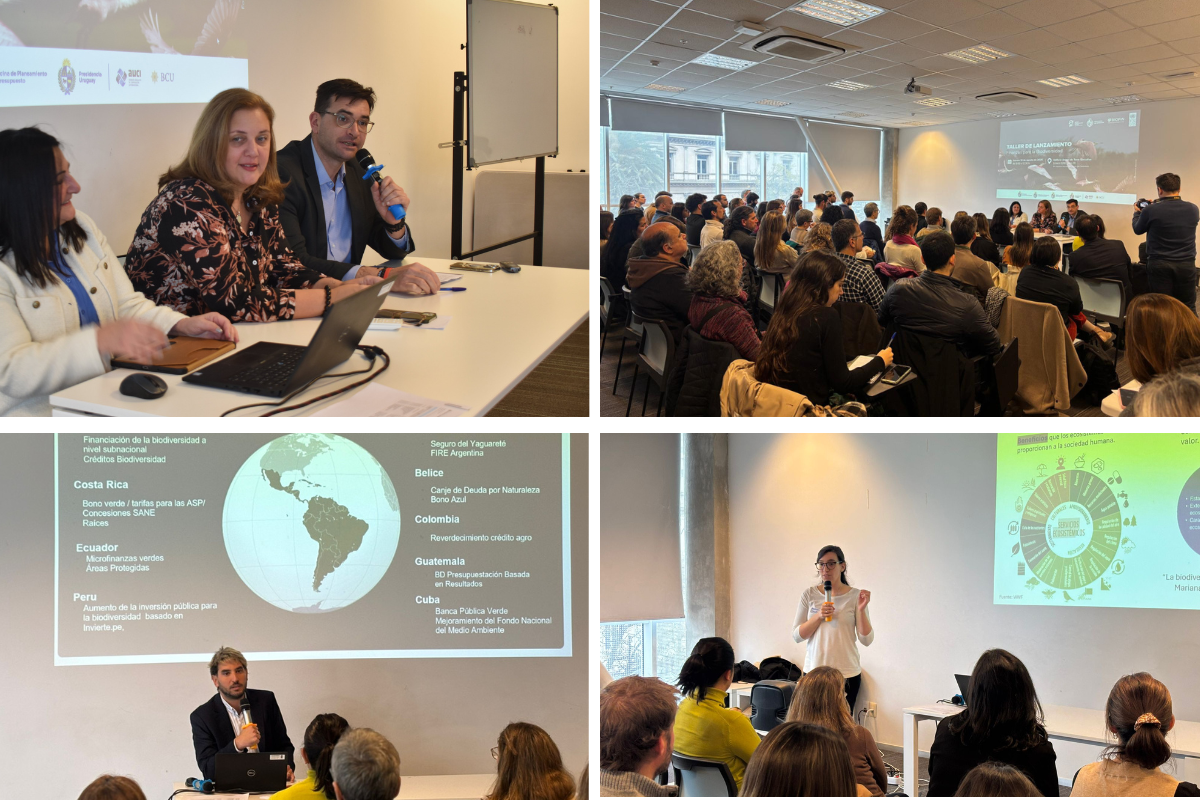
Representatives of the public and private sectors, academia, civil society and international cooperation organizations gathered in Montevideo for the launch of UNDP BIOFIN, a global initiative that helps countries change how they mobilize and use resources to conserve nature.
Held at the Executive Tower Annex, the event provided a space to discuss innovative ways to finance biodiversity, integrate a gender perspective and close the gap between available resources and the country’s growing needs. In their opening remarks, Paloma Morazo, UNDP Acting Resident Representative in Uruguay; Estela Delgado Gargiulo, Director of Biodiversity and Ecosystem Services at the Ministry of Environment; and Martín Clavijo, Director of the Uruguayan Agency for International Cooperation, stressed the urgency of aligning finance with international commitments and developing practical solutions for a sustainable future.
The technical sessions brought together a range of perspectives. Ana Laura Mello, a manager at the Ministry of Environment’s Directorate of Biodiversity and Ecosystem Services, presented the update to the National Biodiversity Strategy. María Luisa Olivera Favretti, an economist in the environmental division of the Ministry of Economy and Finance, discussed the links between the economy and the environment. Nicolás Xanthopoulos, UNDP Environmental Finance Analyst for Latin America and the Caribbean, shared regional lessons relevant to Uruguay. Magdalena Borges, the country’s UNDP BIOFIN project lead, explained the initiative’s methodology, while technical team member Darío Dornel Martínez led a participatory workshop to develop ideas for innovative finance solutions.
Participants explored good practices, financial analysis methods and tools for integrating biodiversity into public policy and financing systems. The aim is to narrow the gap between available funding and what is needed, while supporting Uruguay’s international environmental commitments.
The UNDP BIOFIN approach follows five steps: a policy and institutional review, a biodiversity expenditure review, an assessment of financing needs, preparation of a biodiversity finance plan and implementation. It has already been applied in more than 40 countries. Uruguay is now joining this global effort with funding from the Global Environment Facility (GEF), leadership from the Ministry of Environment and UNDP Uruguay, and support from the Ministry of Economy and Finance, the Ministry of Livestock, Agriculture and Fisheries, the Office of Planning and Budget, the Uruguayan Agency for International Cooperation and the Central Bank of Uruguay.
Through this initiative, Uruguay aims to develop innovative finance solutions that will help protect its natural wealth for future generations.