
What if conserving nature could also create a sustainable source of finance?
Around the world, countries are looking for practical ways to close the biodiversity finance gap. While many solutions focus on mobilizing new funding, Access and Benefit Sharing (ABS) offers a different approach. It ensures that when businesses and organizations benefit from genetic resources, the communities and institutions that protect those resources also receive benefits.
In India, this principle has evolved beyond regulatory compliance into one of the country’s biodiversity finance solutions. Through the UNDP Biodiversity Finance Initiative (BIOFIN), India integrated ABS into its Biodiversity Finance Plan, demonstrating that it can become a predictable and scalable source of finance for biodiversity while creating incentives for conservation and sustainable development.
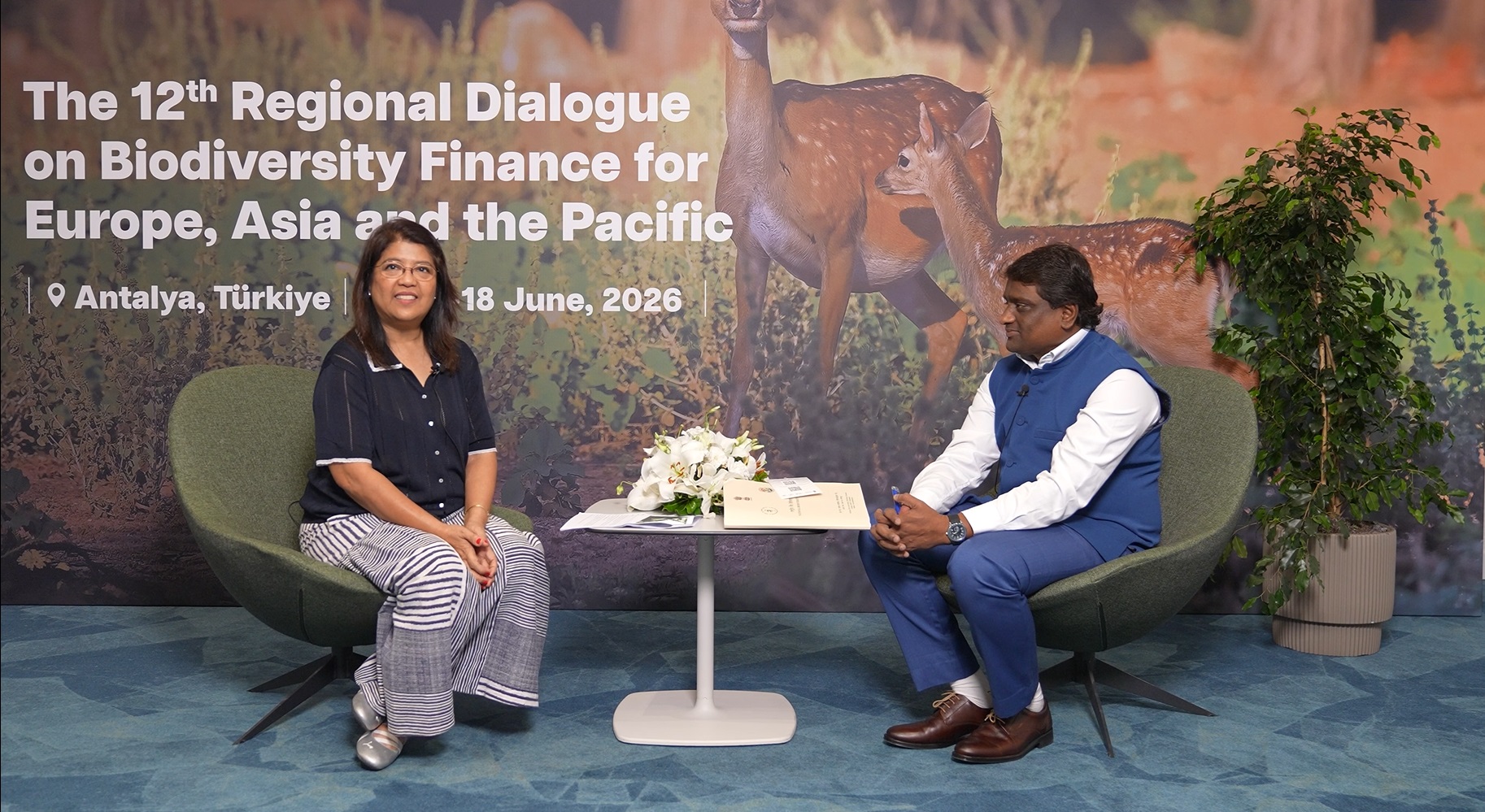
In this interview, Abbie Trinidad, Senior Technical Adviser at UNDP BIOFIN, speaks with Dr. Jeyaram Soundrapandi, Project Officer at the National Biodiversity Authority of India and UNDP BIOFIN, about how ABS works, why it matters, and what other countries can learn from India’s experience.
Watch the full video:
What is Access and Benefit Sharing?
Access and Benefit Sharing is one of the three objectives of the Convention on Biological Diversity (CBD), alongside biodiversity conservation and the sustainable use of biodiversity.
The principle is straightforward. When an individual or company accesses biological or genetic resources and generates commercial benefits from them, part of those benefits should be shared with the people, communities, or institutions responsible for conserving those resources.
Rather than viewing biodiversity simply as a resource to be extracted, ABS recognizes its economic value and creates incentives to conserve it but also ensures equitable sharing of these benefits.
As Dr. Soundrapandi explains, the three objectives of the Convention reinforce one another. When people benefit from biodiversity, they have stronger incentives to use it sustainably, ultimately contributing to its conservation.
“When people benefit from biodiversity, they also have an incentive to conserve it.”
From Compliance to Finance
In many countries, ABS is viewed primarily as a legal obligation under the Convention on Biological Diversity and the Nagoya Protocol.
India chose a different approach.
During the development of its Biodiversity Finance Plan through BIOFIN, the country identified ABS not only as a regulatory mechanism but also as a finance solution capable of generating long-term resources for biodiversity.
Following BIOFIN’s Programme and Institutional Review, Biodiversity Expenditure Review and Financial Needs Assessment, India identified ABS as one of its priority biodiversity finance solutions. The Ministry of Environment, Forest and Climate Change recognized that, if implemented effectively, ABS could become a predictable, viable and scalable financial mechanism that complements public funding for biodiversity.
This shift, from viewing ABS as compliance to recognizing it as an investment mechanism, has become one of India’s most important contributions to biodiversity finance.
India’s Experience: Biodiversity Generating Benefits
India’s experience demonstrates how ABS can generate tangible financial returns while rewarding conservation.
One example highlighted in the interview is Red Sanders (Pterocarpus santalinus), a high-value tree species found only in parts of Andhra Pradesh.
When Red Sanders is auctioned, an additional 5 percent ABS contribution is collected above the market value. These resources are then directed toward the communities and institutions responsible for conserving the species.
According to Dr. Soundrapandi, India has generated approximately 265crore rupees through its ABS system. Around 100 crore rupees (approximately US$24 million) came from Red Sanders alone, with around US$15 million already transferred to local communities, while additional transfers are in progress.
These funds are not simply distributed as compensation. Under India’s Biological Diversity Act, they support local development, improve livelihoods and strengthen conservation efforts in the areas where biological resources originate.
The result is a system where biodiversity conservation and economic development reinforce one another.
Building a Stronger ABS System
Generating biodiversity finance requires more than legislation. It also requires efficient implementation.
Through BIOFIN, India conducted extensive policy analysis and stakeholder consultations to identify barriers limiting the effectiveness of its ABS system.
One major challenge was the manual processing of applications.
To address this, India developed an end-to-end digital ABS platform that automates the entire application process, from submission and review to contract generation. The platform reduces administrative burdens, improves transparency, and makes it easier for businesses to comply with ABS requirements.
BIOFIN also supported the development of a voluntary ABS certification scheme through the Quality Council of India, under the Ministry of Commerce and Industry to setup accredition standards in ABS.
The certification provides participating companies with a market-recognized logo demonstrating that they comply with India’s ABS requirements. For businesses, this serves as both recognition and a market differentiator, encouraging greater participation in the system.
Together, these innovations illustrate how policy reforms, digital tools, and market incentives can work together to increase biodiversity finance from ABS.
Lessons for Other Countries
As more countries prepare National Biodiversity Finance Plans, India’s experience offers practical lessons for governments exploring ABS as a finance solution.
1. Build a strong legal foundation
Countries need legislation that clearly establishes how ABS payments will be collected and how benefits will be shared. Without an enabling legal framework, implementation becomes difficult.
2. Establish an institution to manage the system
India has developed a comprehensive institutional structure, but countries do not need to replicate it immediately. As Dr. Soundrapandi explains, many countries can begin by designating a single Competent National Authority under the Nagoya Protocol before gradually expanding their institutional arrangements.
3. Think beyond compliance
Perhaps the most important lesson is to recognize ABS as more than a regulatory requirement. When supported by effective governance, digital systems and stakeholder engagement, it can become a long-term source of biodiversity finance that benefits both nature and people.
Looking Ahead
Interest in Access and Benefit Sharing continues to grow globally.
The adoption of the Cali Fund at CBD COP16 and increasing international attention to Digital Sequence Information have renewed focus on ABS as an important mechanism for implementing the Convention on Biological Diversity.
With 196 Parties to the Convention on Biological Diversity and 141 Parties to the Nagoya Protocol, many countries are now exploring how ABS can strengthen biodiversity finance while ensuring that the benefits derived from nature are shared more fairly.
India’s experience demonstrates that Access and Benefit Sharing is not simply about regulating the use of biodiversity. It is about creating incentives for conservation, supporting local communities and generating sustainable finance for nature.
As countries continue developing and implementing their National Biodiversity Finance Plans, ABS offers a practical example of how sound policies, effective institutions and innovative finance solutions can help turn biodiversity into a lasting investment in sustainable development.
Watch the full interview to hear Dr. Jeyaram Soundrapandi explain how Access and Benefit Sharing work in practice, the lessons India has learned, and why ABS is becoming an increasingly important biodiversity finance solution worldwide.