

ENGLISH
Four countries pioneering measures to tackle harmful subsidies
Under Target 18 of the Kunming–Montreal Global Biodiversity Framework (KMGBF), governments committed to identifying, eliminating or redesigning incentives, including subsidies…
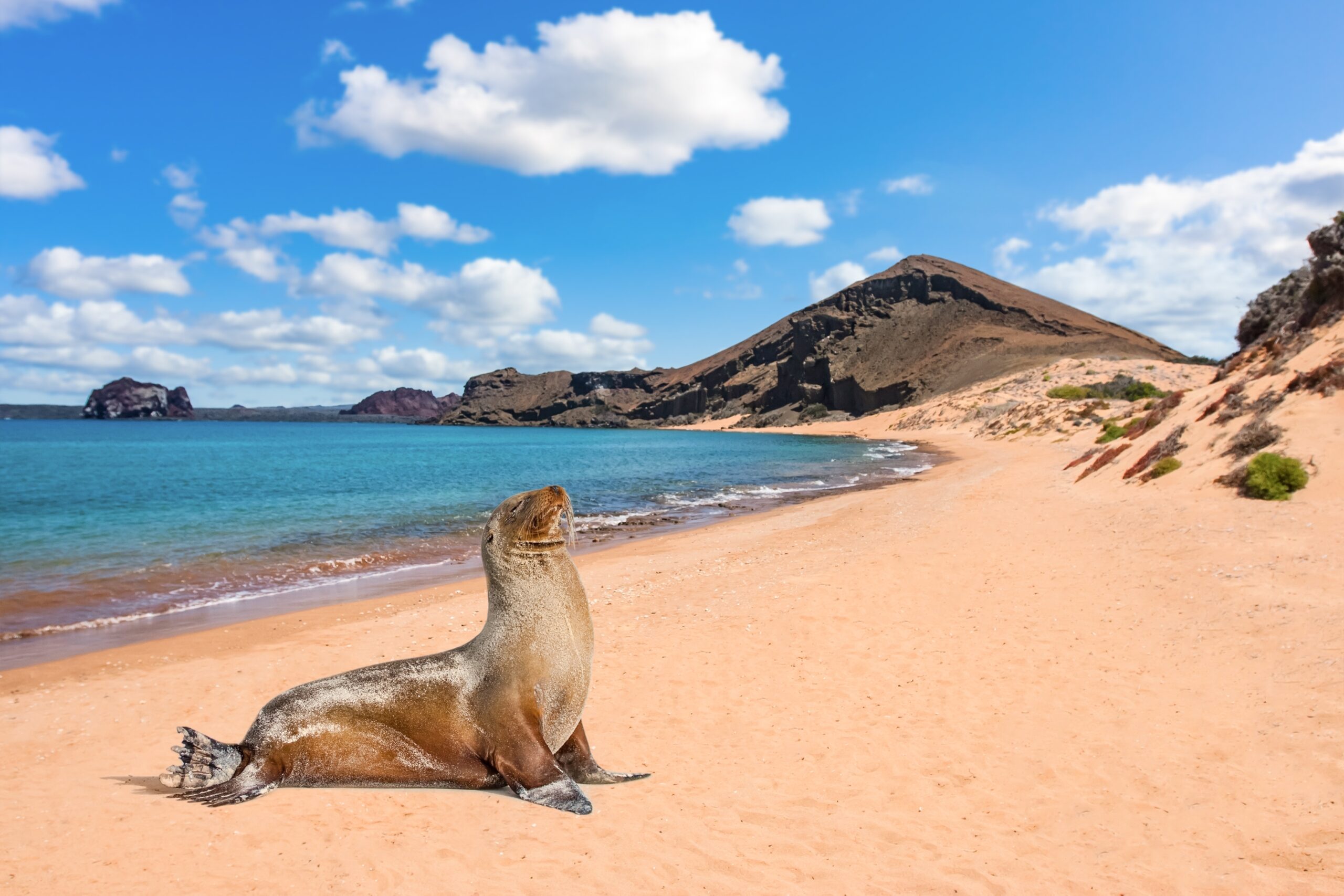




Ecuador is one of the world's 17 megadiverse countries, with extraordinary biodiversity across the Amazon, Andes, Pacific coast and Galápagos Islands. Its ecosystems provide essential services, support local livelihoods and underpin important sectors of the economy, including agriculture, fisheries and tourism. Yet this natural wealth faces growing pressures from land-use change, unsustainable production, infrastructure development and climate change.
UNDP BIOFIN has worked with the Government of Ecuador since 2013 to strengthen biodiversity finance and help close the gap between the resources available and those needed to protect nature. The programme works across public and private finance to improve biodiversity expenditure, mobilize new investment and align financial flows with national biodiversity priorities.
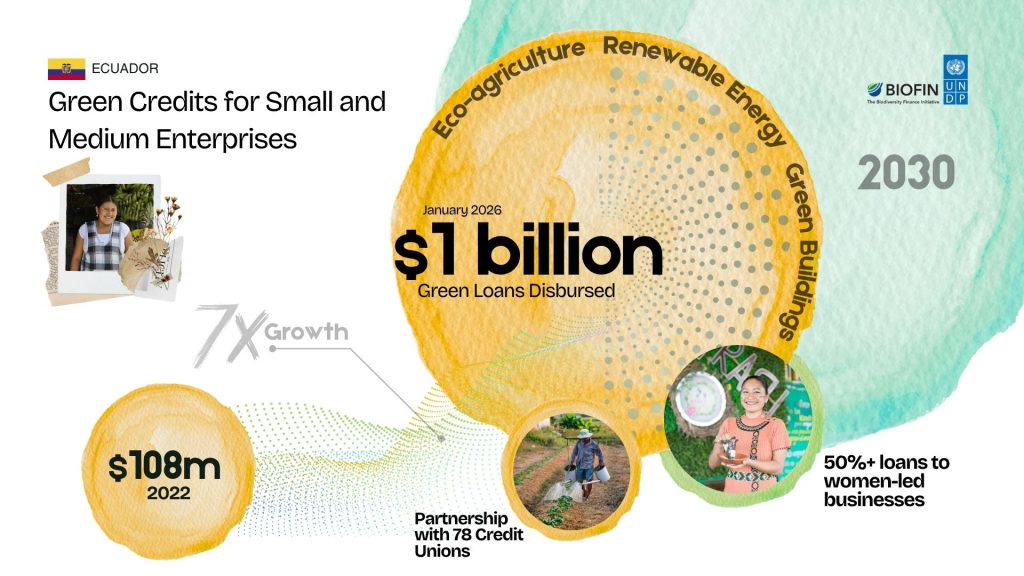
This work is increasingly bringing biodiversity into mainstream financial decision-making. Approximately US$1 billion in financing has been assessed through environmental and social safeguards supported by UNDP BIOFIN, while US$108 million has been allocated to green credit. Ecuador's updated Biodiversity Finance Plan provides a pathway to further mobilize public, private and international resources for biodiversity and support implementation of the Kunming–Montreal Global Biodiversity Framework.
Finance Solution 1: Promoting technical tools for financial mechanisms based on tourism in protected areas.
This finance solution started in 2019 and it focusses on the promotion of financial mechanisms developed during the first phase of BIOFIN II in order to provide technical inputs on financial sustainability to the management and conservation of protected areas to the new administration starting in 2021.
The technical studies developed include different rates or fees from service providers that operate in situ; analyses on the charge for entrance fees to protected areas according the types of visitors; and self-sustainability fees for the maintenance of the protected area system.
The BIOFIN II extension is considering the strong negative effect of the Covid19 pandemic crisis for the Galapagos tourism activity and the inherent risk for the conservation of biodiversity, due to the reduction of important resources for the conservation of its protected areas. In this sense, technical assistance to Galapagos institutions to design other financial solutions in the tourist line and crowdfunding initiatives are being considered.
Finance Solution 2: Optimization of management models to strengthen the management and leverage of resources for biodiversity.
This finance solution started in 2019 considering the articulation among the public and private sectors, with a key role for the financial system to promote sustainable post-pandemic development.
BIOFIN continue strengthening the National Roundtable for Sustainable Finances and also promote other national processes such as the National Roundtable on Bio-economy.
BIOFIN has also promoted the application of financial mechanisms in order to endure the water provision, such as rough water tariffs for selected productive sectors.
Finance Solution 3: Impact Investment Fund for bio enterprises associated with bioindustry
Among the efforts of the private sector in Ecuador to contribute to sustainable development include Social Responsibility (SR) actions. The analysis of recent information on the subject in the country shows that the SR actions of representative companies are preferably aligned with seven standards of the Global
Reporting Initiative - GRI, which are: local communities, materials, energy, water and effluents, biodiversity, emissions, effluents and waste and, economic performance.
However, it should be noted that the contribution of actions from the private sector to national strategies for biodiversity, climate change and sustainable development has been difficult to make visible. This reveals the need and opportunity to optimize the impact of RS actions in the context of national interests.
Thus, arose the idea of creating a subaccount within the FIAS Sustainable Environmental Investment Fund, as a catalyst for SR resources from the private sector. It is in itself a private trust fund, which would welcome voluntary contributions from the business sector and other contributors aligning business interests with sustainable development and national goals for sustainable development. The proposed name of this subaccount is “Social Responsibility and Sustainability Fund (FRSS)”.
Finance Solution 4: Finance sector for biodiversity conservation
This Finance Solution looks for a coordinated work with the Finance Sector (including the Popular and Solidarity Economy) in order to promote more sustainable practices and the development of financial tools (such as green bonds) in the country.
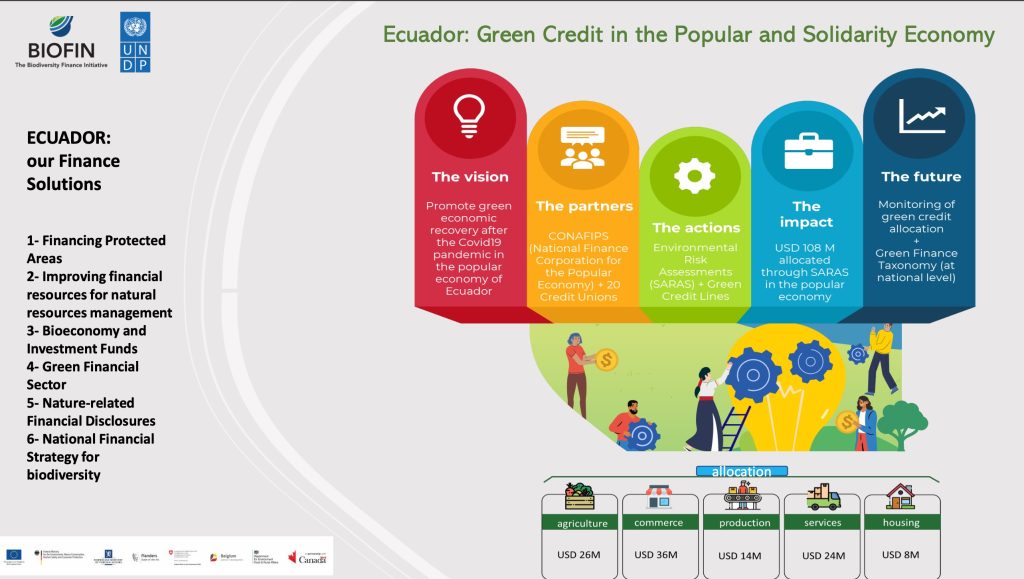
In this sense, BIOFIN will support CONAFIPS (The National Corporation of Credit Unions in Ecuador) for an activity on Green Credit Lines in the Popular Solidarity Economy (EPS) and the implementation of Systems for Social and Environmental Risk within its more than 540 Credit Unions.
For next years it is expected to continue working with CONAFIPS and partners in the monitoring for the green loan allocations. In addition, the promotion of other financial tools with the Finance Sector (such as bonds) will be carried out. Finally, BIOFIN in Ecuador prepared a Nature Financial Disclosure Readiness Policy and Institutional Review (TNFD), including a regulatory and institutional analysis, with a view to establish an enabling environment that will allow the development of a nature related financial disclosure framework.
Finance Solution 5: Financing Strategy for biodiversity conservation in Ecuador
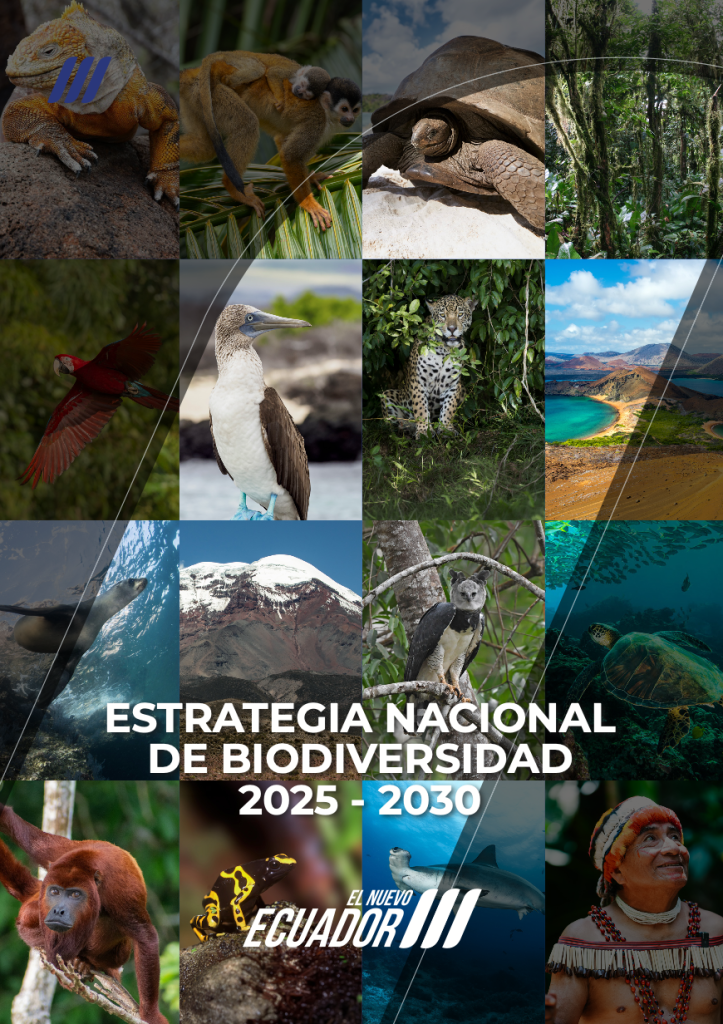
Closely with the Ministry of Environment, Water and Ecologic Transition (MAATE) BIOFIN works in the preparation of a coordinated Financing Strategy for Biodiversity in Ecuador, including the preparation of key technical results such as mapping of international funding for Ecuador; study on harmful subsidies to biodiversity; green credits taxonomy; and the evaluation of a green bond. These inputs have been the basis for the 2024 NBSAP updating process to be implemented until 2030 in the framework of the new Global Biodiversity Framework of the Convention on Biological Diversity (CBD)
Scaling Sustainable Finance
With support from UNDP BIOFIN, Ecuador's National Corporation for Popular and Solidarity Finance (CONAFIPS) introduced an Environmental and Social Risk Management System (SARAS) to integrate environmental safeguards into financial decision-making. By March 2025, approximately US$1 billion in financing had been assessed through the system, helping align financial flows with environmental and sustainability criteria.
Mobilizing Green Credit
UNDP BIOFIN supported the development of green credit lines for Ecuador's Popular and Solidarity Economy and strengthened environmental and social safeguards across the financial sector. In 2022, US$108 million was allocated to green credit, helping expand access to finance for environmentally sustainable businesses and investments.
Advancing Sustainable Capital Markets
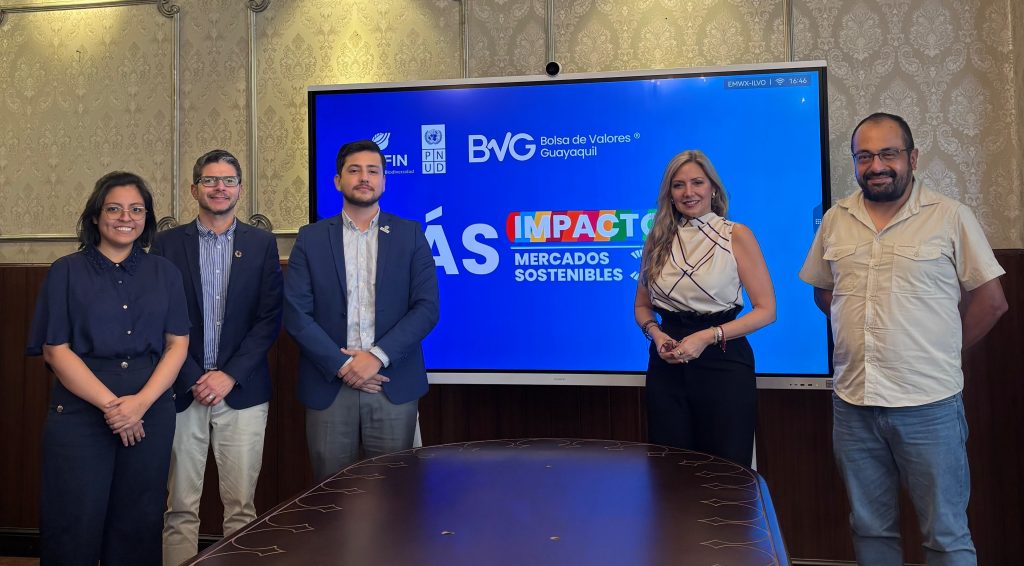
In partnership with the Guayaquil Stock Exchange, UNDP BIOFIN developed the second edition of Ecuador's Thematic Bond Guide, providing practical guidance for issuing green, blue, social and other sustainability-aligned bonds. Ecuador's thematic bond market has reached approximately US$926 million in cumulative issuances since 2019, demonstrating the growing potential of capital markets to finance sustainable development.
Strengthening Biodiversity Finance Planning
UNDP BIOFIN supported the development of Ecuador's updated Biodiversity Finance Plan 2024–2030, aligned with the National Biodiversity Strategy and Action Plan 2025–2030. The Plan provides a strategic framework for improving existing biodiversity expenditure, mobilizing national and international resources and expanding innovative public and private finance for nature.
Repurposing Harmful Subsidies
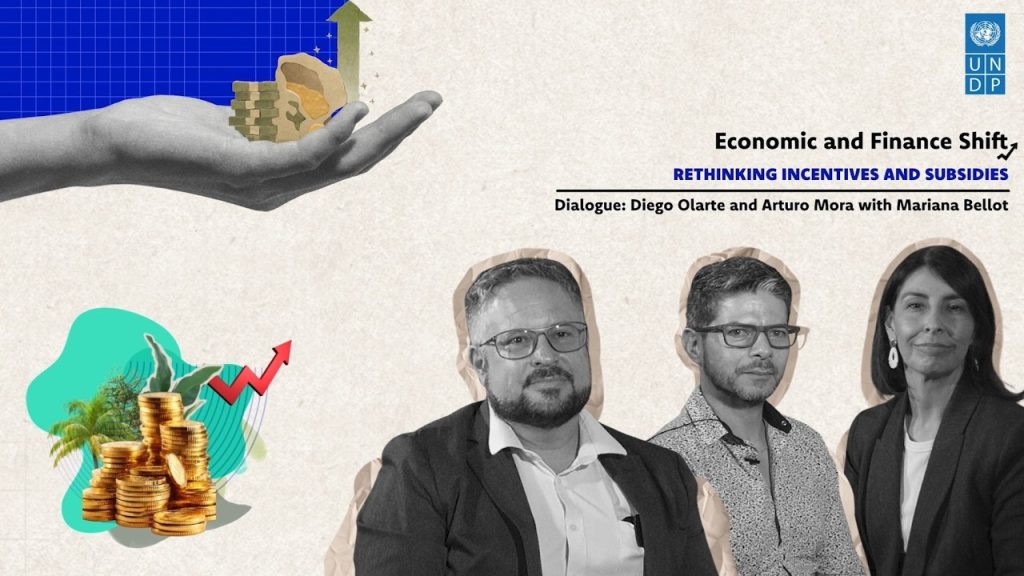
Ecuador is pioneering UNDP BIOFIN's work on identifying and redesigning subsidies harmful to biodiversity. The initiative assesses incentives that can contribute to biodiversity loss and develops pathways for redirecting public resources toward more sustainable practices, supporting implementation of Target 18 of the Kunming–Montreal Global Biodiversity Framework.
Strengthening Local Biodiversity Finance
UNDP BIOFIN supported the Quito Environmental Fund in developing a new resource mobilization and financial sustainability strategy. The approach aims to diversify funding sources, strengthen institutional capacity and improve the efficient and transparent management of resources for biodiversity and environmental priorities in the capital.