

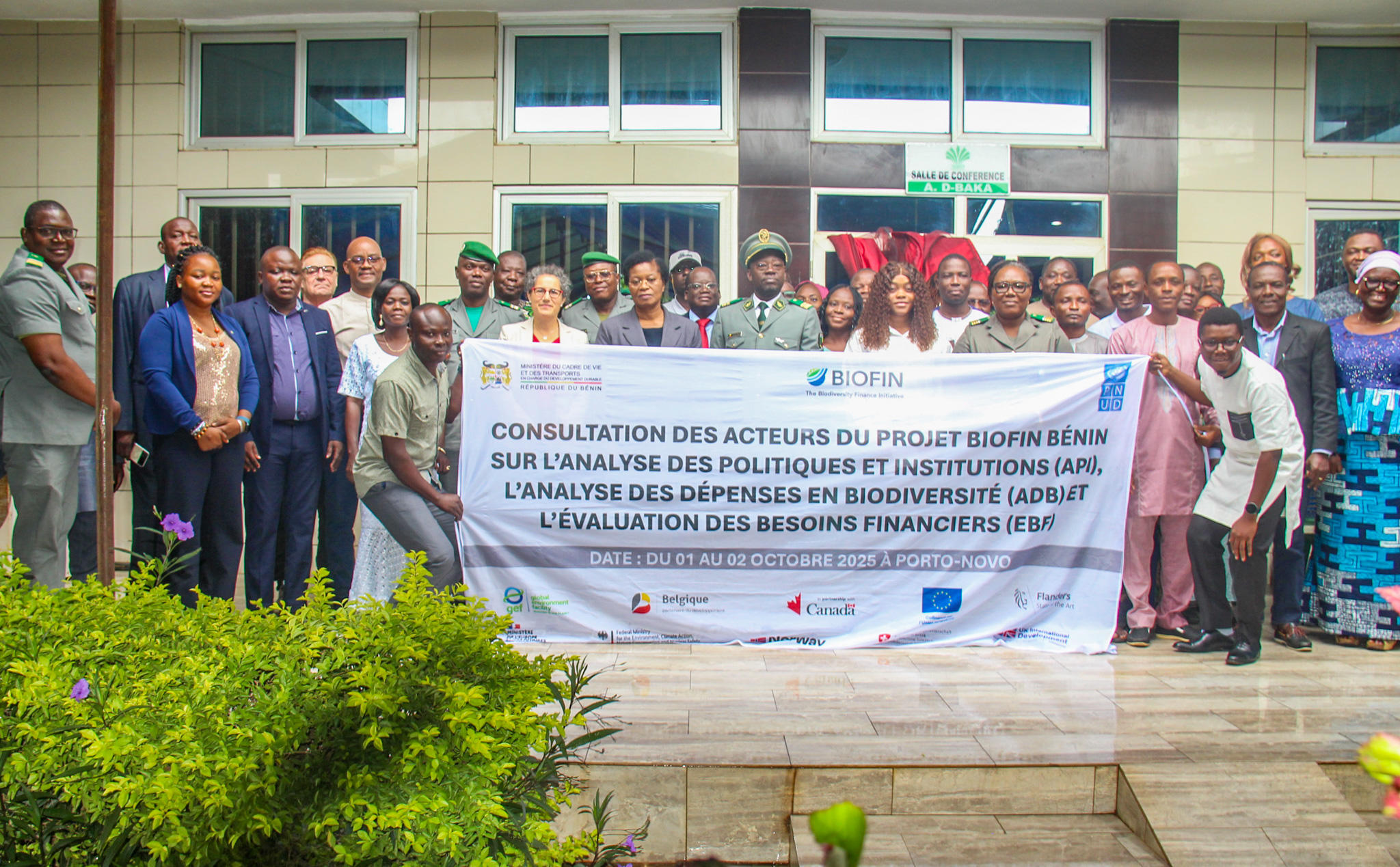
17 October 2025 – UNDP BIOFIN brought together government institutions and other partners in Porto-Novo on 1–2 October 2025 to discuss progress towards Benin’s national Biodiversity Finance Plan. The plan will help the country identify lasting sources of finance for the conservation and sustainable use of its ecosystems.
The workshop was chaired by Jeanne Akakpo Adanbiokou, Chief of Staff to the Minister of Living Environment and Transport, responsible for Sustainable Development. Participants discussed the UNDP BIOFIN methodology and its contribution to implementing the Kunming–Montreal Global Biodiversity Framework.
Discussions focused on three assessments that will inform the finance plan: the Policy and Institutional Review, which examines the policies and institutions shaping biodiversity finance; the Biodiversity Expenditure Review, which analyses public and private spending relevant to biodiversity; and the Financial Needs Assessment, which estimates the resources required to meet biodiversity goals.
Benin’s natural resources face pressure from deforestation, agricultural expansion and climate change. Developing a finance plan will help the country understand current spending, assess its needs and identify practical ways to fund its biodiversity priorities.
UNDP BIOFIN was officially launched in Benin on 19 December 2024 with support from the Global Environment Facility. At the workshop, Akakpo Adanbiokou emphasized that the national plan should help turn recognition of biodiversity as an investment priority into action. She also noted its potential to support the government’s green finance framework and attract investment for biodiversity.
UNDP Deputy Resident Representative in Benin Manon Bernier highlighted the country’s conservation efforts, including the restoration of mangroves in Togbin. She also pointed to continuing challenges: pressure on ecosystems, limited access to suitable finance and the need to integrate biodiversity into policies across sectors.
Representatives of ministries, local authorities, civil society, the private sector, academia and development partners contributed recommendations to strengthen the planning process. At the time of the workshop, the next steps were to complete the three assessments, draft the Biodiversity Finance Plan and hold a validation workshop.