
The global biodiversity finance gap is estimated at approximately US$700 billion a year. Much of the international discussion therefore focuses on how to mobilize more money for nature. But another question is equally important: when finance begins to flow, does it reach the people protecting biodiversity on the ground?
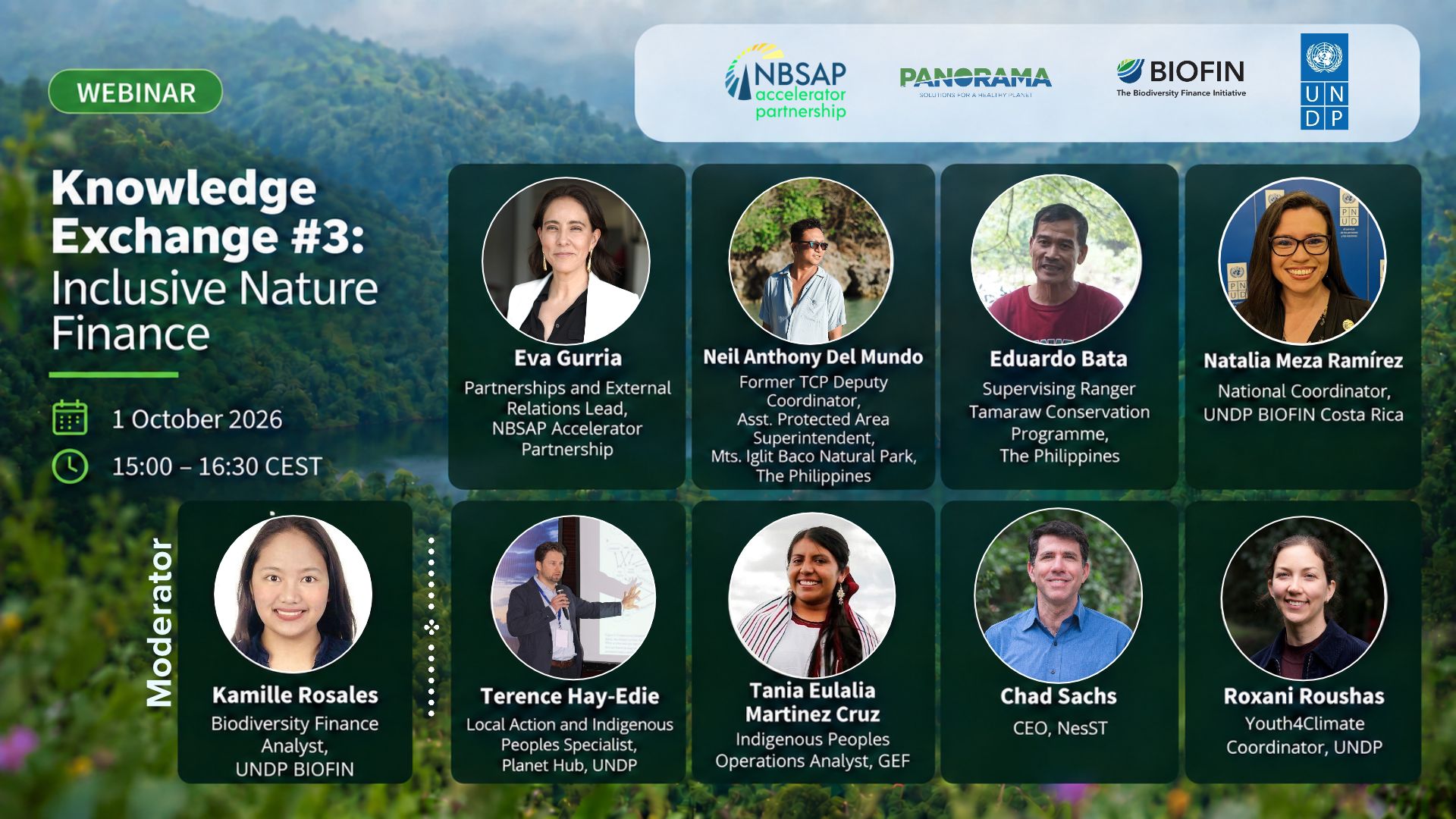
This question was at the centre of the third Knowledge Exchange on Nature Finance of 2026, jointly organized by UNDP BIOFIN, the NBSAP Accelerator Partnership and PANORAMA Solutions.
The exchange brought together practitioners, funders and policymakers to examine how nature finance can become more accessible to Indigenous Peoples, local communities, women, youth, rangers and locally led enterprises.
The examples presented, from crowdfunding for wildlife conservation in the Philippines to public finance for women-led businesses in Costa Rica, showed that inclusive nature finance is not defined only by who ultimately receives funding. It also depends on who helps set priorities, design financial mechanisms and decide how resources are allocated.
Watch the webinar recording:
Closing the “last mile” of nature finance
Indigenous Peoples and local communities are often described as beneficiaries of conservation finance. However, Eva Gurria of the NBSAP Accelerator Partnership emphasized that they are also rights holders, knowledge holders, custodians, innovators and leaders.
A rights-based approach therefore requires more than consulting communities after a programme has already been designed. Local actors need meaningful opportunities to shape priorities, participate in decisions and access finance on fair and appropriate terms.
Financial institutions must also adapt. Application requirements, short funding periods, complex procedures and a reliance on multiple intermediaries can prevent resources from reaching community organizations and smaller enterprises.
Terence Hay-Edie, Local Action and Indigenous Peoples Specialist at UNDP, explained that improving direct access means shortening the route between funders and local actors. It also requires moving beyond a “do no harm” approach based primarily on safeguards towards continuous co-creation, shared governance and partnership.
The appropriate mechanism will not always be the same. Community organizations, Indigenous-led funds, women-led enterprises and youth initiatives require different levels and types of finance. The central principle is that funding should respond to their priorities and circumstances.
Flexible finance sustains conservation in the Philippines
The Together for Tamaraws crowdfunding campaign demonstrates how a relatively small and flexible source of finance can help maintain conservation work during a crisis.
Mounts Iglit-Baco Natural Park is the principal stronghold of the critically endangered tamaraw, a species found only in the Philippines. It is also home to Indigenous Mangyan communities, some of whose members depend on ecotourism and work as rangers, wardens, guides and porters.
When the park closed to tourism during the COVID-19 pandemic, many families suddenly lost their source of income. UNDP BIOFIN Philippines and its partners responded by launching a crowdfunding campaign to support the people protecting the tamaraw and its habitat.
The campaign raised approximately US$32,000 from 195 donors in the Philippines and abroad, exceeding its initial target. It provided salaries, food, field equipment and other essential support to rangers, wardens and Indigenous communities.
For Neil Anthony Del Mundo of the Tamaraw Conservation Programme, the importance of the campaign extended beyond the amount raised.
“What mattered was not only the amount, but the diversity of people willing to contribute during a crisis,” he said.
The campaign connected biodiversity finance directly with immediate community needs. By helping families cope with lost income, it also reduced pressures that could have led to hunting or resource extraction from the protected area.
Other UNDP BIOFIN countries subsequently adapted the approach, including Belize, Costa Rica, Ecuador and Thailand. In the Philippines, it also helped strengthen partnerships that attracted further private support for ranger equipment, conservation and research.
Its central lesson is that inclusive finance can be flexible, community-centred and replicable. When conventional revenue streams stopped, crowdfunding provided a rapid way to keep conservation activities—and the people responsible for them—supported.
Redesigning public finance around women in Costa Rica
Costa Rica presented a different model: changing existing public finance systems so they become more accessible to women leading nature-positive businesses.
UNDP BIOFIN Costa Rica has developed Más Mujeres, Más Naturaleza—More Women, More Nature—as an umbrella strategy for incorporating gender considerations across its biodiversity finance solutions.
One of its newest programmes, Más Natura, Más Rural, supports rural women working on bioeconomy initiatives in areas such as agritourism, natural cosmetics, traditional medicine, handicrafts and sustainable production.
More than 50 women-led projects are currently participating in a pilot in Costa Rica’s Brunca region. The programme aims to reach more than 300 women by 2030, supported by a commitment of approximately US$2.5 million from a national institutional partner.
Instead of using international cooperation funding to provide short-term grants directly, the programme uses it to build capacity, improve business models and help women-led enterprises access national public funding that already exists.
According to Natalia Meza Ramírez, National Coordinator of UNDP BIOFIN Costa Rica, this required understanding why existing funding was not reaching women or nature-positive enterprises—and redesigning the process accordingly.
The programme was co-designed with participating women, communities and institutions. It combines business acceleration with biodiversity and social criteria, field visits, technical assistance and tailored indicators. Each enterprise has an entry and exit profile to measure how its business model and biodiversity impact develop during the programme.
“Listening is a powerful strategy for understanding whether every step we are taking responds to the solutions people actually require,” Meza Ramírez said.
Costa Rica’s experience shows that inclusive finance does not always require creating a new funding source. It can also involve removing barriers that prevent underserved groups from accessing existing resources.
Moving direct access to a larger scale
The Global Environment Facility is also expanding mechanisms designed to support Indigenous Peoples and local communities more directly.
Under the Inclusive Conservation Initiative, 10 Indigenous organizations operating across 12 countries received grants ranging from US$1 million to US$2 million. The projects are based on priorities identified by the participating organizations, while Indigenous leaders serve on steering committees that help determine how funding is managed.
Under GEF-8, a further US$25 million window was established for Indigenous organizations and Indigenous-led funds. More than 800 expressions of interest were received, illustrating both the demand for direct access and the limited availability of suitable funding.
Tania Eulalia Martinez Cruz, Indigenous Peoples Operations Analyst at the Global Environment Facility, announced that a US$100 million dedicated window is being developed under GEF-9—four times the amount provided through the GEF-8 window.
The GEF is also extending an aspirational target for 20 percent of funding to support actions by Indigenous Peoples and local communities across its family of funds. New indicators and guidance are being developed to track where the funding goes and whether it supports priorities determined by Indigenous Peoples and local communities.
Funding targets alone do not guarantee inclusion. The experience demonstrates the importance of involving Indigenous representatives in governance, establishing transparent definitions and measuring how much finance reaches locally determined action.
Patient capital for locally led enterprises
Social enterprises can connect conservation with sustainable livelihoods, particularly where communities need viable alternatives to activities that contribute to ecosystem degradation. Yet these enterprises are frequently overlooked by conventional financial institutions.
Chad Sachs, Chief Executive Officer of NESsT, explained that many locally led enterprises need relatively modest investments of US$30,000 to US$100,000. These amounts are often too small for conventional investors but can be transformative for community-based businesses.
Capital alone is not enough. Enterprises may also require support with financial management, governance, investment readiness and measuring their social and environmental results.
NESsT therefore combines technical assistance with grants, recoverable grants and patient loans. Its experience also suggests that one-year financing is rarely sufficient. Enterprises may need support over two or three years to strengthen their operations and demonstrate their impact.
Investors must also recognize that returns can take several forms. Nature-positive enterprises may not produce conventional market-level financial returns, but they can generate significant environmental and social value while supporting local livelihoods.
Giving young people finance and decision-making power
Young people represent half of the world’s population, yet youth-led initiatives receive only a small share of international environmental funding.
Youth4Climate, an initiative supported by UNDP and the Government of Italy, provides funding of up to US$30,000 to early-stage solutions led by young people. Its four funding cycles have attracted more than 7,000 proposals from over 130 countries.
So far, US$5.5 million has been allocated directly to youth-led initiatives in 69 countries. Half of the selected initiatives have been led by women, while Indigenous youth and young people from least developed countries and small island developing states have also been prioritized.
The programme recognizes the structural barriers facing young applicants. Registering a business or organization can be expensive and time-consuming, while first-time applicants may need assistance with budgeting, work planning and impact measurement.
Youth4Climate therefore provides applicants with capacity development and one-to-one support. Selected initiatives can take up to two years to test and implement their ideas.
Young people also participate in the selection process, including through youth constituencies and the International Indigenous Youth Forum on Climate Change. This allows them to influence which initiatives receive support rather than participating only as applicants or beneficiaries.
Five questions for designing more inclusive finance
The experiences shared during the knowledge exchange suggest five practical questions that governments, funders and financial institutions can ask when developing nature finance mechanisms:
- Who participated in identifying the priorities and designing the mechanism?
- Do local actors have a meaningful role in funding and governance decisions?
- How many intermediaries and administrative requirements stand between the funding source and the people delivering action?
- Does the mechanism combine appropriate finance with long-term capacity and technical support?
- Are biodiversity, social, and inclusion outcomes measured together?
Closing the biodiversity finance gap is not only about mobilizing more capital. It is also about designing finance that local actors can shape, access and use effectively.
When communities, women, young people and Indigenous Peoples participate as partners and decision-makers, nature finance can do more than fund individual projects. It can build institutions, strengthen livelihoods and connect global biodiversity commitments with lasting action on the ground.
The Knowledge Exchange on Nature Finance series is jointly organized by UNDP BIOFIN, the NBSAP Accelerator Partnership and PANORAMA Solutions.