
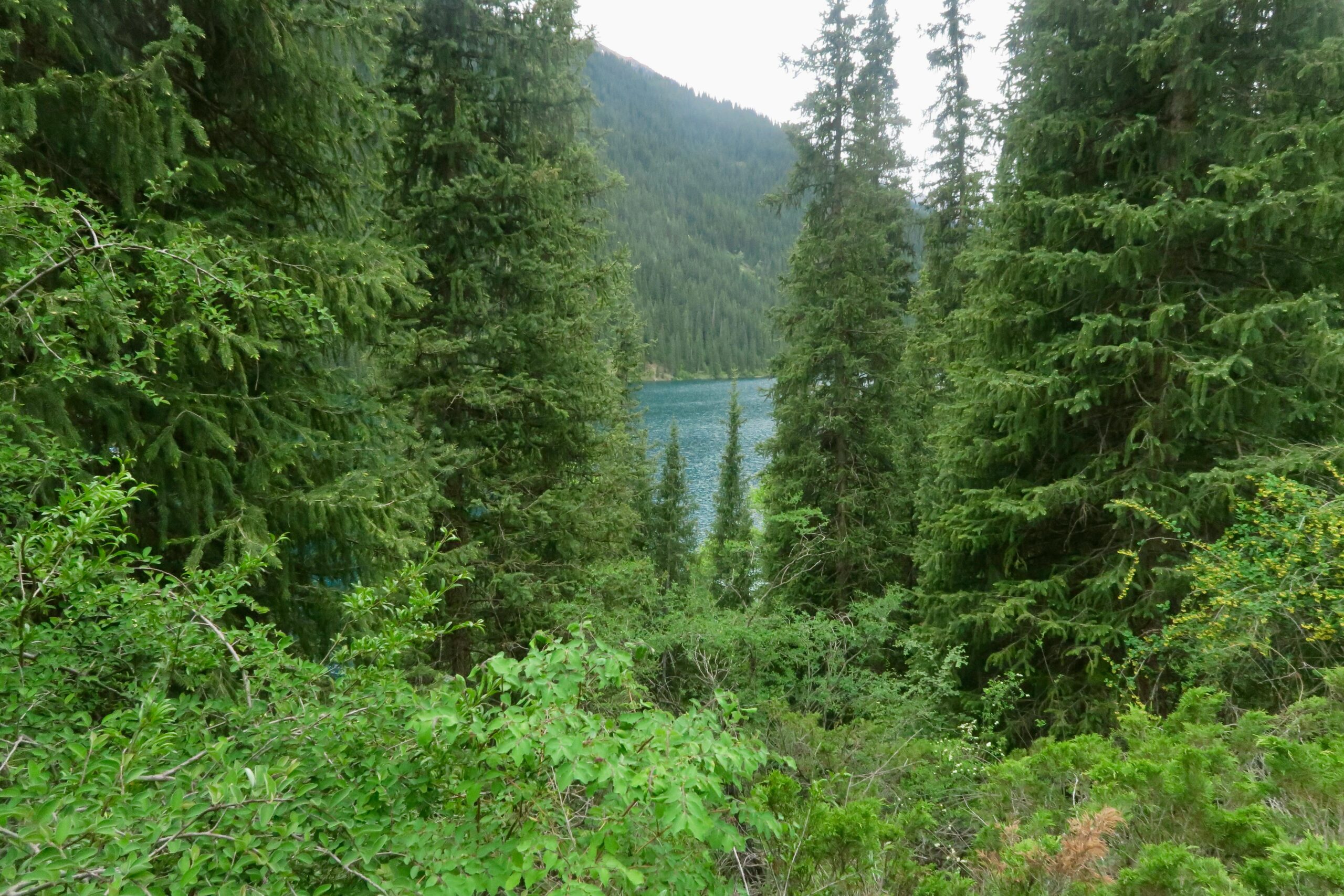
Forests cover only a small share of Kazakhstan’s vast territory, but they provide critical habitat for biodiversity, store carbon and help protect land and water resources. Financing their conservation and restoration, however, cannot rely on public budgets alone.
Kazakhstan is exploring how carbon markets can help change that equation.
Over several years, the country has been building the policy, legal and technical foundations needed to channel carbon finance into forests. With support from the United Nations Development Programme’s Biodiversity Finance Initiative (UNDP BIOFIN), the work has progressed from identifying the finance solution, to testing the approach with private investment, strengthening legislation and developing methodologies, and now building the capacity needed to bring high-integrity projects to market.
The aim is to generate carbon credit but also to create a mechanism through which finance can also contribute to expanding and restoring forests, improving their management and supporting biodiversity.
From a financing gap to a finance solution
The idea emerged through Kazakhstan’s Biodiversity Finance Plan.
The plan identified carbon markets as an opportunity to attract additional investment into forest conservation and sustainable forest management. Most of the Kazakhstan’s forests are located outside protected areas, while financing for forest biodiversity remains insufficient.
Two complementary finance solutions were therefore identified: creating an enabling environment to attract nature-positive carbon investment from international markets and companies and integrating biodiversity-friendly forest carbon offsets into Kazakhstan’s domestic Emissions Trading System.
The premise was straightforward: if high-integrity forest projects can generate credible carbon units, investment motivated by climate objectives can simultaneously support forests and the biodiversity they contain.
But turning that idea into a functioning finance mechanism required more than identifying potential investors. Kazakhstan needed methodologies, clear rules, appropriate legislation and practical experience in developing forest carbon projects.
Testing the model with private finance
An important early test came through cooperation between the Government of Kazakhstan, UNDP and technology company Bitfury.
In 2019, BIOFIN mobilized more than US$798,000 in private investment from Bitfury to pilot a forest carbon approach. The initiative sought to demonstrate how private carbon finance could contribute to forest management while supporting Kazakhstan’s efforts to develop mechanisms for offsetting greenhouse gas emissions.
Among its results, the work helped identify 116,800 hectares of previously unaccounted forests in East Kazakhstan and Pavlodar regions. Of these, 20,200 hectares were subsequently incorporated into the State Forest Fund, bringing them under formal forest management.
The initiative also supported the preparation of forest carbon projects and regulatory and methodological work needed to enable their implementation.
The pilot, which formally concluded in March 2026, provided practical experience that could feed into the wider development of Kazakhstan’s forest carbon framework.
Building the rules for investment
Alongside piloting, UNDP worked with national partners to strengthen the enabling policy environment.
Recommendations supported by UNDP BIOFIN contributed to Kazakhstan’s Environmental Code, including provisions related to carbon credits alongside other biodiversity finance mechanisms such as biodiversity offsets and voluntary payments for ecosystem services.
UNDP BIOFIN also supported methodological work for the development and implementation of forest carbon projects and for calculating greenhouse gas absorption by forests.
A significant further step came in 2025, when amendments to Kazakhstan’s Forest Code established specific provisions for carbon projects implemented on State Forest Fund lands using non-budgetary finance.
The legislation addresses an important issue for potential investors: ownership of the carbon units generated by these projects.
Under Article 9-1 of the Forest Code, carbon units generated by eligible projects financed with non-budgetary resources can belong to the individuals or legal entities that financed the project, subject to Kazakhstan’s rules governing carbon offsets and offset units. The forest stands planted on State Forest Fund land remain state property.
This creates a clearer legal basis for private capital to participate in forest carbon projects while maintaining public ownership of forest resources.
For biodiversity, this distinction matters. Carbon markets can potentially provide an additional source of investment for capital-intensive forest restoration and management activities that are difficult to finance sustainably through public budgets alone.
From rules to high-integrity projects
With the enabling framework taking shape, attention is increasingly turning to implementation.
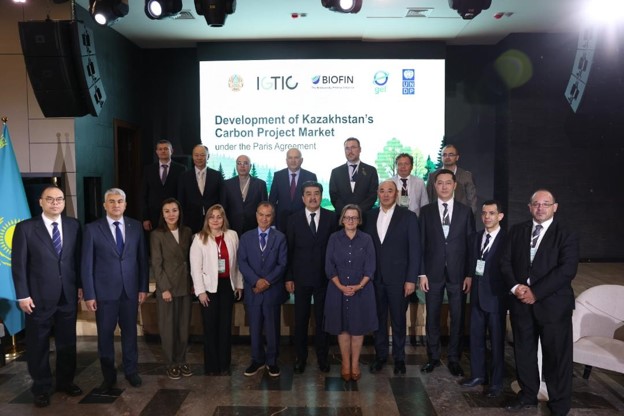
In January 2026, UNDP Kazakhstan in partnership with the Committee for Forestry and Wildlife of the Ministry of Ecology and Natural Resources, brought together more than 100 representatives from government, financial institutions, industry, academia, validation and verification bodies, airlines, private companies and carbon project developers.
The training addressed the practical requirements for developing high-integrity projects in forestry and agriculture: establishing credible baselines, demonstrating additionality, monitoring, reporting, and verification, safeguards, risk management, and nature-based solutions.
This capacity is essential if the regulatory framework is to translate into projects that attract investment.
Carbon markets are increasingly shaped by expectations that projects demonstrate environmental and social integrity in addition to measurable climate benefits. This is particularly important for nature-based projects, where the way forests are restored and managed can determine whether investment delivers meaningful benefits for biodiversity as well as carbon. In this regard, UNDP’s Climate Promise and High Integrity Carbon Markets initiative have informed this process, promoting approaches that integrate high-integrity principles and sustainable development considerations into the design of carbon market frameworks.
For Kazakhstan, this creates an opportunity to build biodiversity considerations into carbon finance from the outset.
Connecting carbon markets and biodiversity finance
Kazakhstan’s experience illustrates a broader shift in thinking about carbon and biodiversity finance.
Closing the biodiversity finance gap does not necessarily require creating entirely new sources of money. It can also mean intentionally designing existing mechanisms so that investment flows contribute more effectively to nature.
Carbon markets offer one such opportunity.
When designed with appropriate safeguards, methodologies and biodiversity objectives, forest carbon projects can potentially connect private buyers with activities that restore ecosystems, expand forest cover and improve long-term forest management.
This is the approach Kazakhstan has been developing step by step: identify the finance solution, test it, establish the enabling legislation and methodologies, build institutional and technical capacity, and create the conditions for scaling investment.
The next challenge will be translating these foundations into a pipeline of credible projects capable of attracting investment while demonstrating measurable benefits for climate, forests and biodiversity.
For UNDP BIOFIN, the opportunity lies in identifying where carbon markets and biodiversity finance can be mutually reinforcing, helping ensure that relevant investments deliver robust biodiversity outcomes alongside climate objectives.