ENGLISH
How Mongolia Plans to Finance Its New Biodiversity Strategy
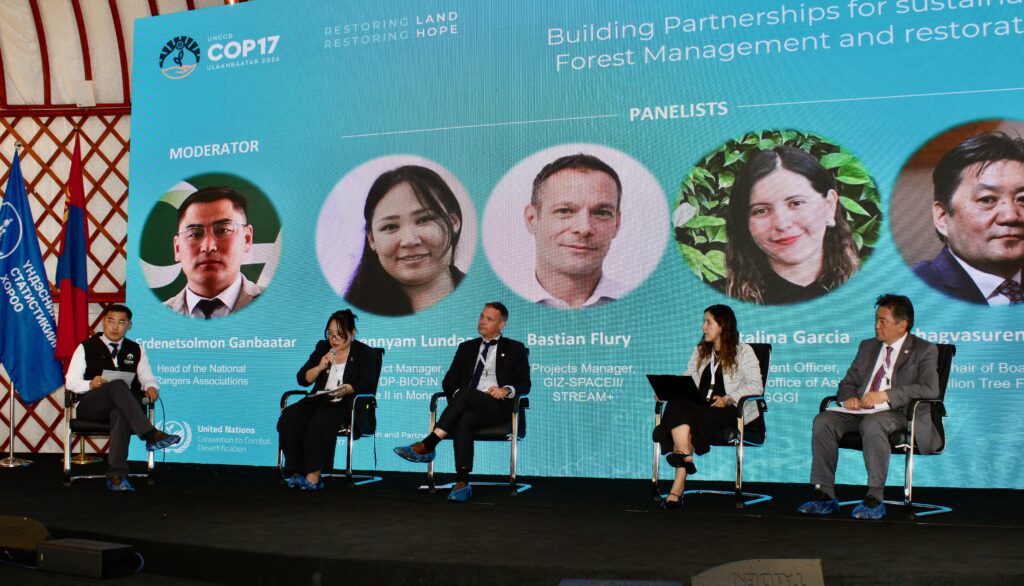
At UNCCD COP17 in Ulaanbaatar, Mongolia presented reforms designed to mobilize investment, address financial flows that harm nature and strengthen…








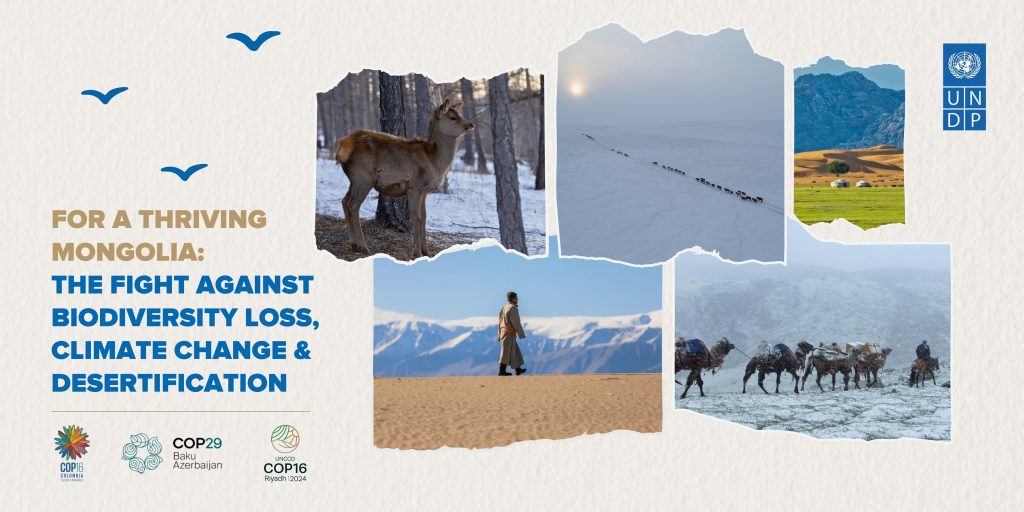
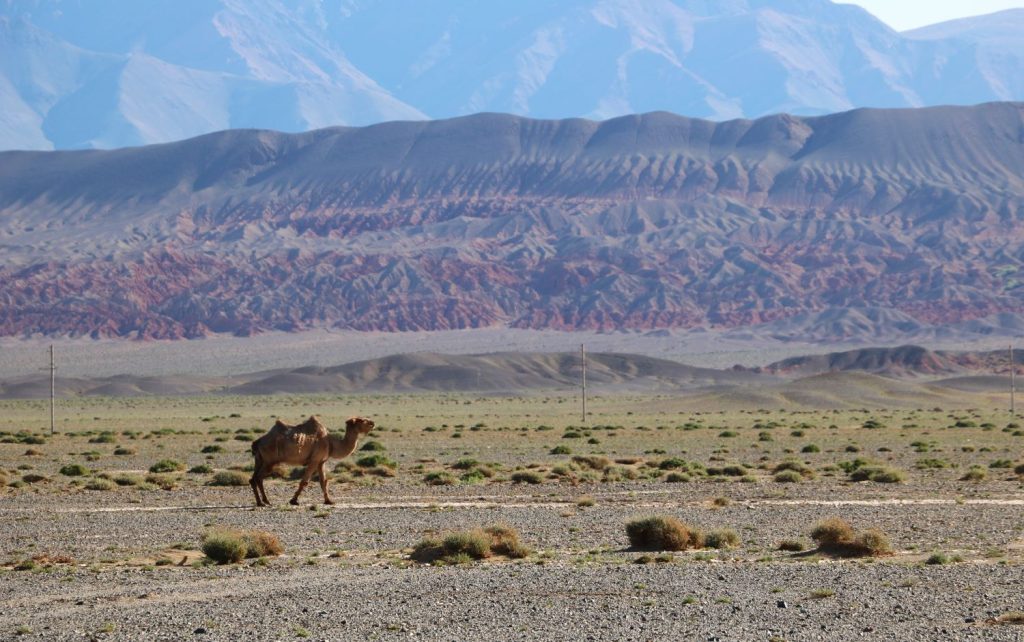
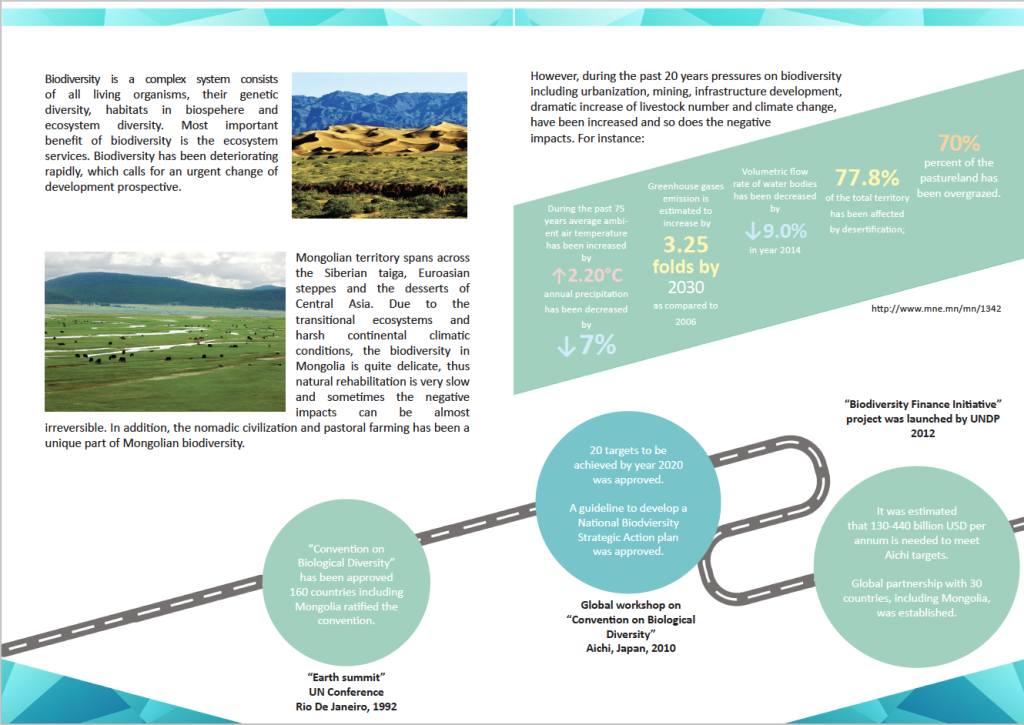
Mongolian territory spans from the Siberian taiga to the Central Asian dry steppes and deserts. Due to the transitional ecosystems and harsh continental climatic conditions, the biodiversity in Mongolia is unique and delicate. Pastoral livestock husbandry is well adapted to seasonal climatic and geographical conditions and is an important part of biodiversity.
The pristine natural and semi-natural ecosystems are dominant in Mongolia (98.4% of the total territory), and the species composition is still in a healthy condition, which provides the opportunity to reduce potential expenditures on biodiversity conservation. However, reflecting on the economic sectoral impacts on biodiversity, very little effort has been made toward sustainable management of natural resources by the main economic sectors reliant on natural resources (livestock husbandry) and sectors based on natural resources (mineral resources). Hence, future biodiversity loss and degradation may get worse, which in turn increases conservation expenditures rather than curtailing them.
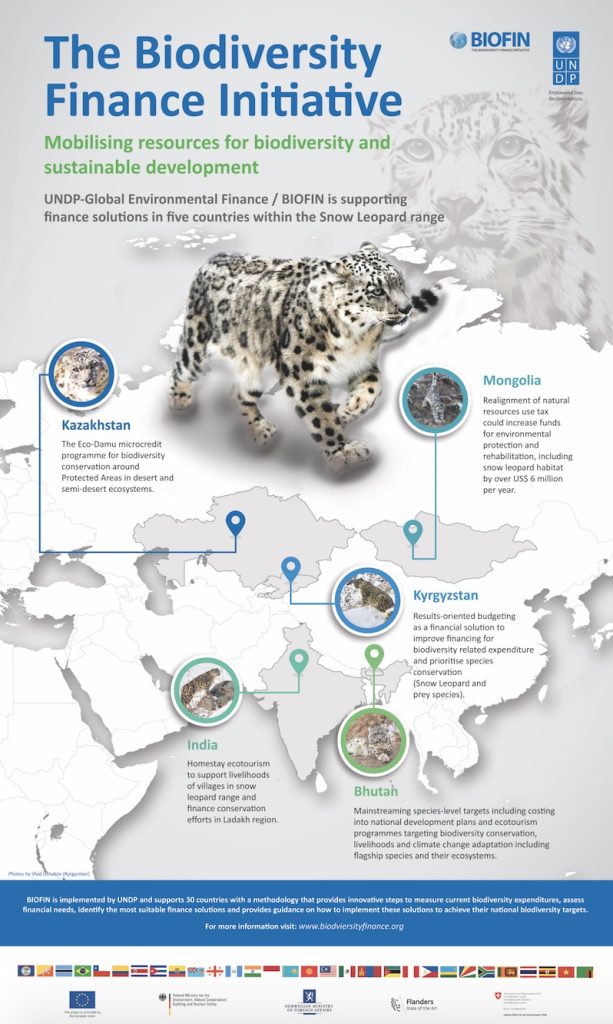
In Mongolia, BIOFIN was officially launched by UNDP in September 2015 with the endorsement of the Ministry of Environment, Green Development and Tourism (presently the Ministry of Environment and Climate Change). BIOFIN’s initial assessments, including Policy and Institutional Review (PIR), Biodiversity Expenditure Review (BER), and Financial Needs Assessment (FNA) were conducted within the framework of the National Biodiversity Programme 2015 – 2025.
Mongolia has since developed a new National Biodiversity Strategic Action Plan (NBSAP), aligned with the Kunming-Montreal Global Biodiversity Framework (KMGBF), which was approved through Government Resolution No.246 in June 2026. The PIR, BER, and FNA are currently being updated to reflect the priorities and targets of the newly approved NBSAP. Based on the findings of these three assessments, Mongolia’s national Biodiversity Finance Plan will be finalized.
Enforcement of the implementation of the Natural Resources Use Fees Law
The finance solution aims to strengthen implementation of the Law on Natural Resource Use Fees by ensuring that revenues generated from the use of water, forests, wildlife, plants and land are effectively reinvested in environmental protection and restoration. It seeks to improve the full budget cycle, from revenue forecasting and planning to expenditure execution, monitoring and reporting, while strengthening transparency, local accountability and results-based environmental financing.
With BIOFIN support, the implementing Bylaw was comprehensively revised in 2022, introducing standardized planning and reporting formats, closer alignment with the national budget cycle and clearer procedures for applying the minimum environmental expenditure requirements under Article 18.1 of the Law. The revision also expanded the use of land-fee revenues for desertification prevention, land-degradation control and restoration, and supported the establishment of the Environmental Budget and Expenditure Database at https://finance.eic.mn.
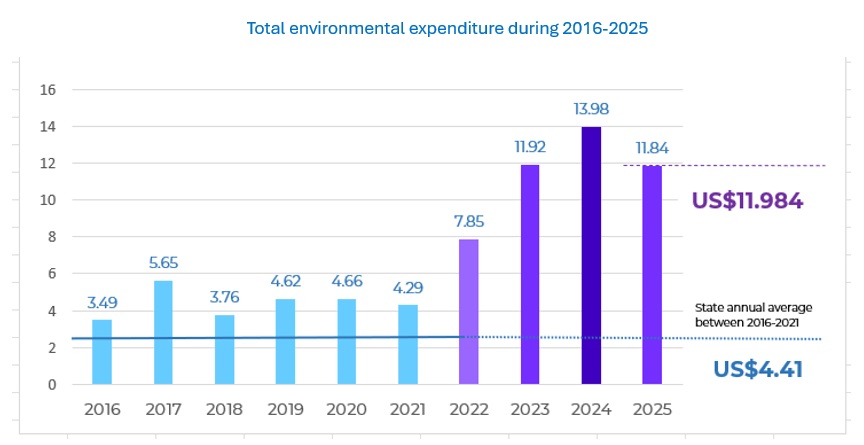
Nationwide capacity-building, technical assistance and closer cooperation with the Ministry of Environment and Climate Change, and the Ministry of Finance helped institutionalize dedicated environmental allocations within local budgets. The mechanism demonstrated resilience during the severe fiscal pressures of 2025: although the implementation rate declined to 45.15 percent and actual environmental expenditure fell from US$13.98 million in 2024 to US$11.84 million in 2025, expenditure remained US$7.43 million above the 2016–2021 annual average, or approximately 2.7 times higher than the baseline level. Natural resource use fee collection also remained strong at US$80.78 million, equivalent to 95.4 percent of the annual revenue plan. For FY2026, the Ministry of Finance approved MNT 84.95 billion for environmental protection and natural resource rehabilitation, equivalent to US$23.78 million based on the average exchange rate from 1 January to 20 July 2026. Following approval by local governments, the total budget allocation reached MNT 89.1 billion, or approximately US$24.95 million.
Lessons from nationwide implementation informed a further revision of the Bylaw to simplify procedures, strengthen results-based planning, reduce manual reporting and enable data exchange with tax, fiscal, Treasury and sectoral systems. Following extensive consultations with local governments, ministries and the public, the revised Bylaw was approved by the Cabinet on 8 July 2026 and will enter into force on 1 January 2027.
Strengthening the Billion Tree Fund to mobilize private finance for nature-based solutions
The objective of the finance solution is to operationalize the private Billion Tree Fund as a sustainable, transparent, and internationally aligned conservation-finance mechanism capable of mobilizing and managing diversified private-sector and international finance for afforestation, forest restoration, biodiversity conservation, and other nature-based solutions.
Major successes and milestones achieved with country programme support:
BIOFIN accelerated institutional engagement and commissioned alignment with the CFA Practice Standards. An institutional gap analysis was completed, priority governance and compliance documents were prepared for Board approval, and the BTF became a CFA institutional member. Four documents prepared are currently under BTF review and approval. In parallel, 41 potential private-sector financing mechanisms were long listed, 10 were shortlisted and financially assessed, and four promising models were identified for further development. The draft BTF Mid-Term Strategy 2025–2030, delivered to the Fund in 2025, are re-considered to establish a results-oriented framework covering restoration investments, sustainable financing and governance, and MRV and carbon-market capacity. It also emphasized financing diversification beyond annual banking-sector contributions and introduced environmental, institutional, and financial performance indicators.
Key next steps toward achieving the finance solution’s objective are finalize and secure Board approval of the Mid-Term Strategy and priority CFA-alignment documents; translate them into annual plans, operational procedures, safeguards, and monitoring arrangements; and progressively address gaps in asset management, risk management, and resource mobilization. Select two priority revenue models for detailed market, legal, financial, and safeguards assessment, develop bankable business and implementation plans, and mobilize private-sector partners for pilot implementation.
Repurposing biodiversity-harmful subsidies
The finance solution aims to identify and progressively repurpose subsidies and other incentives that may contribute to biodiversity loss, while maintaining essential support for livelihoods, food security and economic development. It seeks to redirect public finance toward environmentally sustainable and results-based incentives that promote efficient natural resource use, reduce ecosystem pressures and support Mongolia’s commitments under the Global Biodiversity Framework, particularly Target 18.
With support from the BIOFIN country programme, a national assessment of potentially biodiversity-harmful subsidies was completed using BIOFIN’s The Nature of Subsidies methodology. The assessment identified direct budget subsidies and tax concessions across priority sectors, analysed ten major agricultural incentives, and selected milk and wheat incentives for more detailed assessment and potential reform. Recommended measures included integrating environmental criteria, shifting from production-based to results-based support, piloting revised incentives and strengthening monitoring and safeguards.
To accelerate implementation, the project recruited a reform facilitator to support stakeholder engagement and interministerial coordination. Following consultations with MECC, the immediate entry point was strategically reoriented toward water-related implicit subsidies, including outdated water valuation, use-purpose coefficients, subsidized tariffs, and fee reductions and exemptions. MECC subsequently issued an official request for support, and Government Resolution No. 152 of 22 April 2026 mandated the preparation of revised water valuations, coefficients and water-use fee rates for Cabinet consideration.
The national team will complete the recruitment of the consultant team and support the revision of the ecological-economic valuation of water and sector-specific water-use norms. It will also assess water-use coefficients, fee reductions and exemptions, strengthen cost-recovery and water-efficiency incentives, and undertake consultations to prepare technically sound and socially equitable regulatory proposals.
As the Law on Water is currently under revision, relevant reform provisions will be pursued through this legislative process. This provides a more practical and lower-risk pathway than reopening the Law on Natural Resource Use Fees. In parallel, the BIOFIN national team will continue to advance the gradual reform of agricultural subsidies and other priority incentives affecting biodiversity.
Supporting the private sector in the early adoption of nature-related financial disclosure
The finance solution aims to support the early adoption of nature-related financial disclosure by Mongolian businesses and financial institutions. It seeks to strengthen the identification, assessment and transparent reporting of nature-related dependencies, impacts, risks and opportunities, thereby improving financial decision-making, increasing biodiversity-positive investment and reducing future financial risks associated with biodiversity loss and ecosystem degradation.
Following approval of the finance solution proposal, recruitment of a Technical Analyst for Nature-Related Financial Disclosure and Green Economic Transition is underway. The analyst will provide technical guidance and quality assurance, support the readiness assessment and pilot activities, facilitate stakeholder engagement and capacity-building, and strengthen coordination with the Ministry of Finance, financial regulators, businesses and other partners.
Upcoming Finance solutions
Two finance solution proposals on Results-based budgeting and management in the environmental sector and developing a transparent and ecosystem-based fee-management system for Protected Areas are currently under development.
BIOFIN Mongolia has played a catalytic role in strengthening biodiversity finance by supporting policy reforms, increasing public and private revenues for conservation while reducing negative financial flows, building institutional capacity, and developing a national Biodiversity Finance Plan with practical finance solutions.
Transforming Natural Resource Finance
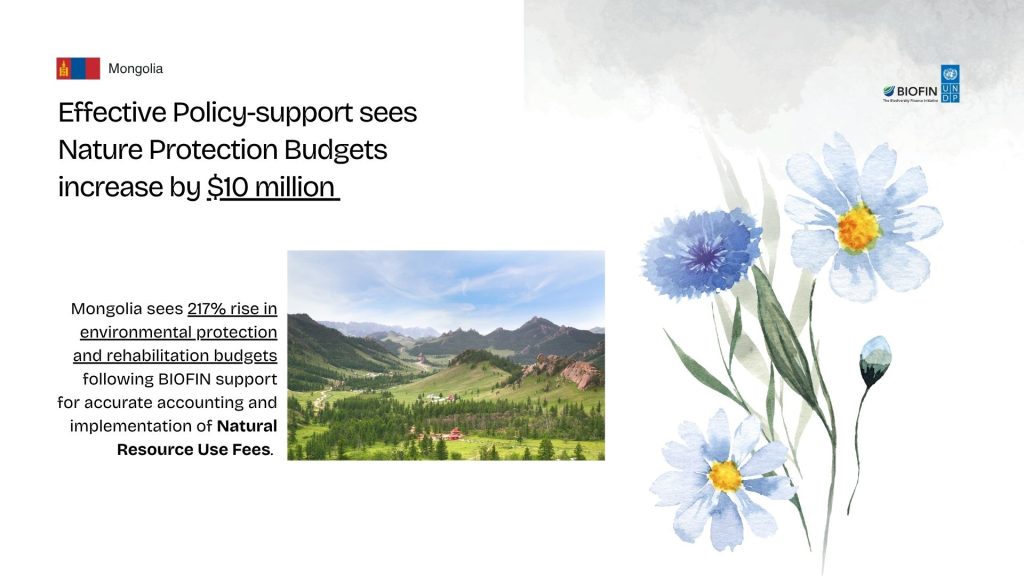
UNDP BIOFIN supported the implementation of Mongolia's Natural Resource Use Fee (NRUF) Law, helping strengthen the collection and management of environmental fees.
Between 2016 and 2021, average annual local environmental expenditure was approximately USD 4.4 million. In 2022, with BIOFIN’s technical support, the implementing bylaw, the only supplementary act to the NRUF law, was substantially revised, and standardized planning and reporting procedures were introduced. Since 2022, following BIOFIN’s technical assistance and support in capacity building and improvements in planning, budgeting and reporting, this annual average has increased to approximately USD 11.4 million.
Between 2022 and 2025, nationwide implementation provided valuable lessons. It highlighted the need to simplify procedures, improve expenditure classification and reporting, automate data collection, connect relevant government systems, and link expenditure more clearly to NBSAP results.
Based on these lessons, BIOFIN supported further regulatory revision in 2026 through extensive consultations with ministries, provincial governments and other stakeholders. The revised bylaw was approved by the Cabinet in July 2026 and will enter into force on 1 January 2027.
The reform is expected to strengthen implementation, automate budget reporting, improve integration with fiscal, treasury and tax systems, and increase transparency and accountability. Most importantly, it will direct more natural-resource revenues toward measurable biodiversity and ecosystem outcomes.
Developing Mongolia's national Biodiversity Finance Plan
UNDP BIOFIN completed the full suite of analytical assessments, including the Policy and Institutional Review (PIR), Biodiversity Expenditure Review (BER), Financial Needs Assessment (FNA), and Biodiversity Finance Plan (BFP) in 2019. The Biodiversity Finance Plan identifies 4 priority finance solutions designed to close Mongolia's biodiversity finance gap by strengthening public finance, improving natural resource governance, mobilizing private investment, and enhancing incentives for sustainable land management.
Following the recent approval of Mongolia’s new NBSAP, the national BIOFIN team is assisting in updating these assessments and the Biodiversity Finance Plan in close collaboration with the GEF-funded UNDP-NBSAP project.
Strengthening Local Capacity for Biodiversity Finance
To support effective implementation of biodiversity finance reforms, BIOFIN delivered nationwide capacity-building programmes for local governments and environmental institutions across all 21 provinces. These programmes strengthened the capacity of government officials to implement the Natural Resource Use Payment Law and improve environmental financing, biodiversity budgeting, and the management and allocation of environmental revenues. Overall, more than 11,000 people have been directly supported by BIOFIN through training, networking, and other capacity-building activities related to biodiversity finance.
Supporting Long-Term Conservation Financing
BIOFIN has helped strengthen the policy and institutional framework for biodiversity finance by integrating finance considerations into national planning and supporting reforms that create sustainable revenue streams for conservation. These efforts contribute to safeguarding Mongolia's unique natural heritage, where 98.4% of the country's territory remains covered by natural and semi-natural ecosystems, while building a stronger financial foundation for achieving national biodiversity targets.