


Before sunrise in the valleys of Chitral, Indigenous Kalash women walk mountain trails that have sustained their communities for generations. They gather wild herbs for traditional medicine, care for orchards that provide food and income, and protect landscapes that are deeply woven into their culture and identity.
For them, biodiversity is not an environmental concept discussed in policy documents. It is the foundation of everyday life.
The same story unfolds across Pakistan. In Gilgit-Baltistan, women entrepreneurs depend on glacier-fed streams to irrigate tunnel farms and raise trout supplied to hotels across Skardu. Along the coast, fishing communities rely on healthy mangroves and productive fisheries, while pastoralists and forest-dependent communities across Punjab, Khyber Pakhtunkhwa and Azad Jammu and Kashmir know that healthy ecosystems sustain their livelihoods.
Different landscapes. Different cultures. One shared reality.
Across Pakistan, biodiversity is not simply about wildlife or protected areas. It is food, water, livelihoods, culture and opportunity.
Recognising this reality, Pakistan chose a different approach to biodiversity finance.
Rather than introducing the Biodiversity Finance Initiative (BIOFIN) as a technical exercise, the country first invested in dialogue. Between August and December 2025, the United Nations Development Programme (UNDP), together with the Ministry of Climate Change and Environmental Coordination (MoCC&EC), convened consultations across Pakistan, bringing together government institutions, academia, civil society, Indigenous Peoples and Local Communities (IPLCs), women’s groups and technical experts.
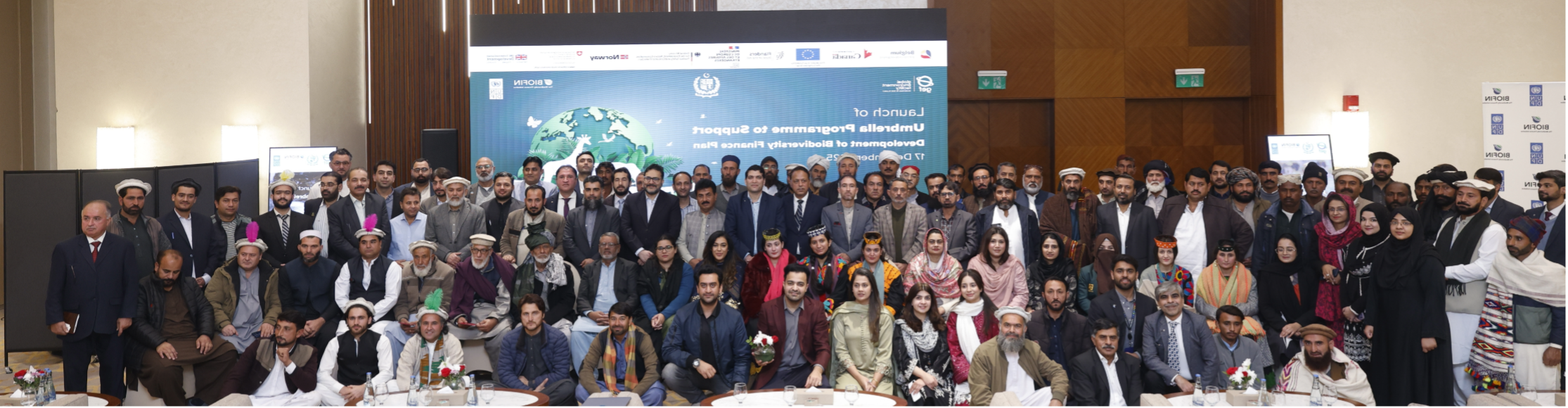
The diversity of participation reflected Pakistan’s remarkable ecological and cultural richness. Indigenous Kalash communities from Chitral, coastal fishing communities from Gwadar and Lasbela, forest-dependent communities from Swat, Dir Kohistan and Azad Jammu and Kashmir, pastoralists from Punjab and mountain communities from Gilgit-Baltistan all shared experiences shaped by the ecosystems they call home.
Although every community told a different story, they challenged the same assumption.
Communities rarely described biodiversity in terms of species or protected areas alone. Instead, they spoke about shrinking glaciers that affect farming, forests that sustain livestock, rivers that support fisheries, medicinal plants passed down through generations, and landscapes that shape cultural identity and local economies.
Biodiversity was no longer framed solely as an environmental or institutional issue, but as a shared national concern intertwined with culture, livelihoods, and development choices.
That shift in perspective fundamentally changed the conversation.
The consultations became more than stakeholder meetings. They created space for honest discussions on conservation priorities, benefit-sharing, governance and community stewardship. Indigenous Kalash women highlighted how biodiversity safeguards culture and traditional knowledge, while mountain communities demonstrated how sustainable agriculture and trout farming are strengthening livelihoods in the face of climate change. Coastal communities emphasised the importance of healthy mangroves and fisheries, and pastoralists highlighted the value of resilient forests and rangelands.
These conversations also challenged conventional approaches to biodiversity finance. The issue was not simply mobilising more financial resources, but ensuring that investments recognise Indigenous knowledge, strengthen sustainable livelihoods and support the communities that have protected Pakistan’s biodiversity for generations.
This nationwide dialogue culminated in the launch of BIOFIN Pakistan, bringing together government institutions, Indigenous Peoples and Local Communities, academia, civil society and development partners around a shared vision for biodiversity finance.
As Director Biodiversity at the Ministry of Climate Change and Environmental Coordination, Naeem Ashraf Raja, noted:
“Pakistan’s biodiversity commitments cannot be delivered through regulation alone. Conservation succeeds when communities are partners and beneficiaries. Community-centred conservation models are about sustainability, fairness, and ensuring that those who protect biodiversity see real value in doing so.”
The launch demonstrated a genuine whole-of-government and whole-of-society approach, where communities and policymakers engaged as partners rather than separate audiences. More importantly, it reflected a new understanding that biodiversity finance extends beyond raising resources; it is about building partnerships, strengthening governance and investing in people whose lives are inseparable from nature.
Pakistan’s consultative approach aligns closely with the ambition of the Kunming-Montreal Global Biodiversity Framework, advancing biodiversity mainstreaming, inclusive participation and the mobilisation of finance for nature.
More importantly, it offers a lesson that extends far beyond Pakistan.
BIOFIN has done more than introduce a financing initiative. It has transformed how biodiversity is discussed, who is included in shaping it, and how global commitments are translated into national action.
Pakistan’s experience demonstrates that financing biodiversity begins long before financial instruments are designed.
It begins by listening. Listening to Indigenous women safeguarding generations of ecological knowledge. Listening to mountain communities adapting to changing glaciers. Listening to fishing communities whose futures depend on healthy seas. Listening to pastoralists and forest communities whose livelihoods depend on healthy ecosystems.
Because when communities are recognised as partners in conservation, biodiversity is no longer simply about protecting nature.
It becomes a shared investment in livelihoods, cultures, resilience and a sustainable future.